Starlink: 70 Satellites Per Week and the 50th Mission of 2026
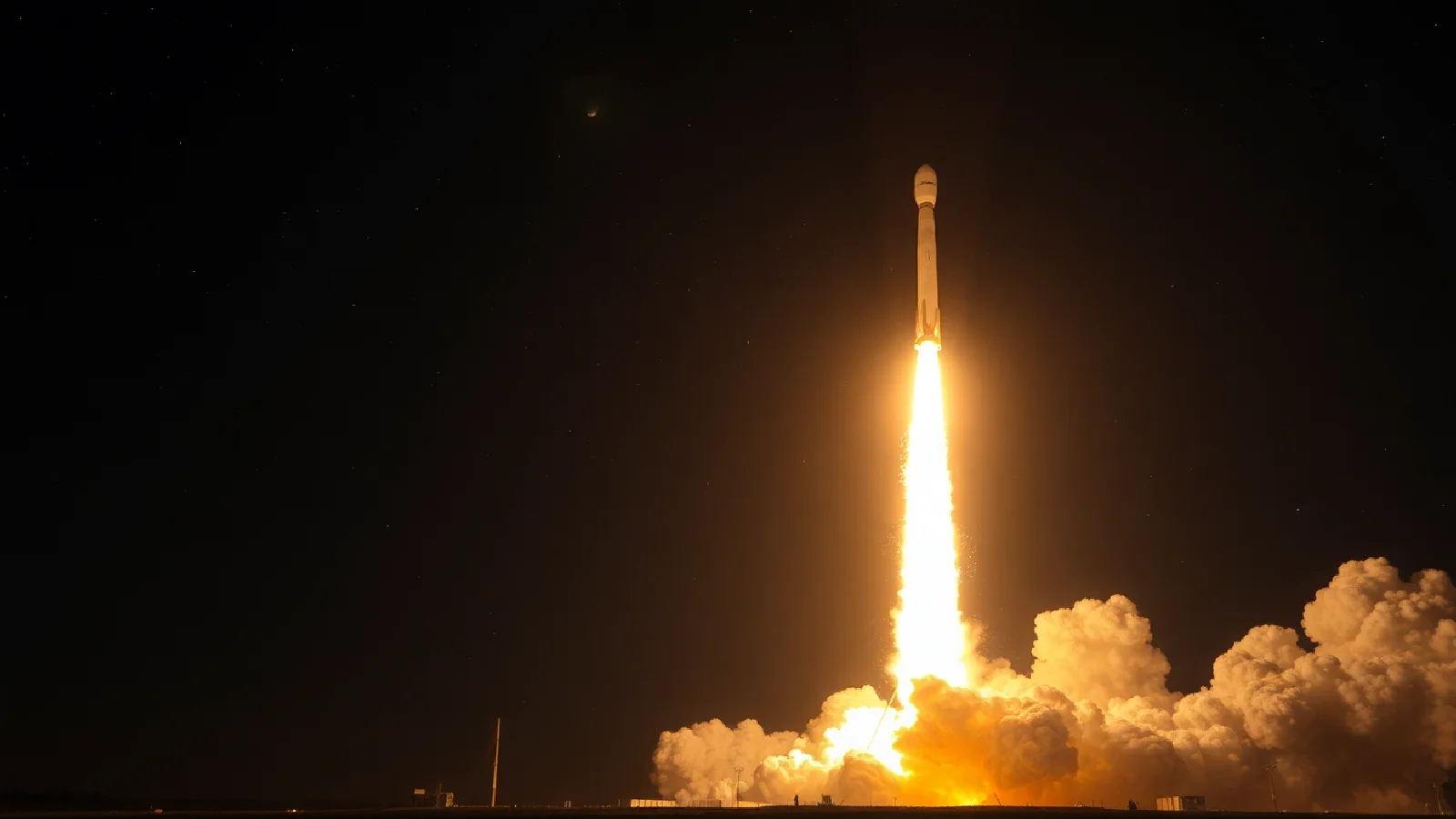
On May 7, 2026, another Falcon 9 rocket lifted off from Cape Canaveral. Twenty-five additional Starlink satellites joined low Earth orbit. Nothing spectacular on the surface, except for one figure: it was the 50th Falcon 9 mission of the year. Less than five months into 2026, SpaceX maintained an unprecedented deployment pace, launching approximately 70 Starlink satellites per week into space.
This milestone illustrates a structural transformation: Starlink is no longer an experimental project. It is now a planetary telecommunications infrastructure undergoing accelerated industrialization, driven by a launch cadence that defies all historical norms of the space sector.
Industrial Production Shattering Records
On April 14, 2026, SpaceX already reached a symbolic milestone: the launch of the 1000th Starlink satellite of the year. As of that date, the active constellation comprised 10,191 operational satellites, according to KeepTrack data. If this pace continues until the end of 2026, more than 3,500 new satellites will further densify the network, pushing the total fleet beyond 10,200 units.
This acceleration illustrates a profound shift in the space sector. As highlighted in a FundaAI report, the industry is moving from a high-performance craftsmanship model — where each satellite was designed to last fifteen years in geostationary orbit — to a mass production model optimized for rapid replacement and a twelve-month return on investment.
"The goal is no longer to build a single satellite to survive fifteen years, but to manufacture assets capable of recovering their costs in about a year, and to be replaced quickly and cheaply."
Acceleration Figures
- 70 satellites deployed per week on average in spring 2026
- 50 Falcon 9 missions completed in five months (as of May 7, 2026)
- 10,200+ operational satellites expected by end of 2026
| Indicator | Key Figure | Period / Context |
|---|---|---|
| Satellites per week | 70 | Spring 2026 |
| Falcon 9 Missions | 50 | In 5 months (as of 07/05/2026) |
| Operational Satellites | 10,191 | As of 04/14/2026 |
| Projection end 2026 | > 10,200 satellites | Based on current pace |
Gen2 and v2-Mini: A Technological Power-Up
Behind these figures lies a technological evolution. May 2026 missions primarily involved the deployment of Gen2 "v2-Mini" satellites, placed in an orbital layer between 500 and 600 km altitude. These new generation satellites boast increased bandwidth capabilities, reduced latency, and intelligent traffic management.
SpaceX is also preparing for the arrival of v3 units, whose hardware iteration cycles are proving much faster than terrestrial telecom operators' upgrades. This agility allows Starlink to correct, optimize, and deploy new features at an unprecedented speed in the field of communication infrastructure.
The densification of coverage addresses several strategic imperatives: reducing latency for real-time applications (gaming, video conferencing, high-frequency trading), increasing capacity per geographical area, and preparing for the integration of demanding vertical markets such as aviation, maritime, emergency services, and AI applications requiring massive data flows.
Increasing Pressure on Low Earth Orbit
This rapid growth does not come without tension. Low Earth orbit is becoming an increasingly contested resource. Amazon is actively preparing to launch its Project Kuiper constellation, and other international players — Chinese, European — are making numerous announcements. Competition for orbital slots and radio spectrum is intensifying.
SpaceX has also submitted an orbital reconfiguration plan aimed at lowering approximately 4,400 satellites from 550 km to 480 km altitude. This maneuver promises gains in latency and throughput, but it also amplifies the challenges of space debris management in an already congested orbital environment.
Space Situational Awareness (SSA) and collision avoidance systems are becoming critical. As Skymapper Inc highlights on LinkedIn, "accurate, timely, and verifiable orbital data is essential for collision avoidance, regulatory compliance, and operational decision-making."
To delve deeper into the risks associated with the proliferation of satellites in low Earth orbit, our article on the Kessler effect and Starlink explores cascade collision scenarios and mitigation strategies.
New Markets and Diversification of Uses
The acceleration of Starlink deployment also corresponds to the opening of new market segments. In 2026, several airlines announced the integration of Starlink to offer high-speed in-flight Wi-Fi. The maritime sector is massively adopting the solution to connect cargo ships, cruise liners, and research vessels. Emergency services, particularly in areas affected by natural disasters, are leveraging the rapid deployment of portable terminals.
But it is perhaps the artificial intelligence market that represents the most disruptive potential. Distributed data centers, real-time model training flows, and decentralized cloud architectures require ever-wider bandwidths. Starlink, with its low latency and global coverage, is positioning itself as a key player in this new generation digital infrastructure.
SpaceX recently filed a request with the FCC to authorize a new ground relay station dubbed "First of Its Name" — an acknowledged reference to Game of Thrones — located at the Starlink factory in Bastrop, Texas. This station will utilize more radio spectrum to accelerate speeds and achieve the gigabit connectivity objectives validated by the US regulatory authority.
Regulatory Challenges and Space Sustainability
Starlink's rise also questions existing regulatory frameworks. National space agencies and international bodies are struggling to keep pace with innovation and deployment. Issues of spectrum coordination, interference prevention, satellite end-of-life management, and liability in the event of collision largely remain unresolved.
SpaceX relies on a controlled deorbiting strategy: Starlink satellites are designed to burn up in the atmosphere at the end of their life, theoretically limiting the risk of persistent debris. However, the multiplication of objects in orbit mechanically complicates space navigation and increases the probability of collision, even with low failure rates.
Actors like Skymapper are developing decentralized observation layers based on telescopes distributed worldwide to monitor orbital activity. These private initiatives complement public systems and pave the way for more transparent and collaborative governance of low Earth orbit.
To better understand the challenges of today's space flights, our comprehensive guide on Starship and its flight tests details SpaceX's ambitions beyond Starlink, particularly for Artemis lunar and Martian missions.
Outlook: Towards Consolidated Space Hegemony?
The year 2026 appears to be an industrial turning point for Starlink. The constellation is no longer just growing; it is structuring, densifying, diversifying. The 50th Falcon 9 mission of the year symbolizes this shift from an exploratory model to a large-scale operational logic.
This dynamic raises several strategic questions. Can SpaceX maintain such a launch pace without major incident? How will competitors react to this accumulated lead? What will be the long-term impacts on the sustainability of low Earth orbit and international space governance?
One thing is certain: Starlink is redrawing the geography of global telecommunications. In just a few years, what was perceived as a niche for remote areas is now establishing itself as a critical infrastructure for global connectivity, the digital economy, and perhaps even future distributed artificial intelligence architectures.
As the number of operational satellites exceeds 10,000 units, low Earth orbit becomes a strategic playground where a much larger game is being played than simply providing internet access. A new era of space conquest is being written, mission after mission, satellite after satellite.