
Agricultural Cybersecurity: When Ransomware Threatens Food Supply

In early 2025, approximately 30,000 livestock farmers found themselves unable to access their online management tools. The cause? A ransomware attack targeting their software host. It became impossible to declare animals, consult records, or manage operations. This sudden paralysis illustrates a worrying reality: digital agriculture has become a prime target for cybercriminals.
Between 2018 and 2023, ransomware cost the agri-food sector approximately $1.4 billion, primarily due to production stoppages. And the trend is worsening: the frequency of attacks more than doubled in one year. In the United States, incidents targeting agri-food industries jumped by 100% in early 2025 compared to the previous year.
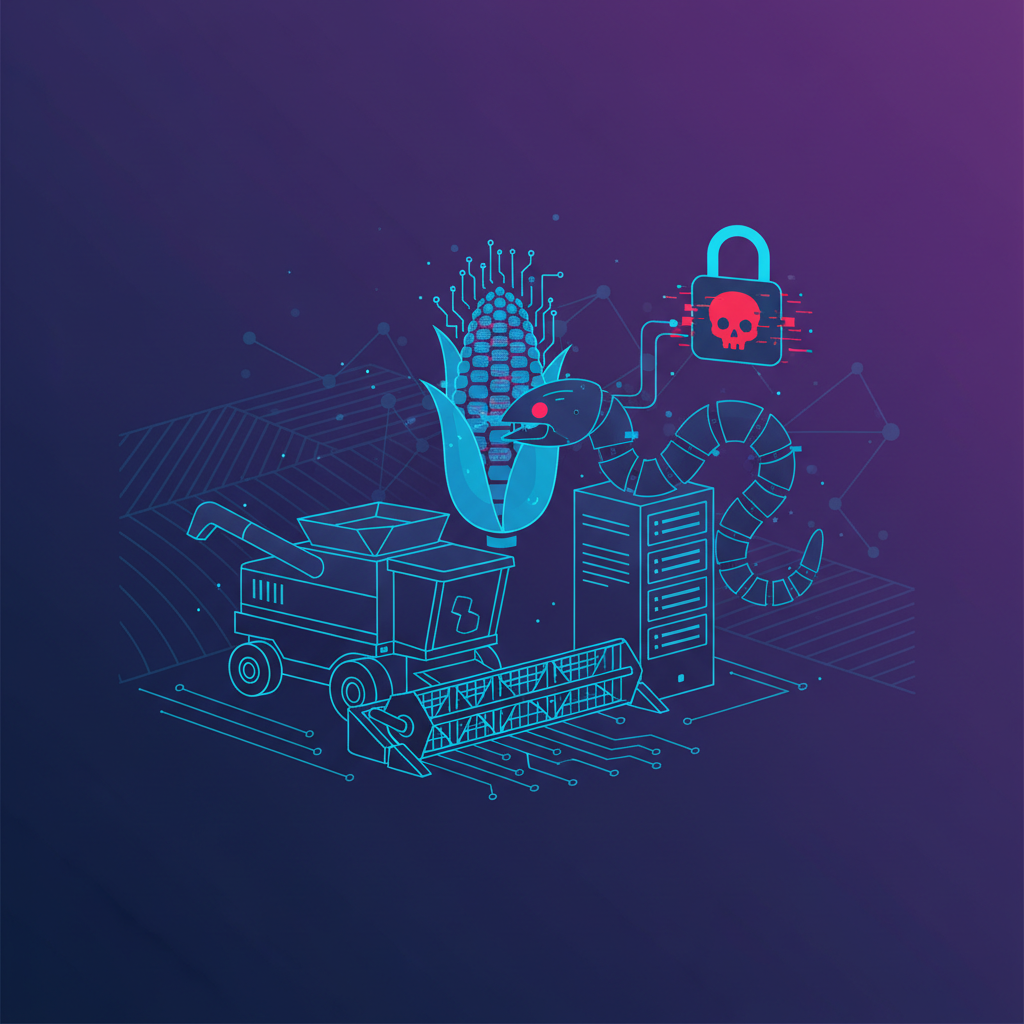
Connected Agriculture, a Vulnerable Link
The digital transformation of agriculture has opened the door to new vulnerabilities. Modern farms rely on IoT (Internet of Things) technologies to automate irrigation, monitor livestock, or manage inventory. Unfortunately, these connected devices often suffer from gaping security flaws.
The sector's cybersecurity maturity remains low. Several factors explain this fragility: the use of legacy IT systems (On-Premise), limited budgets for digital security, and a critical lack of specialized training. Agriculture is no longer just physical; it is digital, as recent industry news reminds us.
Connected agricultural equipment – autonomous tractors, weather sensors, surveillance drones – collects and transmits sensitive data. But these data flows represent as many potential entry points for attackers. Once a system is compromised, hackers can spread laterally throughout the farm's entire network.
Third-Party Providers, the Supply Chain's Achilles' Heel
Alarmingly: 90% of cyberattacks in the sector originate from third-party providers. Cloud service providers, management software publishers, or maintenance companies serve as intermediate targets, allowing attackers to reach dozens, or even thousands, of clients simultaneously.
This rebound attack strategy exploits the supply chain as a vector for compromise. A single weak link is enough to spread the infection throughout the entire ecosystem. The 2025 attack against the agricultural management solutions host is a perfect illustration: a single entry point, 30,000 farms paralyzed.
Ransomware-as-a-Service: Industrialized Cybercrime
Criminal groups are no longer content with opportunistic attacks. They have professionalized their operations with the ransomware-as-a-service (RaaS) model. Platforms like Qilin, Akira, or Lockbit 3.0 offer ready-to-use attack kits to affiliates who do not need advanced technical skills.
The agri-food sector experienced a more than 100% increase in ransomware incidents in one year, revealing systemic vulnerability to increasingly organized attackers.
This criminal economic model operates on a revenue-sharing principle: the malware developers receive a commission on each ransom paid. This industrialization has significantly increased the volume and sophistication of attacks.
Modern ransomware no longer just encrypts data. It first exfiltrates sensitive information to exert double extortion: pay to recover data, then pay again to prevent its publication. In the agricultural sector, these leaks can compromise strategic commercial data, customer information, or manufacturing secrets.
| RaaS Group | Key Feature | Target |
|---|---|---|
| Qilin | Advanced encryption | SMEs, large enterprises |
| Akira | Data exfiltration | Supply chains |
| Lockbit 3.0 | Wide reach | Critical infrastructure |
Impact on Global Food Security
Beyond direct financial losses, cyberattacks against the agri-food sector threaten the continuity of food production. A paralyzed farm can no longer properly feed its livestock, a stopped processing plant causes stock shortages, and a compromised logistics system delays deliveries.
These disruptions have cascading consequences throughout the entire food supply chain. Delivery delays affect distributors and, ultimately, consumers. On a larger scale, the multiplication of incidents could compromise food availability and price stability.
The geopolitical dimension of these threats cannot be ignored. As ANSSI recalled in its 2025 panorama, coordinated cyberattacks with destructive aims against critical infrastructure are multiplying. Agriculture, a strategic sector par excellence, is becoming a prime target for malicious actors, whether criminal or state-sponsored.
The Hidden Costs of Paralysis
The direct cost of ransoms represents only a fraction of the actual losses. Production stoppages generate considerable additional costs: lost perishable products, unfulfilled contracts, late penalties, loss of customer trust. An average farm can lose tens of thousands of euros per day of stoppage.
Recovery after an incident is also long and costly. Systems must be restored, data integrity verified, defenses strengthened, and personnel trained. Not to mention the impact on the company's reputation and the trust of business partners.
Defense Strategies for the Agricultural Sector
Faced with this growing threat, agri-food sector players must adopt a proactive approach to cybersecurity. Several levers of action can be activated simultaneously.
Training is the first line of defense. Raising awareness among teams about cyber risks, social engineering techniques (phishing, identity theft), and good security practices can drastically reduce the risk of initial infection. The majority of compromises begin with human error exploited by attackers.
Infrastructure modernization is also essential. Abandoning obsolete systems, segmenting networks, implementing strong authentication, encrypting sensitive data: these are all technical measures that significantly complicate the task of cybercriminals.
Collaborations and Information Sharing
The agricultural sector would benefit from pooling its defenses. Cybersecurity in the agri-food industry requires a collective approach, with sharing of threat intelligence, indicators of compromise, and best practices.
Partnerships with national cybersecurity authorities provide access to expert resources and alerts. Cyber incident response centers can support companies in crisis management and post-attack remediation.
Regular auditing of the supply chain becomes indispensable. Evaluating the security level of suppliers, imposing strict contractual clauses regarding data protection, and requiring certifications: these measures limit the risks of compromise by rebound.
Towards Cyber-Resilient Agriculture
The digital transformation of agriculture is irreversible and generally positive. But it requires rethinking security as a strategic component, just like productivity or quality. The interconnection of agricultural systems with emerging technologies like AI and IoT amplifies opportunities but also vulnerabilities.
Investments in cybersecurity should no longer be considered a burden but an essential insurance. The cost of a successful attack far exceeds the expenses necessary to protect against it. Companies that integrate this dimension from the design of their digital projects gain a sustainable competitive advantage.
Regulatory evolution accompanies this awareness. Security standards are tightening, incident notification obligations are becoming widespread, and companies' liability in the event of data leaks is increasing. Anticipating these requirements helps avoid sanctions and reputational damage.
The cyber resilience of the agricultural sector determines its ability to sustainably feed the planet. Faced with an unyielding threat, collective mobilization – farmers, industrialists, public authorities, security experts – becomes an absolute necessity. The stakes extend far beyond the economic framework: it is about protecting an essential pillar of our societies.
Tomorrow's agriculture will be connected and secure, or it will be vulnerable. The choice belongs to the sector's stakeholders, but time is running out. Every day without adequate protection offers cybercriminals a new opportunity to strike. The question is no longer whether your operation will be targeted, but when.