
Humanoid Robots in 2026: Mass Production Transforms Logistics
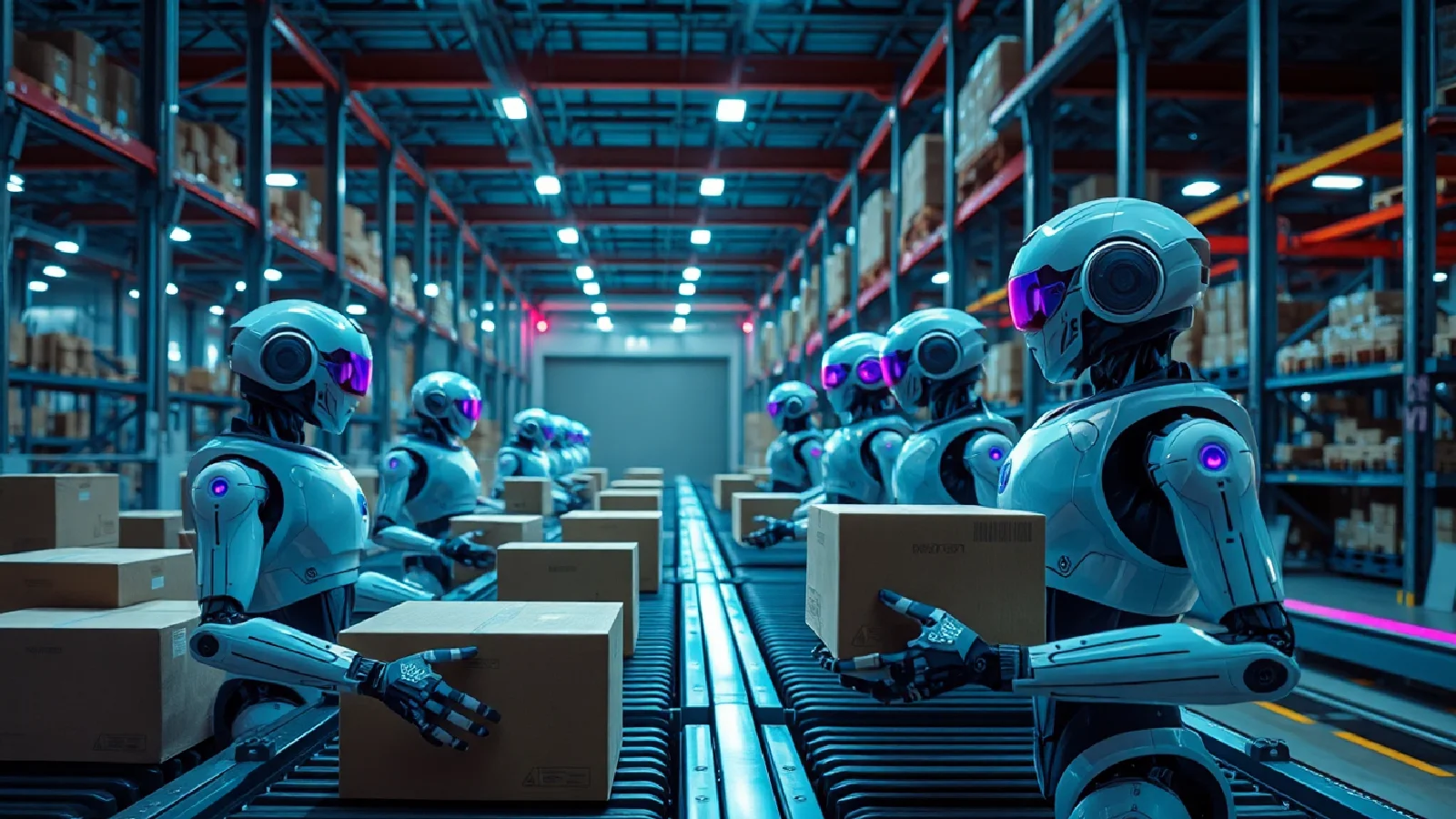
It's no longer uncommon to hear about automation as an inevitable trend. But what if we told you that by 2026, bipedal machines could be navigating your warehouse aisles, handling packages, and even climbing stairs? Far from science fiction, this reality is taking shape thanks to the mass production of humanoid robots, spearheaded by major players like Hyundai and Agility Robotics. This quiet revolution is set to redefine logistics and warehouse organization, promising to fill labor gaps and perform repetitive or dangerous tasks.
A New Era for Logistics Automation
2026 marks a turning point. Humanoid robots, once confined to laboratories, are entering a pilot deployment phase in industrial environments. Their ability to operate in spaces designed for humans, without requiring costly reconfigurations of existing infrastructure (shelving, aisles), is a decisive advantage. Early deployments already show humanoids being used for various tasks, from transporting pallets and picking diverse packages to supporting assembly processes.
Companies like Hyundai, with its involvement in actuator standardization via Hyundai Mobis and an optimized supply chain through Hyundai Glovis, play a crucial role in this democratization. Similarly, Agility Robotics, with its Digit robot, is at the forefront of these innovations. These advancements not only help address staff shortages but also allow human workers to be assigned to higher-value tasks, gradually transforming their role into that of supervisors of mixed "human-robot" teams.

Integration and Synergy with Existing Systems
The arrival of humanoids does not mean the elimination of existing automation technologies. On the contrary, it paves the way for deeper integration. In 2026, we are already observing synergies between humanoid robots and autonomous mobile robot (AMR) systems, as well as advanced orchestration platforms. This coordination enables smoother "robot-to-goods" flows, where machines can move independently to retrieve and transport goods.
The goal is to create hyper-efficient logistics ecosystems. For example, the convergence of advancements in generative AI and vision-language models (VLM) provides robots with a better ability to interpret complex and unpredictable environments, making their integration more intuitive and effective. The humanoid robot market is also rapidly expanding, with forecasts reaching up to 750 billion USD by 2035, and potentially 4 trillion USD by 2050 [Source 3], thus rivaling today's automotive industry. Challenges related to solid-state batteries will also be crucial for this evolution, as discussed in this article.
Challenges for Widespread Adoption
Despite immense potential, the mass adoption of humanoid robots in 2026 faces several technical and economic obstacles [Source 1]:
- Energy autonomy: High consumption and limited autonomy (2 to 4 hours) require significant advancements in batteries and fast-charging systems.
- Speed and load capacity: Current capabilities are modest, which restricts their efficiency for high-throughput tasks or those requiring heavy load movement.
- Unit cost: The high price — from tens to hundreds of thousands of dollars per unit — remains a major barrier for many companies.
- Safety and reliability: In environments shared with humans, safety is paramount, requiring strict standards and impeccable reliability.
- Perception and dexterity: Manipulating deformable, irregular, or fragile objects remains a challenge for current robotics, due to limitations in perception and tactile dexterity.
Companies like Tesla, with its Optimus project, or Unitree with the R1 (commercialized at $5,900 in 2026) are trying to make these technologies more accessible, but industrial maturity varies. You can learn more about the current state of humanoid robots in the industry at Automate Show [Source 2].
Comparison of Notable Humanoid Robots in 2026
| Characteristic | Tesla Optimus | Unitree R1 | Agility Robotics Digit |
|---|---|---|---|
| Primary Goal | versatile, production | versatile, accessible | warehouse logistics |
| Estimated Cost (2026) | Tens of thousands of $ | $5,900 | Hundreds of thousands of $ |
| Advancements | AI, mass production | Affordability, R&D | Bipedal gait, package manipulation |

Evolution Prospects: Towards Standards and New Professions
The roadmap for broader adoption of humanoid robots is clear: reduce costs, improve performance, and establish rigorous standards. The involvement of major players such as Hyundai Motor Group, which announced its AI robotics strategy at CES 2026 [Source 5], is a strong indicator of industry commitment.
Competition is fierce to determine the dominant operating system, with NVIDIA pushing Isaac + Project GR00T, Google working with Boston Dynamics, and Meta aiming to become the "Android of humanoids." This competition could eventually foster the emergence of robust and interoperable platforms. As these technologies deploy, new professional roles will emerge, notably that of "robotized flow coordinator."
For successful integration, the industry will need to develop standards for:- The maintenance of multi-manufacturer robot fleets.
- The cybersecurity of these connected systems.
- The interoperability between different brands and types of robots.
These collective efforts will unlock the full potential of humanoid robots, with forecasts of several million units deployed by 2030 in warehouses, distribution centers, and factories. For an overview of general warehouse automation trends, see this article on Locus Robotics.