
USB4 v2 and Thunderbolt 5: The Future of ZimaCube 2?
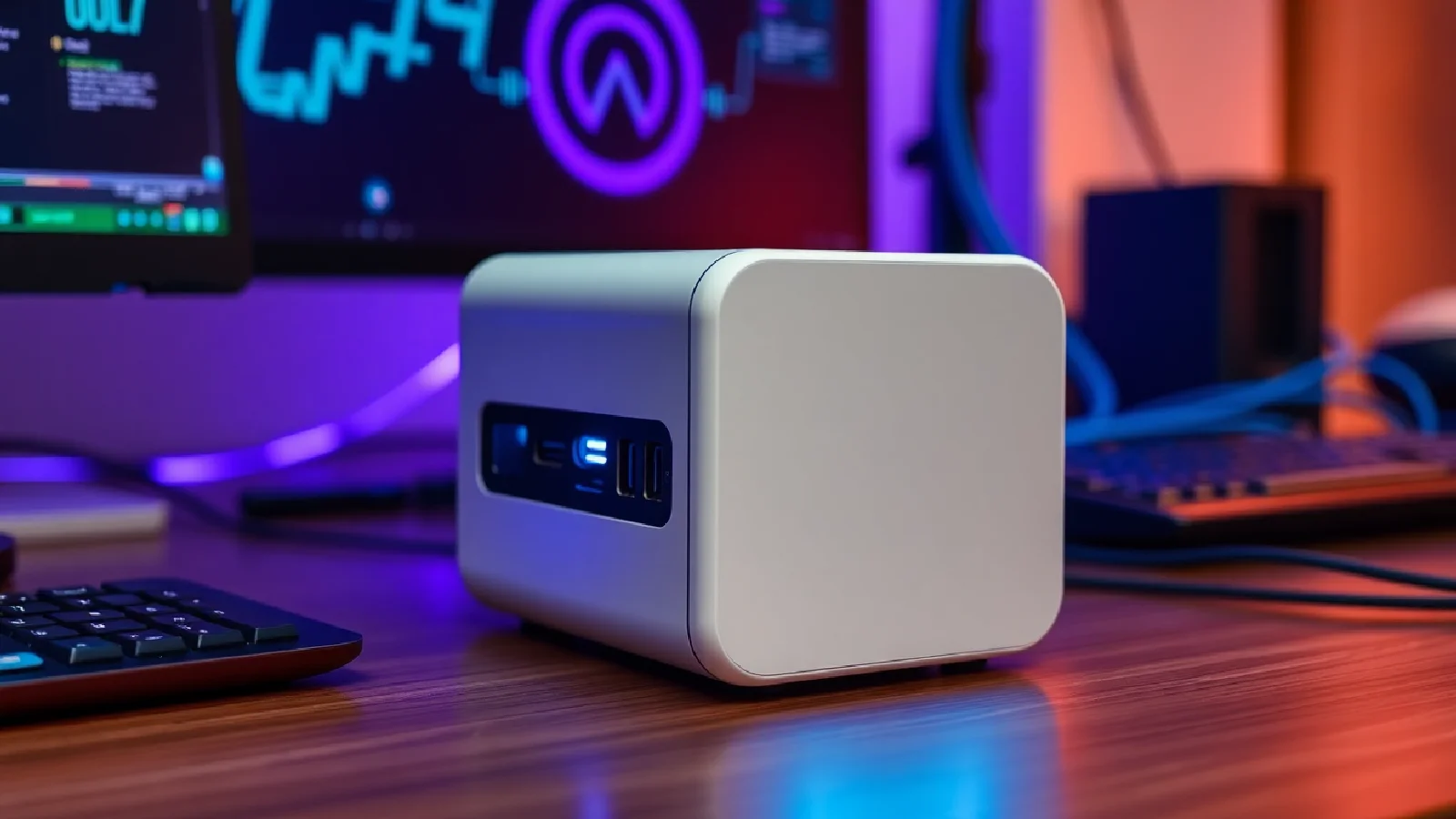
The ZimaCube 2 from IceWhale Technology is entering the self-hosting market with two Thunderbolt 4 ports capable of transferring up to 40 Gb/s. But the technological horizon is already shifting: USB4 v2 and Thunderbolt 5 are raising this threshold to 80 Gb/s, effectively doubling the available bandwidth. For users of compact NAS devices, creative workstations, or mini-servers, this evolution could redefine the connectivity, expandability, and performance of personal cloud ecosystems.
ZimaCube 2: A Compact NAS with Server Ambitions
Available for pre-order in early 2025, the ZimaCube 2 is part of the accessible self-hosting solutions lineup. Built around a 12th generation Intel Alder Lake processor (Core i3-1215U for the entry-level, i5-1235U for Pro and Creator versions), it integrates six SATA III bays for 3.5″ or 2.5″ drives, up to four M.2 NVMe slots, and two PCIe slots for GPU or 10 GbE network extensions.
Connectivity is one of its strong points: two Thunderbolt 4 ports, four USB 3.0 Type-A, two 2.5 GbE Ethernet (10 GbE optional), HDMI 2.0, and DisplayPort 1.4. This profile positions it as a versatile platform, capable of handling various workloads: RAID storage, virtualization, video transcoding, AI inference, or 3D rendering with a dedicated GPU.
| Feature | Specification |
|---|---|
| Processor | Intel Alder Lake 12th Gen (i3-1215U / i5-1235U) |
| Storage Bays | 6 SATA III (3.5" or 2.5") |
| M.2 NVMe Slots | Up to 4 |
| Thunderbolt Ports | 2 x Thunderbolt 4 (40 Gb/s) |
| Network Ports | 2 x 2.5 GbE (10 GbE optional) |

USB4 v2 and Thunderbolt 5: A Leap from 40 to 80 Gb/s
USB4 v2 and Thunderbolt 5 specifications, both built on the same protocol stack, push the maximum throughput to 80 Gb/s. This speed matches the performance of a PCIe 4.0 ×4 link, the standard used by recent NVMe SSDs and many high-end expansion cards.
In practical terms, this means an external device can communicate with the system at the same speed as an internal component directly connected to the motherboard's PCIe bus. The implication is significant for NAS users who wish to add:
- External NVMe RAID enclosures without performance loss
- High-resolution video capture cards for real-time editing
- External GPUs (eGPUs) for rendering or machine learning
- 25 GbE or 40 GbE network adapters to interconnect multiple servers or NAS devices
All this via a single USB-C cable, while maintaining full backward compatibility with USB 3.x, USB4 1.0, and previous Thunderbolt generations.
"USB4 v2 and Thunderbolt 5 will allow external devices to match internal performance, thus eliminating one of the last compromises of compact self-hosting."
Concrete Implications for ZimaCube 2
Although the current ZimaCube 2 is limited to Thunderbolt 4, a hardware revision incorporating Thunderbolt 5 or USB4 v2 would radically transform its potential. Let's see how.
Storage Expansion Without Bottlenecks
Today, connecting an external NVMe RAID via Thunderbolt 4 (40 Gb/s) offers about 5 GB/s in practice. With 80 Gb/s, this figure theoretically rises to 10 GB/s, allowing multiple fast storage units to be daisy-chained without saturating the bus. For a 4K or 8K video editor working with multi-terabyte RAW files, the difference is tangible.
eGPU for AI Inference and Rendering
The ZimaCube 2's PCIe 4.0 ×16 slot (wired as ×4) already accommodates an NVIDIA RTX Pro 2000 in the Creator pack. But a Thunderbolt 5 port would allow the addition of a second external GPU via an eGPU enclosure, thus doubling the available computing power for AI containers, transcoding services, or CUDA workloads.
Multi-Host Daisy-Chaining and Universal Docks
Thunderbolt 5 improves daisy-chaining management, i.e., connecting multiple devices in a series on the same port. Limitations encountered with certain Thunderbolt 4 implementations on consumer motherboards (sometimes imperfect lane bonding) disappear. A TB5-equipped ZimaCube 2 could thus serve as a central hub for multiple machines: PC, laptop, editing station, sharing storage, GPU, and network via a single entry point.
What Challenges for Adoption in the Self-Hosting Ecosystem?
While the promises are enticing, several obstacles remain.
Cost and Availability of Controllers
Intel's Thunderbolt 5 controllers and USB4 v2 chips remain rare and expensive in 2025. Integrating one of these components into an affordable compact NAS represents an industrial gamble that few manufacturers will dare to take before 2026-2027.
Cable and Peripheral Compatibility
A certified 80 Gb/s Thunderbolt 5 cable costs significantly more than a standard TB4 cable. Users will also need to verify that their peripherals (docks, RAID enclosures, eGPUs) actually support the new standard to take advantage of it. Backward compatibility guarantees functionality, but not maximum performance.
Latency and Thermal Management
Doubling the throughput also means managing more intense data flows and increased heat dissipation, both at the controller and cable level. Future iterations of the ZimaCube will likely need to revise their internal design to ensure optimal ventilation and avoid thermal throttling during sustained loads.

Towards an Evolving Personal Cloud Ecosystem
Integrating USB4 v2 or Thunderbolt 5 into the ZimaCube 2 would pave the way for a truly evolving self-hosting ecosystem. Rather than replacing the device every two or three years, users could add external modules as their needs grow: additional storage, a 25 GbE network card, a GPU for machine learning, or even a fiber optic adapter to interconnect multiple sites.
This modular approach is reminiscent of professional workstations, but democratized for the general public and small teams. It echoes the ambitions of WiFi 7 Mesh, which also promises to remove the last wireless bottlenecks. In parallel, the rise of ARM architecture in data centers, driven by AWS Graviton and Meta, raises the question of convergence between low-power chips and high performance, an balance that future NAS devices will also need to find.
Outlook for 2026 and Beyond
In the short term, few consumer models will integrate Thunderbolt 5 from their launch. The current ZimaCube 2 already fully utilizes Thunderbolt 4, and its product roadmap does not suggest an immediate revision. But the arrival of 14th or 15th generation Intel processors with native TB5 controllers could accelerate adoption.
By 2027, we can imagine a ZimaCube 3 or a Pro+ variant natively integrating 80 Gb/s, accompanied by an ecosystem of certified peripherals: RAID enclosures, multi-display docks, optimized eGPUs. Home-lab and personal cloud users will then have an infrastructure capable of rivaling rack servers at a tenth of the cost and footprint.
Conclusion
The evolution towards USB4 v2 and Thunderbolt 5 is not just about numbers: it redefines the boundary between external peripheral and internal component, between compact NAS and workstation, between personal cloud and miniature data center. The ZimaCube 2, although equipped with Thunderbolt 4, is already paving the way for rich and evolving connectivity. Its future iterations, boosted by 80 Gb/s, could transform self-hosting into a credible alternative to centralized cloud solutions, provided the industry overcomes the challenges of cost, compatibility, and thermal management. For technology enthusiasts and creative professionals, the horizon looks promising.