ARM vs Intel/AMD 2026: The Datacenter Server Battle
Datacenters in 2026 are witnessing a profound transformation in the server processor landscape. While Intel still dominated nearly 100% of the market a few years ago, ARM has now established itself as the third essential player, disrupting a duopoly that once seemed unshakeable.
This rise to power is no accident. Hyperscalers like AWS, Microsoft Azure, and Google Cloud have heavily invested in custom ARM chips, driven by increasingly compelling economic and ecological arguments compared to traditional Intel and AMD solutions.
An Unprecedented Reshuffling of the Cards
According to TechPowerUp, Intel has seen its market share drop from nearly 100% in 2017 to approximately 67% today. This erosion is explained by the combined offensive of AMD with its EPYC processors and the emergence of ARM solutions in cloud-native environments.
AMD has particularly shone with its Zen architecture, reaching over 10% of server revenue by 2020, then exceeding 20% in 2022. Analysts predict continued growth, with approximately 36% market share expected by 2025.
ARM, for its part, has reached a symbolic milestone by capturing approximately 10% of global server CPU revenue in 2026. This breakthrough is based on three fundamental pillars:
- AWS's Graviton 3+, optimized for cloud workloads
- Neoverse N3 chips deployed by Azure and Google
- 20% superior energy efficiency compared to x86 solutions
ARM's Economic and Energy Advantage
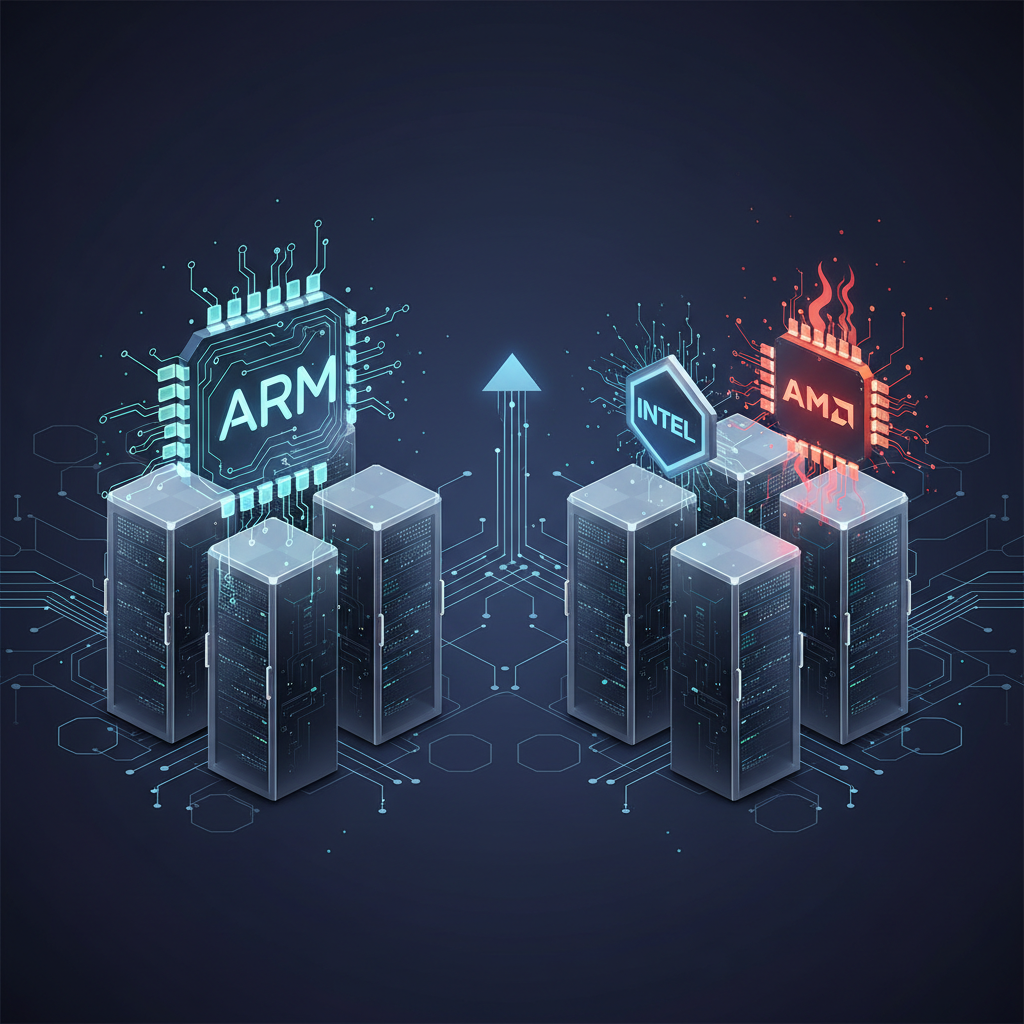
ARM's most impactful argument lies in its cost-effectiveness. With an average cost of $70 per core, ARM has a clear advantage over Intel's Xeon 6+ ($120 per core) and AMD's EPYC ($100 per core).
This price difference is accompanied by approximately 20% lower energy consumption per core, a major asset in a context where datacenters represent a growing share of global electricity consumption. For cloud operators, this energy efficiency directly translates into a 20 to 30% reduction in TCO (Total Cost of Ownership).
"ARM's superior energy efficiency and advantageous cost per core make it the preferred choice for the scale-out workloads of large cloud operators."
| Feature | ARM ($70/core) | Intel Xeon 6+ ($120/core) | AMD EPYC ($100/core) |
|---|---|---|---|
| Cost per core | Lower | Higher | High |
| Energy consumption | -20% per core | Higher | Higher |
| TCO for Operators | -20 to 30% | Higher | Higher |
Intel Retaliates with Xeon 6+ Clearwater Forest
Facing this offensive, Intel is not standing still. The Xeon 6+ Clearwater Forest, etched with 18A technology, promises an IPC (Instructions Per Cycle) increase of approximately 15% and can integrate up to 64 cores.
However, these improvements struggle to compensate for Intel's structural weaknesses in certain segments. x86 processors remain more power-hungry and show difficulties competing with ARM on scale-out workloads where density and energy efficiency take precedence over raw performance. Intel also faces other challenges, as highlighted in this LinkedIn report.
Intel's strategy relies on its historical presence in hybrid environments and its mature software ecosystem. The manufacturer thus retains approximately 55% of the market in 2026, but this dominant position is gradually eroding.
AMD Bets Everything on Raw Power
AMD adopts a different approach with its EPYC Genoa processors and the future Bergamo generation. With up to 96 cores for Genoa and exceptional memory bandwidth, AMD primarily targets HPC (High Performance Computing) and artificial intelligence workloads.
As illustrated by AMD's announcement at CES 2026, the manufacturer is banking on a "yotta-scale" architecture to meet the needs of AI datacenters. This strategy allows it to maintain approximately 35% market share by positioning itself in the most lucrative segments.
Nevertheless, the TCO of AMD solutions remains 20 to 30% higher than that of ARM solutions for equivalent performance levels, limiting their adoption for cost-sensitive workloads.
The Technological Challenges of 2026
This technological battle reveals different paradigms. ARM excels in energy efficiency and distributed architectures but still needs to prove its capability on legacy workloads requiring x86 compatibility.
Intel and AMD, for their part, benefit from a mature software ecosystem but must contend with higher energy consumption and increasing manufacturing costs. The integration of advanced network infrastructure features like Wi-Fi 7 in modern datacenters further complicates the equation.
The Impact on the Technology Ecosystem
This reshuffling of the cards influences the entire industry. Developers must now optimize their applications for heterogeneous architectures, while system administrators juggle different solutions depending on the workloads.
According to Mordor Intelligence, the datacenter semiconductor market, valued at $179.85 billion in 2025, is expected to reach $230.75 billion by 2030, driven by AI and cloud infrastructures.
This growth particularly benefits ARM, whose designs naturally adapt to AI workloads thanks to their modular architecture and energy efficiency. Hyperscalers can thus deploy more computing power for the same energy budget.
The Future of Competition
The datacenter landscape in 2026 is shaping up around three distinct but complementary poles. Intel maintains its leadership position thanks to its broad portfolio and presence in hybrid environments. AMD dominates high-performance segments with its multi-core solutions. ARM establishes itself in cloud-native workloads and energy-cost-sensitive applications.
This coexistence could persist, with each architecture finding its niches of excellence. However, the evolution towards edge computing and distributed AI could further strengthen ARM's position, naturally suited to energy constraints and miniaturization.
Massive investments in digital infrastructure and industrial policies like the CHIPS Act in the United States are also reshaping the geography of production, with a gradual repatriation of manufacturing capabilities.