Quantum Computing 2026: IBM vs D-Wave, Who Dominates the Race?

The quantum revolution is in full swing in 2026, and two tech giants are fiercely competing for the top spot: IBM with its universal gate-based quantum processors and D-Wave with its specialization in quantum annealing. This technological battle extends far beyond a simple qubit race to become a major strategic issue redefining the future of computing.
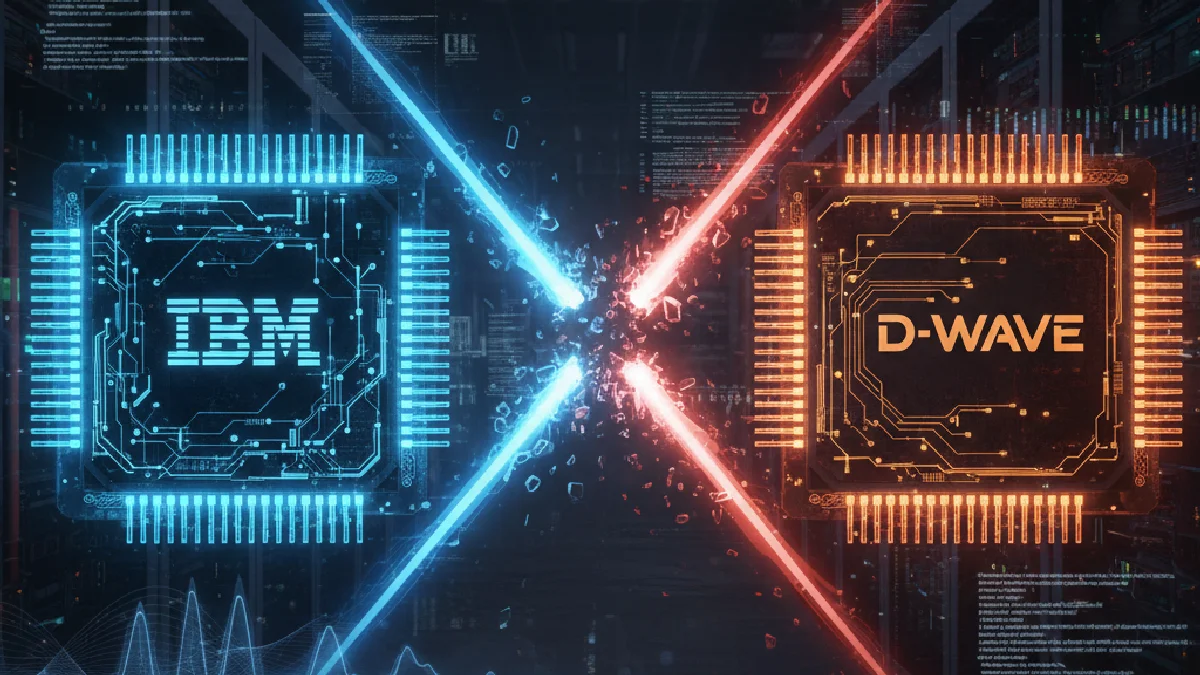
As the global quantum computing market crosses new growth thresholds, each company is banking on a radically different approach. IBM is pursuing its vision of universal quantum computing capable of solving all types of problems, while D-Wave focuses its efforts on commercial optimization with solutions already deployed at its clients.
IBM: The Universal Approach of Superconducting Qubits
IBM maintains its course on superconducting qubit technology with an ambitious strategy aiming to exceed 1,000 physical qubits in 2026. The Big Blue firm is betting everything on its IBM Quantum Network ecosystem, which now brings together over 200 global organizations, from universities to Fortune 500 companies.
IBM's hybrid cloud platform forms the backbone of this strategy. Developers can access quantum processors via Qiskit, the open-source framework with over 500,000 active users. This democratic approach to quantum computing allows IBM to create a true ecosystem around its technology.
Quantum Error Correction: The Major Challenge
IBM's primary goal for 2026 remains the integration of quantum error correction into its processors. This crucial technology would enable the first "fault-tolerant" quantum computers, capable of maintaining quantum coherence over long durations.
"2026 marks our transition to the first reliable logical quantum processors, paving the way for revolutionary commercial applications" - IBM Quantum Team
IBM's quantum volume, a key metric for quantum performance, aims to exceed one million units thanks to continuous improvements in qubit fidelity and inter-qubit connectivity.
D-Wave: Specialization in Quantum Annealing
For its part, D-Wave has chosen a diametrically opposite path by specializing exclusively in quantum annealing. This approach, while more limited in scope, offers concrete advantages for certain types of optimization problems.

The D-Wave Advantage series now exceeds 5,000 qubits, a remarkable technical feat even if these qubits are not directly comparable to IBM's universal qubits. This technology particularly excels in:
- Logistics and supply chain problems
- Financial portfolio optimization
- Real-time resource planning
- Specialized machine learning challenges
An Already Mature Commercial Ecosystem
D-Wave's competitive advantage lies in its dedicated software ecosystem and its already operational industrial partnerships. Companies like Volkswagen, Lockheed Martin, and NEC actively use D-Wave solutions to solve concrete optimization problems.
Financial analysts also highlight this difference in approach: where IBM prepares for the future with versatile technology, D-Wave is already generating substantial revenue with specialized applications.
Technological Strategies: NISQ vs Quantum Annealing
The confrontation between IBM and D-Wave perfectly illustrates the technological debate animating the quantum sector. IBM is betting on the NISQ (Noisy Intermediate-Scale Quantum) era, seeking to maximize the utility of current quantum processors despite their limitations.
This NISQ approach by IBM focuses on:
- Continuous improvement of quantum coherence
- Development of hybrid quantum-classical algorithms
- Optimization of quantum circuits to reduce noise
D-Wave's quantum annealing, on the other hand, bypasses these challenges by focusing on a specific set of problems where this approach naturally excels. This specialization allows for practical results today, without waiting for future technological advancements. For more information on technical developments, see our article on Angstrom nodes in 2026.
2026 Roadmaps: Convergent and Divergent Visions
The roadmaps of the two giants for 2026 reveal distinct but complementary ambitions. IBM aims for the democratization of quantum computing via its cloud, while preparing for the post-NISQ era with its work on error correction.
D-Wave, for its part, is accelerating the commercialization of its solutions with new industrial partnerships and the expansion of its Leap cloud platform. The Canadian company is also focusing on integrating artificial intelligence with its quantum processors.
| Key Feature | IBM Quantum | D-Wave Systems |
|---|---|---|
| Main Approach | Universal Processors | Quantum Annealing |
| Qubit Technology | Superconducting | Specialized Qubits |
| 2026 Goal | Error Correction | Commercialization |
Both strategies converge, however, on a crucial point: the importance of the quantum cloud. Whether via IBM Quantum Network or D-Wave Leap, remote access to quantum resources is becoming the norm, democratizing this revolutionary technology.
Commercial Impact and Partner Ecosystems
An analysis of partner ecosystems reveals contrasting commercial approaches. IBM cultivates an impressive academic and research network, fostering long-term innovation and training the next generation of quantum developers.
D-Wave favors direct industrial partnerships, generating immediate commercial impact. This strategy is reflected in stock market performance: D-Wave recorded 200% growth in 2026 compared to only 10% for its universal qubit-focused competitors.
Application sectors also differ: IBM targets pharmaceutical research, cryptography, and molecular simulation, while D-Wave dominates logistics, finance, and industrial optimization.
Technological Challenges and Future Prospects
Despite their respective successes, both companies face major challenges. IBM must solve the problem of quantum noise and improve the coherence time of its qubits to make its systems truly practical.
D-Wave, although more commercially advanced, remains limited by the specialized nature of its technology. Expansion into new application areas requires continuous innovation in its processor architecture.
The Bain & Company report on the quantum future highlights that 2026 marks a decisive turning point where "quantum theory transforms into commercial reality," a position that currently favors D-Wave but could shift towards IBM with the advent of fault-tolerant processors. The growth of the global market confirms this trend.
2026 Verdict: Two Leaders, Two Markets
Rather than designating a single winner, the 2026 analysis reveals that IBM and D-Wave each dominate their respective segments. IBM reigns over the quantum research and development ecosystem, preparing for the future with its universal technologies. D-Wave excels in the commercial market for specialized optimization solutions.
This coexistence reflects the growing maturity of the quantum sector, where different technological approaches find their optimal applications. The future likely belongs to this technological diversity, with each approach serving specific market needs.
Companies seeking immediate optimization solutions will turn to D-Wave, while those investing in fundamental research and future applications will favor the IBM ecosystem. This natural market segmentation allows both giants to prosper without directly cannibalizing each other.