
Meta vs Google: The Shift in Ad Leadership by 2027

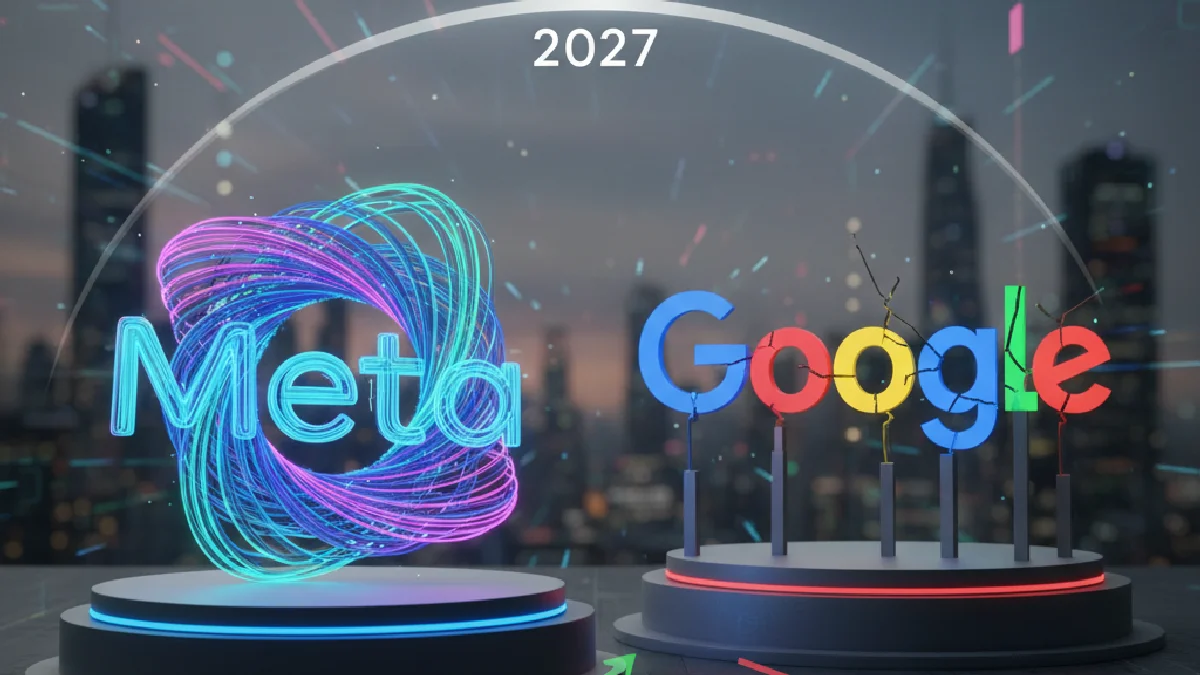
A major shift is on the horizon for the global digital advertising market by 2027. For the first time since the advent of the modern web, Meta could dethrone Google and become the undisputed leader in digital advertising revenue. This reversal, announced by several analyst reports, is based on an aggressive artificial intelligence strategy, sustained growth, and an automated advertising ecosystem that appeals to advertisers worldwide. Meanwhile, Google must contend with regulatory challenges, a modernization of its AI infrastructure, and increased competition in short-form video formats.
Meta's Rise to Power: Telling Figures
Meta's financial performance speaks for itself. In 2026, the Menlo Park giant is showing advertising growth exceeding 24%, a pace expected to be maintained, or even accelerated, in 2027. Google, for its part, is recording more moderate growth, around 12%. This growth gap, coupled with the rapid expansion of Meta's advertising ecosystem across Instagram, WhatsApp, Threads, and Reels, creates an unprecedented dynamic.
According to EMARKETER analysts, Meta is expected to capture enough market share to surpass Google as early as next year, ending two decades of undisputed dominance by the search engine. This prediction is based on three key factors: the effectiveness of Meta's AI tools, the diversification of its ad placements, and its ability to automate the entire advertising funnel.
Meta's success is due to a systemic approach. Where Google multiplies distinct tools—Google Ads, Performance Max, YouTube Ads—Meta unifies the advertising experience around a central platform that automatically orchestrates every step of the user journey.
Advantage+: AI at the Heart of Meta's Advertising Arsenal
Meta's true asset lies in its Advantage+ system, a suite of AI-powered tools that automate targeting, content creation, and budget optimization. Unlike traditional approaches where advertisers manually define segments and creatives, Advantage+ adopts a "black box" logic: simply specify a business objective and a budget, and the AI handles the rest.
Specifically, Advantage+ relies on several technological layers:
- Broad targeting: The algorithm identifies the most receptive audiences without prior segmentation, maximizing reach while maintaining a good conversion rate.
- Automated creative generation: Thanks to the Manus and Andromeda models, Meta generates thousands of ad variations (texts, visuals, formats) tailored to each user's preferences.
- Real-time budget optimization: Campaigns continuously adjust their bids based on performance signals, reducing acquisition costs while boosting return on investment.
This approach provides advertisers with unprecedented efficiency. Creative tests, which used to take weeks with human teams, are now completed in minutes. Campaigns become predictive, anticipating purchasing behaviors even before the user explicitly expresses intent.
"Meta's AI tools allow testing thousands of creative variations in minutes, offering a better return on investment than ever before."
WhatsApp, Threads, and Reels: New Advertising Territories
Beyond Facebook and Instagram, Meta is expanding its advertising playground. WhatsApp, long kept away from monetization, is gradually opening up to advertisers via sponsored messages and AI-driven conversational experiences. Threads, the competitor to X (formerly Twitter), offers native formats integrated into the news feed, while Reels capitalizes on the global appetite for short-form vertical video.
This multiplication of placements offers advertisers omnichannel coverage and high advertising intensity. Crucially, it leverages ultra-performing recommendation algorithms capable of seamlessly injecting sponsored content without disrupting the user experience.
Short-form video, in particular, is a strategic growth driver. Reels generate massive engagement and benefit from constant creative variety thanks to generative AI. In this universe, freshness and personalization take precedence over brand notoriety, which gives Meta an advantage over YouTube Shorts, where Google still struggles to monetize effectively.
Google's Challenges: AI Modernization and Regulatory Pressures
Faced with this offensive, Google is not without resources but must manage a dual challenge. First, modernize its AI stack. The launch of Gemini, the language model competing with GPT-4, and the improvement of Performance Max demonstrate substantial efforts. However, these tools are not yet integrated as seamlessly as Meta's Advantage+ ecosystem. Advertisers report that Performance Max remains complex to set up, with limited transparency on the decisions made by the algorithm.
Second, Google faces increased regulatory pressures, particularly in Europe. GDPR and the AI Act impose strict constraints on conversion tracking, the use of personal data, and the monetization of user profiles. These regulations complicate ad targeting and reduce the granularity of available audiences, whereas Meta, by leveraging more first-party data collected within its closed applications, benefits from greater leeway.
Public trust also weighs heavily. While Meta has had its share of scandals (Cambridge Analytica, misinformation), Google has been criticized for several years for the quality of its search results, which are increasingly filled with ads and automatically generated content. The rise of alternative engines and the growing integration of conversational AI (ChatGPT, Perplexity) weaken Google's historical monopoly on online purchase intent.
To learn more about AI dynamics within major platforms, read our article on Gemini vs. AI Personalization.
The "Black-Box" Approach: Efficiency vs. Transparency
The extensive automation by Meta raises a strategic question: how far should advertising creation be delegated to artificial intelligence? The Advantage+ model relies on a black box logic where the advertiser no longer controls operational details. The algorithm decides on audiences, creatives, timings, and bids. This opacity frightens some marketers accustomed to controlling every variable but appeals to those who prioritize raw efficiency and ROI.
Initial feedback shows that this approach works particularly well for high-volume campaigns, product launches, and direct conversion strategies. However, it is less suitable for brands seeking nuanced storytelling, precise editorial control, or strict visual consistency.
Google, for its part, attempts an intermediate position with Performance Max: extensive automation, but with safeguards to preserve certain strategic choices (audience exclusions, creative control, brand parameters). It remains to be seen whether this hybrid approach will be enough to contain Meta's lead.
What are the Implications for Advertisers and Agencies?
This announced shift reshuffles the cards in the advertising market. Advertisers must rethink their budget allocations and internal competencies. Investing heavily in Meta implies mastering generative AI logic, accepting less granular control, and focusing on creative agility rather than exhaustive control.
Media agencies face additional pressure. Hourly billing, a dominant model for decades, becomes obsolete when AI generates campaigns in a few clicks. Agencies must pivot towards value-added models: strategic consulting, predictive analysis, multichannel orchestration, and differentiated creative production. Some structures are already adopting the concept of a high-performance studio, combining human expertise and AI infrastructure to maximize operational efficiency. For more details, a practical guide for digital marketing agencies in 2026 and an article on high-performance B2B engineering explore these transformations.
To explore B2B transformations and AI integration in marketing strategies, our analysis on AI copilots offers additional insight.
Can Google Reverse the Trend?
Nothing is set in stone. Google still has considerable assets: a loyal advertiser base, a colossal Display network, YouTube as the dominant video platform, and massive investments in Gemini and generative AI. If the group manages to simplify its tools, strengthen algorithmic transparency, and better monetize emerging formats (Shorts, voice search, conversational experiences), it can slow down, or even halt, Meta's progress.
But time is running out. The current dynamic clearly favors Meta, whose closed and integrated ecosystem appeals to advertisers seeking simplicity and performance. The coming quarters will be decisive in observing whether Google succeeds in modernizing its advertising model or if 2027 will indeed mark the end of an era.
Comparison of Meta and Google Advertising Strategies (2027 Forecasts)
| Characteristic | Meta (Advantage+) | Google (Performance Max/YouTube) |
|---|---|---|
| Ad Growth | > 24 % (2026, projected for 2027) | ~ 12 % (2026) |
| AI Approach | "Black box", complete automation (targeting, creative, opti) | Advanced automation with safeguards (targeting, budgeting) |
| Ad Ecosystem | Integrated (Facebook, Instagram, WhatsApp, Threads, Reels) | Google Ads, Display Network, YouTube (Shorts) |
| Competitive Advantage | Closed ecosystem, first-party data. | Vast network, YouTube dominant in video. |
FAQ (JSON format - translate question and answer fields only):