
Assembling Your Lithium Battery Pack: The Complete DIY Guide
Assembling your own lithium battery pack is an economical and customizable solution for many energy independence projects. Whether it's to power a home solar system, an electric vehicle, or portable equipment, this DIY approach offers total control over the capacity, voltage, and performance of your energy storage.
The growing popularity of lithium-ion batteries is due to their high energy density and longer lifespan compared to traditional technologies. By 2025, the global domestic energy storage market is expected to reach $15.7 billion, partly fueled by the rise of DIY energy construction [^1].
Essential Materials and Components
Lithium-ion Cells: The Heart of the System
The choice of 18650 or 21700 cells is the fundamental step. These cylindrical formats offer the best performance-to-price ratio for DIY assemblies. A quality 18650 cell (Samsung, LG, Panasonic) typically provides 3.7V nominal and 2500 to 3500 mAh capacity [^2].
It is imperative that the cells have identical characteristics: same brand, same model, same manufacturing date. This homogeneity ensures optimal balancing and extends the pack's lifespan.
Protection Circuit (BMS)
The Battery Management System is the brain of your assembly. This critical component manages cell balancing, protection against overcharging, excessive discharge, and short circuits. For a 10S pack (10 cells in series), expect to pay around 50 to 100 euros for a quality BMS.
Connection Accessories
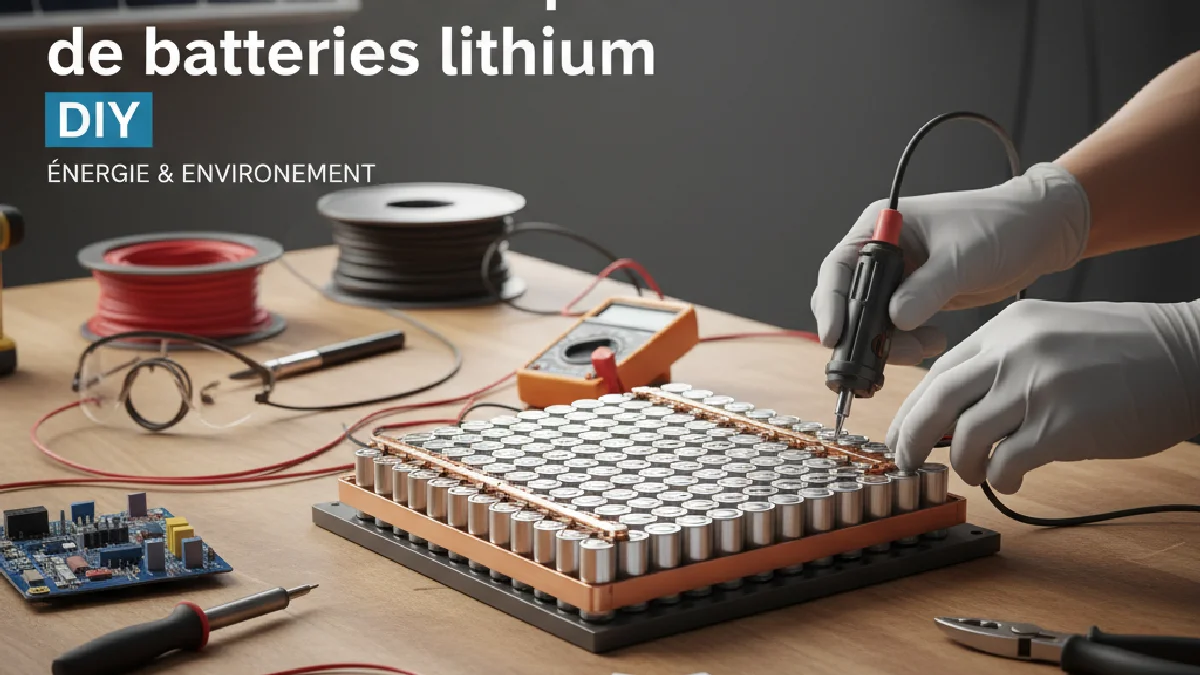
- Nickel strips (8-10mm wide) for soldering
- 40-60W soldering iron with a fine tip
- 12-AWG copper wire for main connections
- Cell holders or insulating foam
- Heat shrink tubing for insulation
Pack Configuration and Sizing
Nominal Voltage Calculation
Series configuration determines the pack's total voltage. Each lithium-ion cell provides 3.7V nominal (4.2V charged, 2.5V minimum discharged). To obtain 12V nominal, assemble 3 cells in series (3S). For 36V, opt for a 10S configuration.
"A 10S5P pack (10 cells in series, 5 in parallel) delivers 36V nominal with a capacity of 12.5 Ah, or approximately 450 Wh of stored energy."
Parallel Configuration for Capacity
Parallel connections multiply the capacity while maintaining the voltage. Five 2500 mAh cells in parallel yield a total of 12.5 Ah. This modular approach allows for precise adjustment of autonomy according to your needs.
Optimal sizing depends on the application: prioritize high voltage (more series cells) for electric motors, and significant capacity (more parallel cells) for extended autonomy.
| Connection Type | Effect on Voltage | Effect on Capacity |
|---|---|---|
| Series (S) | Increases | Stable |
| Parallel (P) | Stable | Increases |
Step-by-Step Assembly
Preparation and Safety
Work in a clean, dry, and well-ventilated environment. Wear insulating gloves and safety glasses. Ensure each cell has a voltage between 3.2 and 3.8V before assembly.
According to Barnabé Chaillot, a renewable energy expert, safety remains paramount: "Never handle damaged, swollen, or corroded cells."
Soldering Series Connections
1. Positioning: Place cells alternately (+ - + - +) to minimize connection length. 2. Quick soldering: Limit iron contact time to 2-3 seconds maximum to avoid overheating. 3. Nickel strips: Use strips of at least 8mm to support discharge current.
Series connections link the positive pole of one cell to the negative of the next. This step requires precision and speed to preserve cell integrity.
Parallel Connections and Finalization
Parallel connections group all positive poles together and all negative poles together. Use copper wire of a cross-section suitable for the maximum anticipated current (12-AWG for 30A, 10-AWG for 40A).
The BMS installation follows the manufacturer's diagram. First, connect the balancing wires (one per series cell group), then the main B+ and B- connections.
Management System Configuration
BMS Programming
Most modern BMS offer customizable programming via a smartphone app. Set voltage thresholds (3.0V minimum, 4.15V maximum per cell), maximum charging current, and protection timings.
A typical configuration for Samsung 25R cells:- Low cutoff voltage: 3.0V per cell
- End-of-charge voltage: 4.1V per cell
- Maximum charging current: 0.5C (i.e., 1.25A for a 2500 mAh cell)
Initial Test and Break-in
The first charge cycle should be performed at a low current (0.2C maximum) to allow for initial balancing. Monitor temperature and individual voltages during this critical phase.
As explained in the technical guide from WeareFPV, "a gradual break-in over 3-5 cycles significantly improves long-term performance."
Optimization and Maintenance
Performance Monitoring
A well-assembled pack maintains stable balancing between cells (deviation less than 50mV). Regularly check these voltages with a voltmeter or the BMS app. Increasing imbalance often signals a faulty cell.
Integration with Renewable Systems
Your lithium pack integrates perfectly with existing solar installations. Combined with sodium-ion batteries for long-duration storage, it forms an optimal hybrid storage system.
Lifespan and Recycling
A quality assembly easily exceeds 2000 cycles at 80% residual capacity, or 8-10 years of normal use. At the end of their life, lithium cells can be recycled for 95% of their components by approved specialists [^3].
Savings and Return on Investment
Financial Analysis
A DIY 48V/100Ah pack (4.8 kWh) costs approximately 800-1200 euros in components, compared to 2500-3500 euros for a commercial equivalent [^4]. The savings thus reach 60-70% of the purchase price.
This difference is explained by the elimination of commercial margins and the possibility of using salvaged cells (laptops, electric vehicles) after testing and reconditioning [^5].
Practical Applications
Application areas include:
- Residential solar storage: partial or total energy autonomy
- Light electric vehicles: bicycles, scooters, small cars
- Portable equipment: RVs, boats, isolated habitats
- Backup systems: emergency power, safety lighting
Conclusion
DIY assembly of lithium battery packs democratizes access to advanced energy storage technologies. This approach combines substantial savings, extensive customization, and the satisfaction of creating your own energy system.
Mastering these techniques is part of a growing trend towards energy autonomy. By 2025, in the face of rising energy costs and environmental challenges, manufacturing your own storage solutions will become a considerable asset.
Success relies on technical rigor, adherence to safety instructions, and investment in quality components. This acquired expertise opens the way to more ambitious energy projects and true electrical independence.
--- [^1]: DES HAUTS-DE-FRANCE - rev3: https://rev3-entreprises.fr/wp-content/uploads/sites/7/2017/10/LA-VIE-REV3-DES-HDF_pages.pdf [^2]: DIY Lithium Batteries How To Build Your Own Battery ...: https://fr.scribd.com/document/910539166/DIY-Lithium-Batteries-How-to-Build-Your-Own-Battery-Packs-Micah [^3]: Fabrication de packs de batteries 12 V avec des ...: https://www.reddit.com/r/batteries/comments/1jf8dzd/making_12v_battery_packs_with_18650_batteries/?tl=fr [^4]: DES HAUTS-DE-FRANCE - rev3: https://rev3-entreprises.fr/wp-content/uploads/sites/7/2017/10/LA-VIE-REV3-DES-HDF_pages.pdf [^5]: DIY Lithium Batteries How To Build Your Own Battery ...: https://fr.scribd.com/document/910539166/DIY-Lithium-Batteries-How-to-Build-Your-Own-Battery-Packs-Micah