
Multifamily REIT Market: Persistent Oversupply in 2026

Multifamily REITs face a major challenge in 2026: an excess of supply that is profoundly transforming the rules of the game. This oversupply exerts downward pressure on rents and returns, forcing investors and managers to rethink their capital allocation strategies.
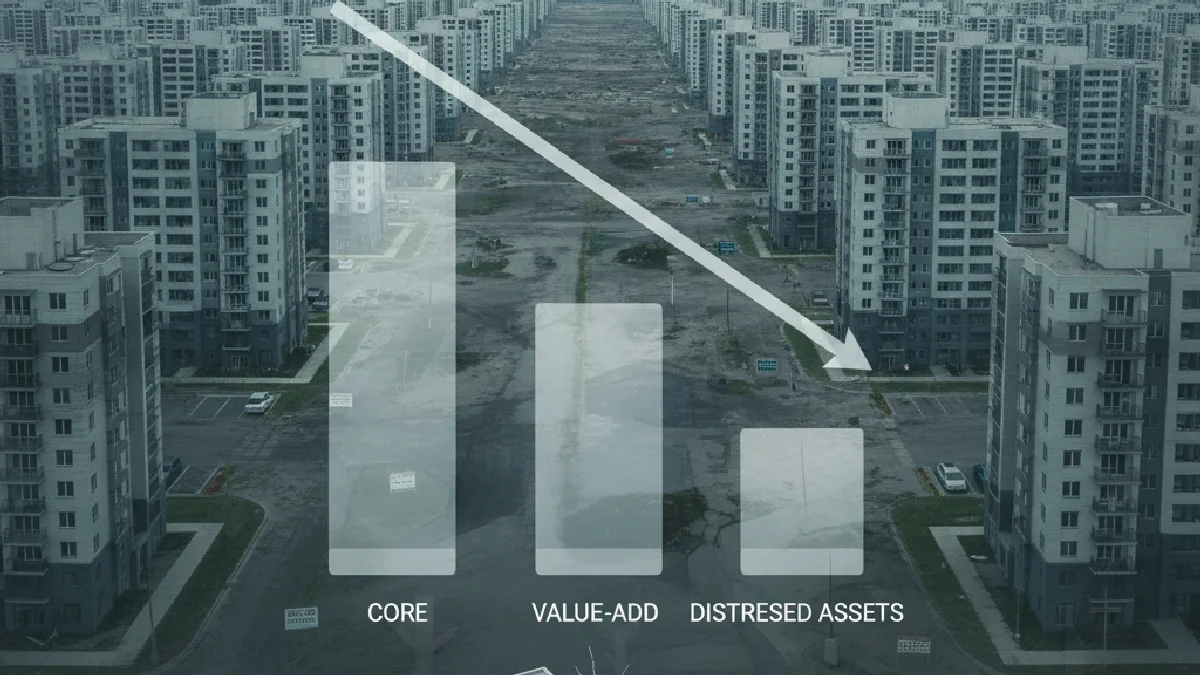
In this tight market context, three approaches stand out: core investments prioritizing quality and stability, value-add strategies focusing on renovating underperforming assets, and opportunities for distressed asset acquisitions. Simultaneously, portfolio rationalization through mergers and acquisitions and targeted divestitures is becoming the norm to maintain disciplined balance sheets.
Structural Oversupply Weighing on Returns
The multifamily housing market has been experiencing a wave of deliveries since 2024 that far exceeds demand in many North American markets. This oversupply is not cyclical: it results from a pipeline of projects launched during the low-interest-rate period, which are now maturing as economic conditions have changed.
Pressure is evident on several fronts. Vacancy rates are increasing in several metropolitan areas, while managers must revise their pricing downwards to maintain occupancy rates. New developments, often with high-end amenities, attract tenants at the expense of older buildings that struggle to justify their current rents.
This dynamic is transforming investor selection criteria. Location is becoming more critical than ever, with a premium placed on areas with strong supply constraints where construction remains limited by regulatory or geographical factors. Markets with strong demographic dynamics — young professionals, an aging population requiring adapted housing — now attract the bulk of capital.
Investment Strategies: Three Approaches to Navigate the Crisis
Faced with this oversupply, institutional investors are adopting three main strategies, each corresponding to a different risk profile.
The Core Approach: Quality and Resilience
Core investors concentrate their capital on already well-occupied assets located in areas with high rental demand. This defensive strategy prioritizes stable cash flows over aggressive growth. The focus is on rigorous selection: recent or recently renovated buildings, premium locations, and proven professional management.
This approach particularly appeals to institutional investors balancing performance and long-term goals, prioritizing capital preservation in an uncertain environment.
Value-Add Strategies: Renovating to Capture Value
Value-add funds see oversupply as an opportunity to acquire underperforming buildings at reduced prices. Their strategy relies on three main levers:
- Renovation of units and common areas to justify rent increases
- Improvement of operational management and cost optimization
- Addition of differentiating services (coworking spaces, fitness rooms, concierge services)
This approach requires specialized operational expertise and patient capital but can generate attractive returns when asset transformation is successful.
Opportunism: Buying Distress
Opportunistic investors target distressed assets: forced sales, highly indebted buildings whose owners can no longer meet their obligations, or unfinished development projects. These situations offer attractive entry points but carry high risks.
Some also explore conversion strategies — transforming obsolete office buildings into multifamily housing — or densification, adding units to underutilized land. These projects require a thorough understanding of local regulations and flawless execution capabilities.

Portfolio Rationalization: Consolidation Accelerates
The oversupply is prompting several multifamily REITs to review their strategic positioning. The phenomenon of rationalization manifests in two complementary ways.
On the one hand, targeted divestitures allow for debt reduction and disengagement from secondary markets deemed less attractive. Several companies have announced the sale of a significant portion of their multifamily assets to reallocate capital towards segments deemed more promising: anchored retail, offices in tech hubs, data centers, or self-storage facilities that show sustained demand.
On the other hand, mergers and acquisitions are increasing. Mid-sized REITs, with fewer resources to navigate the turbulent period, are becoming acquisition targets for major players seeking to consolidate their position in strategic markets. This consolidation allows for operational economies of scale and improved bargaining power with suppliers.
"Balance sheet discipline and maintaining sustainable dividends remain key criteria for attracting capital in an oversupply environment."
The Rise of Non-Listed and Hybrid Structures
Faced with the uncertainties of the listed market, non-listed REITs are gaining popularity among investors seeking stable cash flows with less volatility. These structures offer exposure to the multifamily sector without the daily fluctuations of stock markets.
Managers of these vehicles leverage sophisticated valuation solutions to improve transparency and strengthen investor confidence. This transparency becomes a competitive advantage in a context where capital providers scrutinize valuation policies and risk management processes.
Hybrid structures — combining listed and unlisted assets, or mixing traditional REITs and Delaware Statutory Trusts (DSTs) — are also developing, offering greater flexibility in portfolio management and tax optimization.
This evolution is part of a broader trend where alternative investment vehicles are redefining asset allocation, including in real estate.
Alternative Sectors: Diversification as a Shield
Faced with the difficulties of the multifamily segment, several diversified REITs are rebalancing their portfolios towards more resilient alternative sectors.
Senior housing shows notable outperformance in net operating income, driven by favorable demographic trends. The aging North American population creates structural demand for this type of asset.
Data centers are experiencing exceptional demand, fueled by the expansion of artificial intelligence, cloud computing, and the digital transformation of businesses. Although this segment requires specific technical expertise, the potential returns attract significant capital.
Self-storage continues to demonstrate its economic resilience, with high occupancy rates and relatively low operational costs. This segment benefits from regulatory barriers to entry in many markets.
Medical offices and life sciences facilities also represent attractive alternatives, benefiting from long leases and solvent tenants, even if competition for these assets is intensifying.
Technology and Operational Management: Efficiency as a Differentiator
In an environment of compressed margins, operational excellence becomes a key differentiating factor. Multifamily REITs are investing heavily in property management technologies to optimize costs and improve the tenant experience.
| Technology / Solution | Primary Benefit |
|---|---|
| Automated rental management platforms | Reduced administrative costs, fast processing |
| Predictive analytics tools | Anticipate vacancies, adjust pricing |
| Smart energy solutions | Cost reduction, sustainability |
| Mobile apps / Tenant portals | Facilitate communication and management |
Automated rental management platforms reduce administrative costs while speeding up request processing. Predictive analytics tools help anticipate vacancy periods and adjust pricing strategies in real-time.
Integrating smart energy solutions — connected thermostats, LED lighting, water management systems — reduces operational costs while meeting growing expectations for environmental sustainability. These investments also improve the competitiveness of buildings compared to new constructions.
Mobile applications and tenant portals facilitate communications, rent payments, and common amenity reservations, enhancing resident satisfaction and retention.
Investor Outlook: Selectivity and Patience
The multifamily REIT market in 2026 demands a methodical and selective approach. Successful investors distinguish themselves by their ability to identify pockets of value in an overall saturated environment.
Geography remains the primary selection filter: secondary markets with strong demographic growth, where supply remains constrained, offer better prospects than oversaturated major metropolitan areas. University towns, emerging tech hubs, and areas benefiting from positive internal migration deserve particular attention. For more information, refer to Fidelity Dialogues: Investing in Real Estate in 2026.
The quality of management teams is the second decisive criterion. In a challenging context, the ability to optimize operations, maintain high occupancy rates, and negotiate effectively with suppliers makes all the difference between REITs that maintain their distributions and those that must reduce them.
Finally, balance sheet strength remains paramount. REITs with controlled debt ratios, balanced geographical diversification, and staggered debt maturities are better positioned to navigate this period and seize consolidation opportunities as they arise.
For individual investors seeking exposure to the sector, diversified approaches via specialized ETFs or automated allocation solutions can offer sector exposure while diluting specific risks.