CRISPR vs. Base Editing: Which Technique Redefines Gene Therapy?

Correcting genetic mutations is no longer science fiction. Since the popularization of CRISPR-Cas9 in the early 2010s, gene medicine has reached a decisive milestone. But a new generation of tools is emerging: base editing promises surgical precision without the undesirable side effects of classical techniques. Between versatility and safety, which technology will shape tomorrow's therapies?
CRISPR-Cas9: Versatility at the Cost of Unpredictability
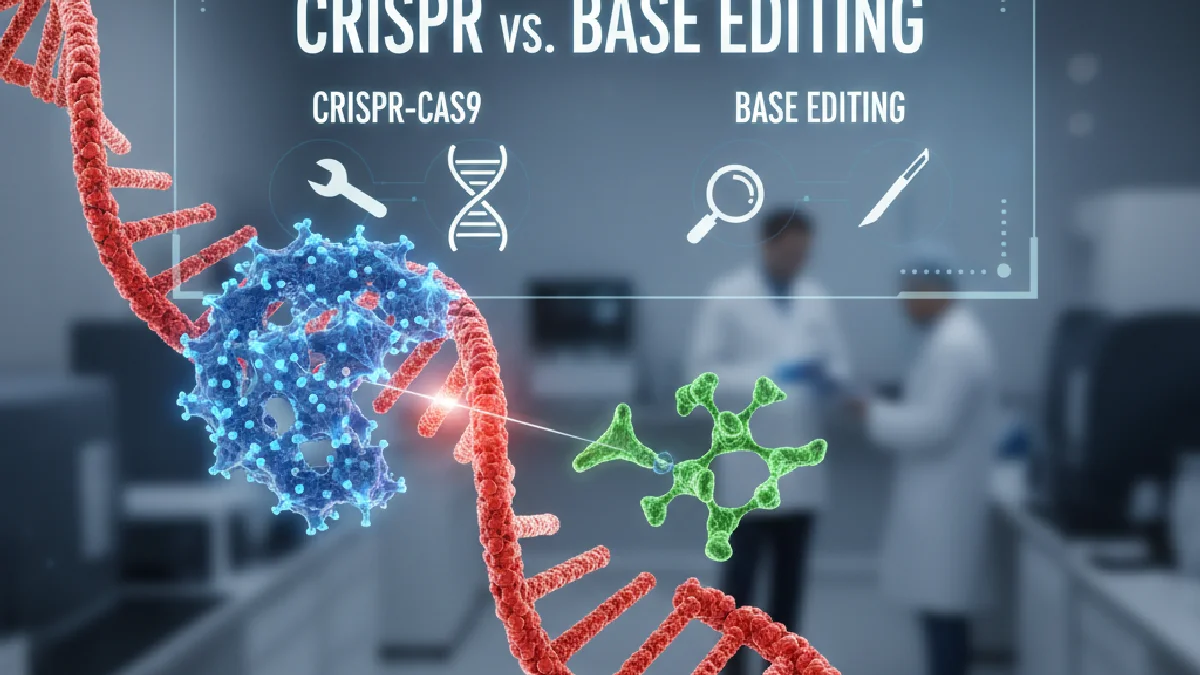
The CRISPR-Cas9 system functions like RNA-guided molecular scissors. The Cas9 enzyme cuts both strands of DNA (double-strand break, DSB) at a precise location in the genome, triggering the cell's natural repair mechanisms. This simple principle allows for various modifications: insertions, deletions, and replacements of entire genes.
Clinical Applications: Concrete Successes
This versatility explains its massive adoption in clinical trials. Medical teams use CRISPR-Cas9 to modify hematopoietic stem cells ex vivo for the treatment of sickle cell disease and beta-thalassemia. Even more ambitiously, in vivo protocols directly target the liver to correct transthyretin amyloidosis, a progressive neurodegenerative disease.
According to KACTUS Bio, CRISPR remains the reference tool for complex edits requiring significant chromosomal rearrangements or the insertion of long sequences.
The Downsides
The creation of double-strand breaks (DSBs), however, triggers cascades of side effects. Cellular repair pathways – primarily non-homologous end joining (NHEJ) and homologous recombination (HDR) – frequently produce undesired insertions or deletions (indels). These errors can inactivate essential genes or cause chromosomal rearrangements.
More concerning: DSBs activate the p53 protein, the guardian of the genome, which can trigger apoptosis of modified cells. The presence of Cas9, a foreign bacterial protein, also elicits immune responses in some patients, compromising therapeutic efficacy and long-term safety.
Base Editing: Precision Without Breaks
Developed in 2016 by teams led by David Liu (Broad Institute) and Akihido Kondo (Kobe University), base editing adopts a radically different strategy. It fuses a modified version of Cas9 (nickase, which only cuts a single strand) with a deaminase enzyme capable of directly converting one nitrogenous base into another.
Two Families of Editors
Cytosine base editors (CBEs) convert C•G pairs to T•A, while adenine base editors (ABEs) perform the inverse transformation of A•T to G•C. These direct chemical modifications bypass double-strand breaks and donor DNA templates, eliminating the main sources of error in classical CRISPR.
A comparative study presented by Umar Sagir demonstrates that base editors regularly achieve correction rates exceeding the symbolic threshold in eukaryotic cells, while drastically reducing indel formation.
Demonstrated Therapeutic Advantages
Base editing particularly targets monogenic diseases caused by point mutations. Transition mutations (C→T or A→G) represent a substantial majority of known human pathogenic variants. This technique has already proven effective in:
- Correcting mutations responsible for sickle cell disease and beta-thalassemia
- Improving CAR-T cells for leukemia treatment
- Experimental approaches for Leber's hereditary optic neuropathy
Base editing transforms genetic correction into molecular surgery: precise, predictable, and significantly safer than traditional approaches.
Limitations and Constraints of Each Approach
What Base Editing Cannot Do
The specificity of base editors paradoxically constitutes their main limitation. They only perform base transitions (purine to purine, pyrimidine to pyrimidine), excluding transversions (purine to pyrimidine or vice versa). It is also impossible to insert or delete several consecutive nucleotides, or to integrate entire genes.
The editing window (typically 5 to 10 nucleotides) can also modify bases adjacent to the target, creating unintentional off-target edits. The in vivo delivery of base editor constructs, which are larger than Cas9 alone, also poses major logistical challenges.
When CRISPR-Cas9 Remains Indispensable
For multiplex editing (simultaneous modification of several genes), large insertions or deletions, and complex chromosomal rearrangements, CRISPR-Cas9 remains the reference tool. Its modular system also allows for applications beyond simple correction: gene activation or repression, chromosomal imaging, and large-scale functional screening.
Fundamental research still overwhelmingly favors CRISPR for its flexibility and its ability to rapidly generate cellular or animal models carrying specific mutations.
Towards a Strategic Complementarity
The choice between CRISPR-Cas9 and base editing is not a binary opposition, but rather a matter of suitability for the therapeutic need. For a point mutation responsible for a hemoglobinopathy, base editing offers a superior safety profile. To modify a complex locus or insert a complete therapeutic gene, classical CRISPR remains essential.
Recent advances also suggest technological convergence. Prime editing, a hybrid technique developed by Liu's team, combines the precision of base editing with the ability to perform all types of modifications (insertions, deletions, replacements). This third path could reconcile versatility and safety.
Clinical Pipeline and Prospects
Clinical trials for base editing are progressing rapidly. Protocols are currently evaluating treatments for hepatic, retinal, and blood disorders. The reduction of adverse effects could accelerate regulatory approvals and broaden the spectrum of treatable diseases.
In parallel, continuous improvements in Cas variants (Cas12, Cas13, CasΦ) reduce tool size, improve specificity, and decrease immunogenicity. These technical refinements are gradually bringing CRISPR's performance closer to that of base editing in terms of safety.
Beyond Technology: Systemic Challenges
Accessibility and Costs
The increasing sophistication of gene therapies raises the question of their accessibility. Ex vivo treatments require specialized hospital infrastructure, limiting their deployment to academic centers or advanced hospitals. Production costs, although decreasing, remain prohibitive for many healthcare systems.
In vivo editing could democratize access by simplifying protocols, but it requires delivery vectors (AAV, lipid nanoparticles) that are still imperfect. Research into vectorization methods constitutes a critical bottleneck for the next generation of treatments.
Ethical Considerations
The increasing effectiveness of genomic editing tools revives debates on germline modifications (heritable). While the international scientific community maintains a de facto moratorium on these applications, the line between acceptable somatic therapy and controversial genetic enhancement remains blurred.
Technological progress often outpaces regulatory frameworks. Health agencies are striving to adapt their evaluation protocols for therapies that permanently modify the genome, unlike reversible conventional drugs. This interface between biomedical innovation and public governance will largely define the pace of clinical adoption.
A Revolution Under Construction
Gene medicine is entering a maturation phase where several technologies coexist, each optimized for specific use cases. CRISPR-Cas9 paved the way by demonstrating the clinical feasibility of genomic editing. Base editing refines this approach by prioritizing precision and safety for point mutations.
Upcoming years will likely see the emergence of a diversified toolkit, where clinicians and researchers will select the appropriate technique based on the patient's genetic profile, the complexity of the mutation, and delivery constraints. This therapeutic personalization, similar to the approach adopted in precision medicine for rare neurological diseases, represents the future of clinical genetics.
The challenge now extends beyond pure technical performance: it involves building accessible healthcare pathways, training healthcare professionals in these new approaches, and integrating these innovations into global therapeutic strategies. Early successes in treating hemoglobinopathies suggest considerable potential for hundreds of monogenic diseases that are still incurable. This prospect, far from hyperbolic promises, relies on meticulous engineering and rigorous clinical validation.
Comparison of Gene Editing Technologies
| Characteristic | CRISPR-Cas9 | Base Editing |
|---|---|---|
| Main Mechanism | Double-strand breaks (DSB) | Direct conversion of a nitrogenous base |
| Type of Modification | Insertions, deletions, replacements, rearrangements | Base transitions (C→T, A→G) |
| Precision / Side Effects | Less precise, risk of indels, p53 cytotoxicity | Very precise, low indel formation |
| Ideal Applications | Chromosomal rearrangements, gene insertions | Point mutations (monogenic diseases) |