Making Graphene at Home: A Practical Guide for the Explorer
Making Graphene at Home: A Practical Guide for the Explorer
Graphene, this revolutionary two-dimensional material composed of a single layer of carbon atoms, fascinates as much by its exceptional properties as by the complexity of its production. 200 times more electrically conductive than copper, flexible, and transparent, it represents the future of many technologies. Contrary to popular belief, it is possible to produce graphene at home with accessible methods and basic equipment.
This democratization of synthesis opens new perspectives for amateur researchers, students, and science enthusiasts. In 2026, several techniques allow for the creation of graphene flakes of sufficient quality for experiments and educational demonstrations, without requiring significant investment.

Graphene Fundamentals for Beginners
Graphene belongs to the family of two-dimensional materials or 2D materials. These materials have a nanometric dimension – their thickness – while their other two dimensions extend to larger scales. This unique structure gives graphene remarkable properties: exceptional electrical conductivity, mechanical strength 200 times greater than steel, and optical transparency of 97.7%.
Industrial production of graphene relies on costly processes such as chemical vapor deposition (CVD) or epitaxy on silicon carbide. Fortunately, two main methods allow for domestic synthesis: mechanical exfoliation of graphite and thermal reduction of carbon dioxide.
According to research published by Techniques Ingénieur, these artisanal approaches produce graphene flakes a few tens of micrometers in size, perfectly suited for educational applications and amateur laboratory experiments.
Method 1: Mechanical Exfoliation of Graphite
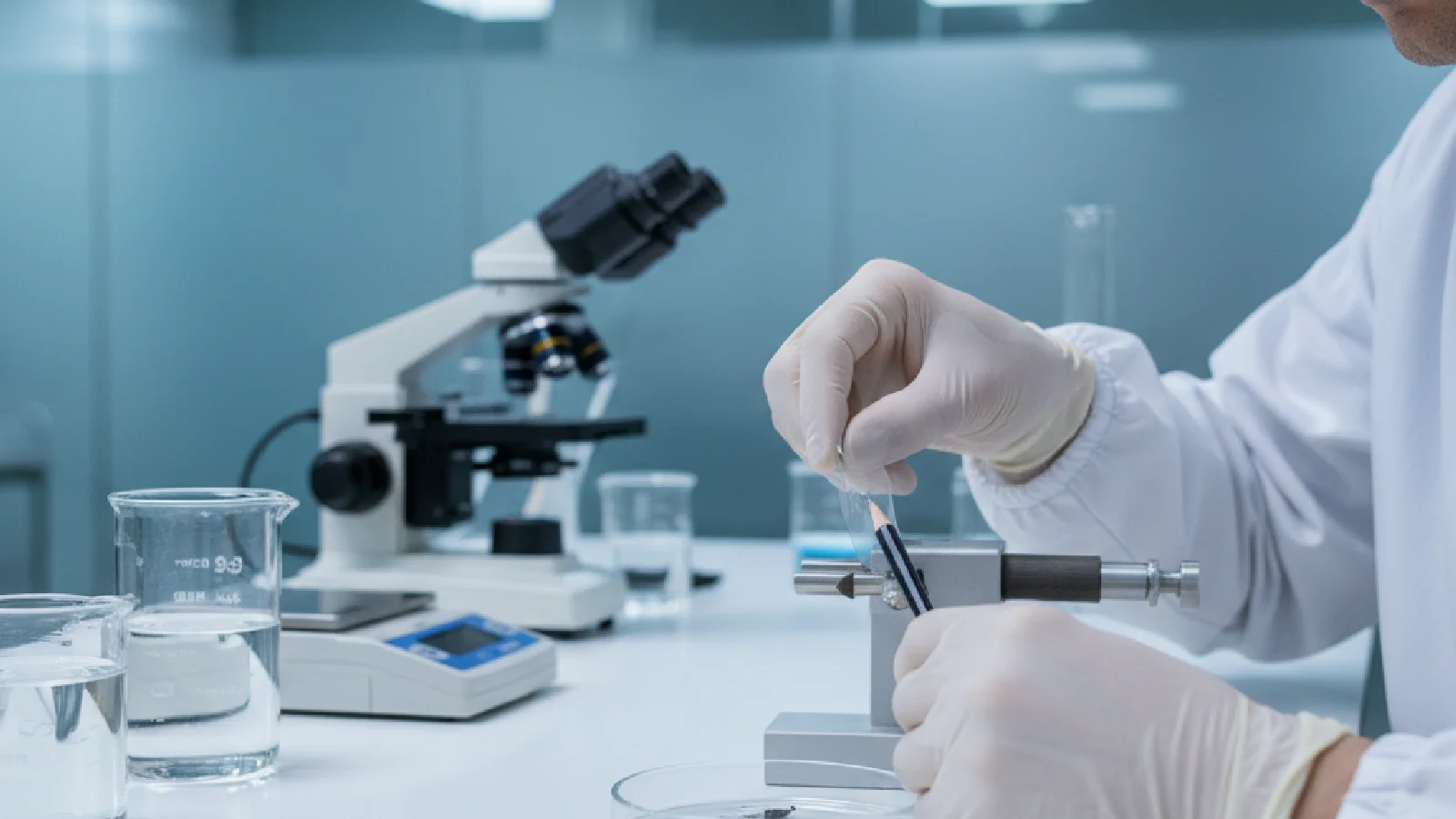
Mechanical exfoliation is the most accessible technique for beginners. This method, inspired by the pioneering work of Geim and Novoselov (Nobel Prize 2010), uses the adhesive force of tape to separate atomic layers of graphite.
Required Materials
- High-purity graphite (9H pencil leads or graphite block)
- Quality transparent adhesive tape
- Clean substrate (glass slide, silicon wafer, or aluminum foil)
- Controlled heat source (hot plate or oven)
- Personal protective equipment
Detailed Procedure
Start by securing the graphite on a stable surface and apply adhesive tape over its entire surface. Apply uniform pressure for 30 seconds before vigorously removing the tape. This first exfoliation detaches the surface layers of the graphite.
Repeat the operation 5 to 10 times on the same sample to increase the number of separated flakes. The more you repeat the process, the more fine fragments you obtain that are likely to contain single-layer graphene.
"Mechanical exfoliation allows for the production of graphene domains of excellent crystalline quality, even if their size remains limited to a few tens of micrometers." - National Metrology Laboratory
Then transfer the flakes onto your substrate by gently pressing the adhesive tape for 2 minutes. Moderate heating to 80°C improves adhesion and facilitates tape removal without damaging the flakes.
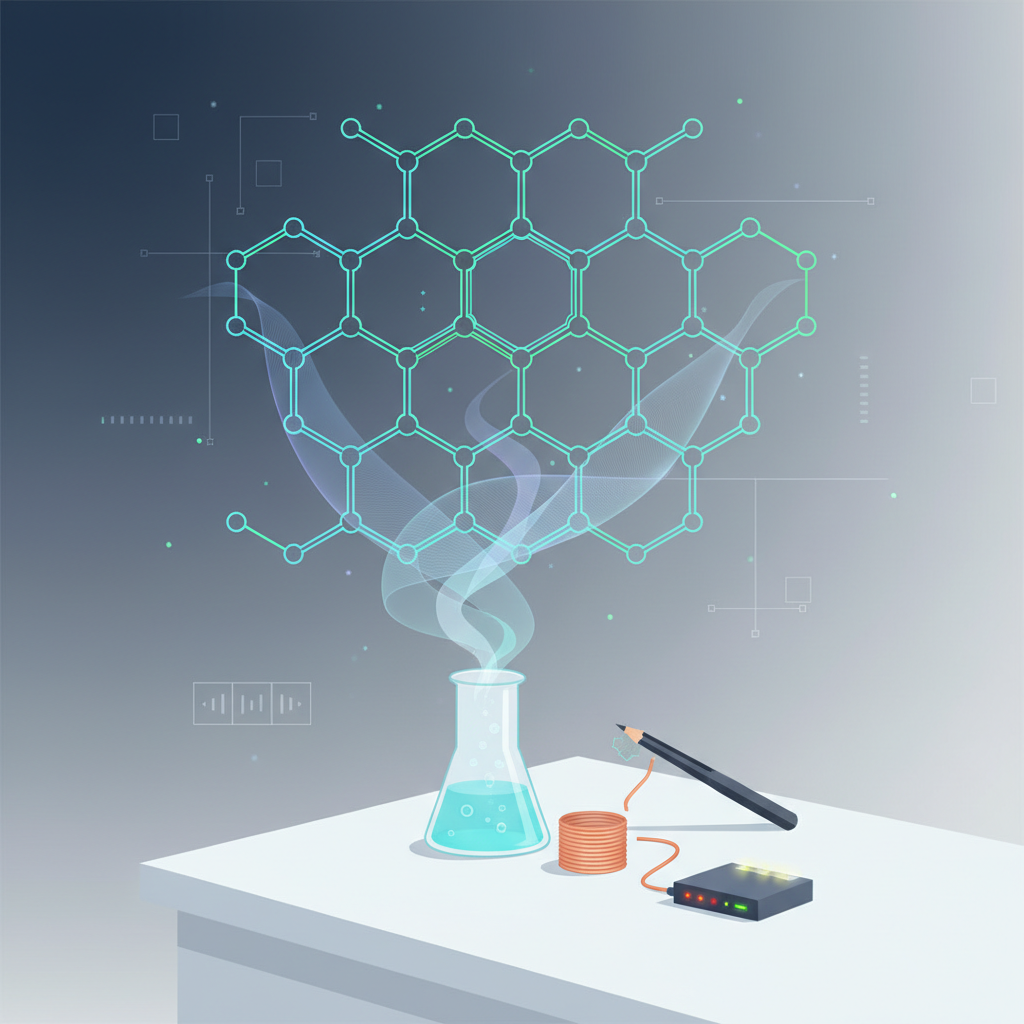
Method 2: Thermal Reduction of CO₂ with Magnesium
This more technical approach transforms carbon dioxide into graphene through a high-temperature reduction reaction. Metallic magnesium acts as a reducing agent, releasing carbon that reorganizes into a graphene structure.
Required Equipment
- Pure magnesium powder (99% minimum)
- Dry ice (solid CO₂)
- Refractory ceramic crucible
- Oven capable of reaching 700°C
- Ventilation system and controlled atmosphere (nitrogen or argon)
Experimental Protocol
Finely grind the metallic magnesium to increase its surface area. Place 1 gram of powder in the crucible and add approximately 10 grams of dry ice. This stoichiometry promotes a complete reaction while avoiding excessive heat.
Gradually heat to 600-700°C under an inert atmosphere. The reaction begins around 400°C with significant gas release. Maintain the temperature for 10 to 15 minutes to allow for the complete formation of graphene structures.
After cooling, collect the carbon deposits formed on the cold walls of the oven. These deposits contain multi-layer graphene flakes less than 10 atomic layers thick.
Characterization and Optimization of Your Samples
The quality of the produced graphene requires appropriate characterization to validate the success of the synthesis. Several simple techniques allow you to evaluate your samples without sophisticated equipment.
Electrical Conductivity Tests
Use a multimeter to measure the resistance of your flakes. Quality graphene exhibits a sheet resistance of 2-50 ohms per square, significantly lower than that of bulk graphite (0.1 ohm⋅mm).
Graphene metrology developed by national laboratories provides precise references for evaluating your domestic productions.
Microscopic Observations
A standard optical microscope reveals the presence of characteristic transparent flakes. Single-layer areas appear almost invisible, while bilayer and trilayer regions show progressive optical contrast.
Thermal Post-treatment
Annealing at 300-350°C under nitrogen for 30 minutes removes organic residues and improves crystalline quality. This optional step increases conductivity and reduces structural defects.
Safety and Risk Management
Handling these processes requires strict precautions to avoid accidents. Nanomaterials like graphene present specific risks related to their small size and reactivity.
Protective Equipment
- Certified safety glasses
- Chemical-resistant gloves
- FFP2 respiratory mask minimum
- Cotton lab coat
- Work under a fume hood or in a ventilated outdoor area
Waste Management
Oxidized magnesium residues are classified as chemical waste and require appropriate treatment. Contact your local treatment center for collection procedures. Graphite dust can be composted after neutralization.
Handling dry ice requires adequate ventilation to prevent CO₂ accumulation in confined spaces. Always store dry ice in non-hermetic containers.
Possible Applications and Experiments
Your homemade graphene samples open up a vast field of educational experiments and scientific demonstrations. These applications concretely illustrate the extraordinary properties of the material.
Conductivity Tests
Create simple electrical circuits by depositing your flakes on insulating substrates. Connect LEDs to visualize electrical conduction through a single atomic layer. This spectacular experiment demonstrates graphene's efficiency as a conductor.
Optical Transparency Studies
Overlap several flakes to observe the progressive variation in transparency. Each layer absorbs exactly 2.3% of visible light, allowing for precise counting of the number of atomic layers.
These experiments fit perfectly into educational programs on nanotechnologies, concretely illustrating the applications of two-dimensional materials.
Improvement Prospects and Future Developments
In 2026, the continuous improvement of domestic synthesis techniques opens new possibilities. Researchers are developing hybrid methods combining mechanical exfoliation and gentle chemical treatment to increase yields.
Integrating simple sensors allows for real-time monitoring of production quality. These innovations bring amateur performance closer to professional standards, as observed in high-temperature superconductors.
The community of scientific "makers" actively shares innovations and optimizations via collaborative platforms. This dynamic accelerates the evolution of techniques and democratizes access to these cutting-edge technologies.
Conclusion
The domestic production of graphene perfectly illustrates the democratization of nanotechnologies. These accessible methods transform an elite material into an object of exploration for all science enthusiasts. Although the samples produced will never rival industrial productions in terms of size and uniformity, they offer sufficient quality to understand and experiment with the extraordinary properties of graphene.
This artisanal approach is part of a broader educational process, where direct manipulation of materials reinforces theoretical understanding. In 2026, the constant evolution of these techniques promises continuous improvements, bringing domestic performance ever closer to professional standards.
The adventure of homemade graphene is just beginning, paving the way for a new generation of scientific explorers equipped to tackle tomorrow's technological challenges.