
The Real Problem with Aging: When Time Disappears
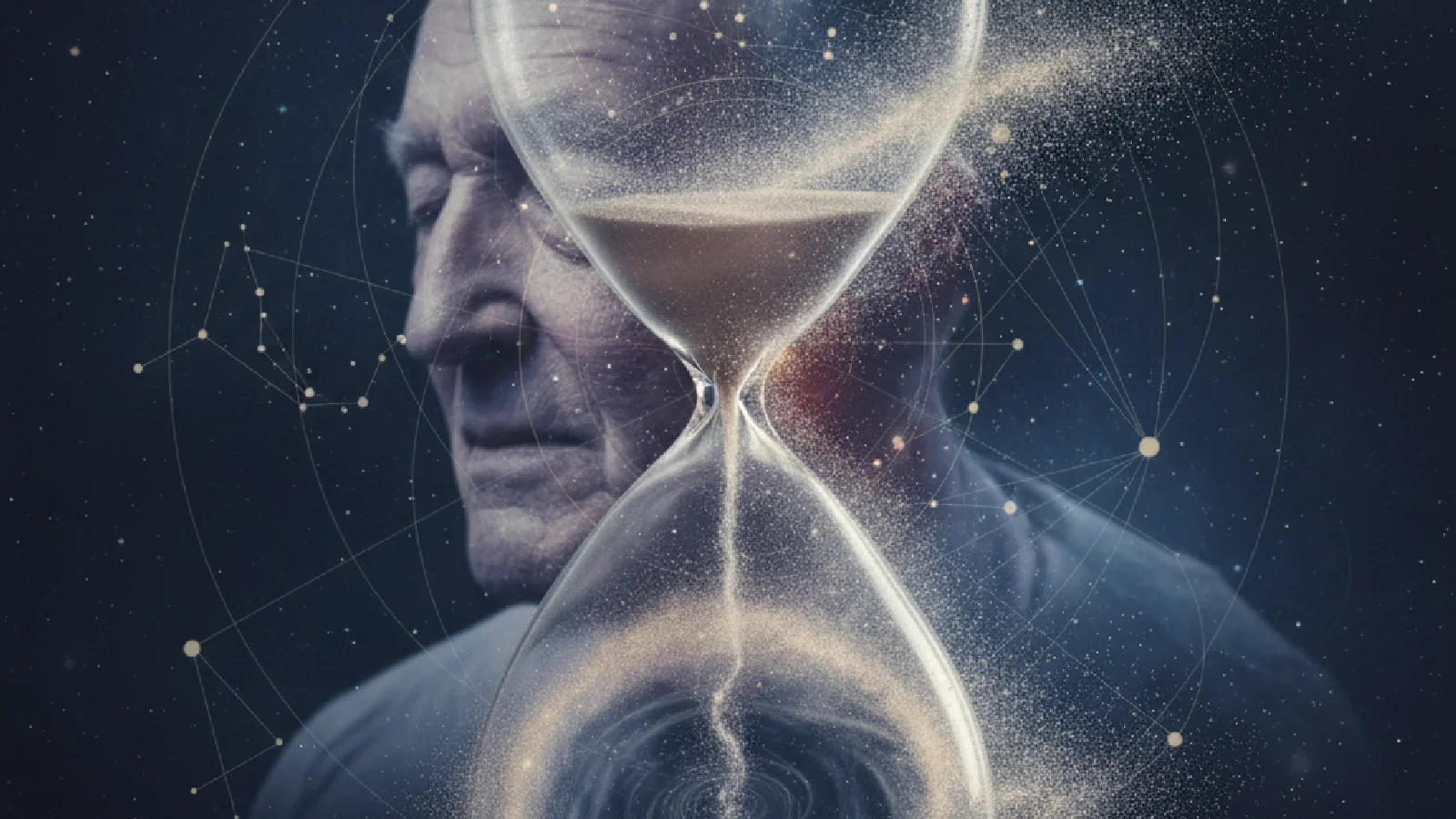
At 8 years old, summer vacation seems to last an eternity. At 50, years fly by like accelerated seasons. This radical transformation of our relationship with time reveals one of the deepest challenges of aging: not the fear of dying prematurely, but the agonizing sensation that time is escaping us, slipping through our fingers.

The Subjective Physics of Accelerating Time
Contrary to popular belief, aging does not transform our biological clock in a linear fashion. Neuroscience research reveals that our temporal perception changes according to several fascinating mechanisms.
For a 10-year-old child, a year represents 10% of their existence. For a 50-year-old adult, that same year constitutes only 2% of their lived life. This mathematical proportion partly explains why time passes faster as we age.
The Theory of Decreasing Novelty
Neuroscientists identify three major factors in this subjective acceleration:
- Habituation: daily routines create fewer distinct memory imprints
- Decrease in firsts: fewer significant novelties punctuate our days
- Behavioral automation: our actions become more mechanical, less conscious
| Acceleration Factor | Description |
|---|---|
| Habituation | Fewer distinct memory imprints |
| Decreasing Novelty | Scarcity of significant events |
| Automation | More mechanical, less conscious actions and behaviors |
When Existence Becomes Homogeneous
"The fact of aging, heralding death, the individual end of time, is socially rejected in its reality, obscured in its truth, denied because we do not know how to find meaning in it."
This observation, taken from Jacques Jalon's work on the time to age, highlights a crucial psychological dimension: the progressive homogenization of temporal experience. Aging impacts our perception and relationship with time.
As we age, our days become more alike. Professional obligations, family routines, and habits create a predictable framework that, paradoxically, makes distinctive temporal markers disappear. This uniformity generates a particular anxiety: that of seeing one's life merge into an undifferentiated continuity.

Fading Temporal Markers
Psychologists identify several temporal markers that diminish with age:
- Significant events: first job, marriage, birth of children intensely punctuate youth, then become rarer.
- Major learning experiences: acquiring new skills becomes less frequent, reducing memorable milestones.
- Breaks in routine: changes in environment or status become less common.
The Existential Anguish of Lost Time
Unlike certain species that live 200 years, humans develop a keen awareness of their temporal finitude. This awareness generates a specific form of anxiety: not the fear of dying, but that of "living badly" the remaining time. As a guest of the University of Geneva points out, "To die is a loss. To live too long is also a loss".
The psychological difficulty of aging lies in this double bind: on the one hand, the sensation of acceleration makes every moment more precious; on the other, habit dulls our ability to fully savor them.
The Paradox of Experience
The more experiences we accumulate, the more our brain automatically categorizes them, reducing their emotional and memorial impact. This cognitive economy makes us gain in efficiency but lose in lived intensity.
The Neurosciences of Subjective Time
Recent research in chronobiology reveals that our temporal perception involves several interconnected brain regions. The insula, prefrontal cortex, and limbic structures collaborate to construct our subjective experience of time.
With age, these neural circuits change. The decrease in certain neurotransmitters, particularly dopamine, affects our ability to perceive novelty and to psychologically "stretch" significant moments.
These neurobiological mechanisms explain why the mystery of time accelerating with age fascinates researchers so much: it reveals the complex interaction between our biology and our construction of experience.
Strategies to Reclaim Temporality
Faced with this temporal erosion, several approaches can help us regain a richer relationship with time:
- Cultivating novelty: regularly integrating new experiences, even modest ones, to create new memory markers.
- Practicing mindfulness: developing attention to the present moment to enrich the subjective experience of each instant.
- Diversifying activities: breaking routines to reintroduce variability into daily life.
These strategies, inspired by work on the difficulty of aging, aim to restore the temporal density of our existence.
Reconciling Finitude and Fullness
The ultimate challenge of aging is to accept finitude without succumbing to temporal anxiety. This reconciliation involves redefining our relationship with time: no longer as a resource that is depleted, but as a medium of accomplishment. This personal transformation can only be achieved through patient and methodical inner work.
Acceptance of aging implies understanding that temporal quality can compensate for quantity. A moment fully lived is better than a day passively endured.
This philosophy of rediscovered time offers a liberating perspective: aging is not losing time, it is learning to inhabit it differently. Maturity brings this unique ability to transform the present moment into subjective eternity, provided we cultivate this enriched temporal awareness.