Asteroid Mining: NASA's Lunar Technologies, a Space Springboard
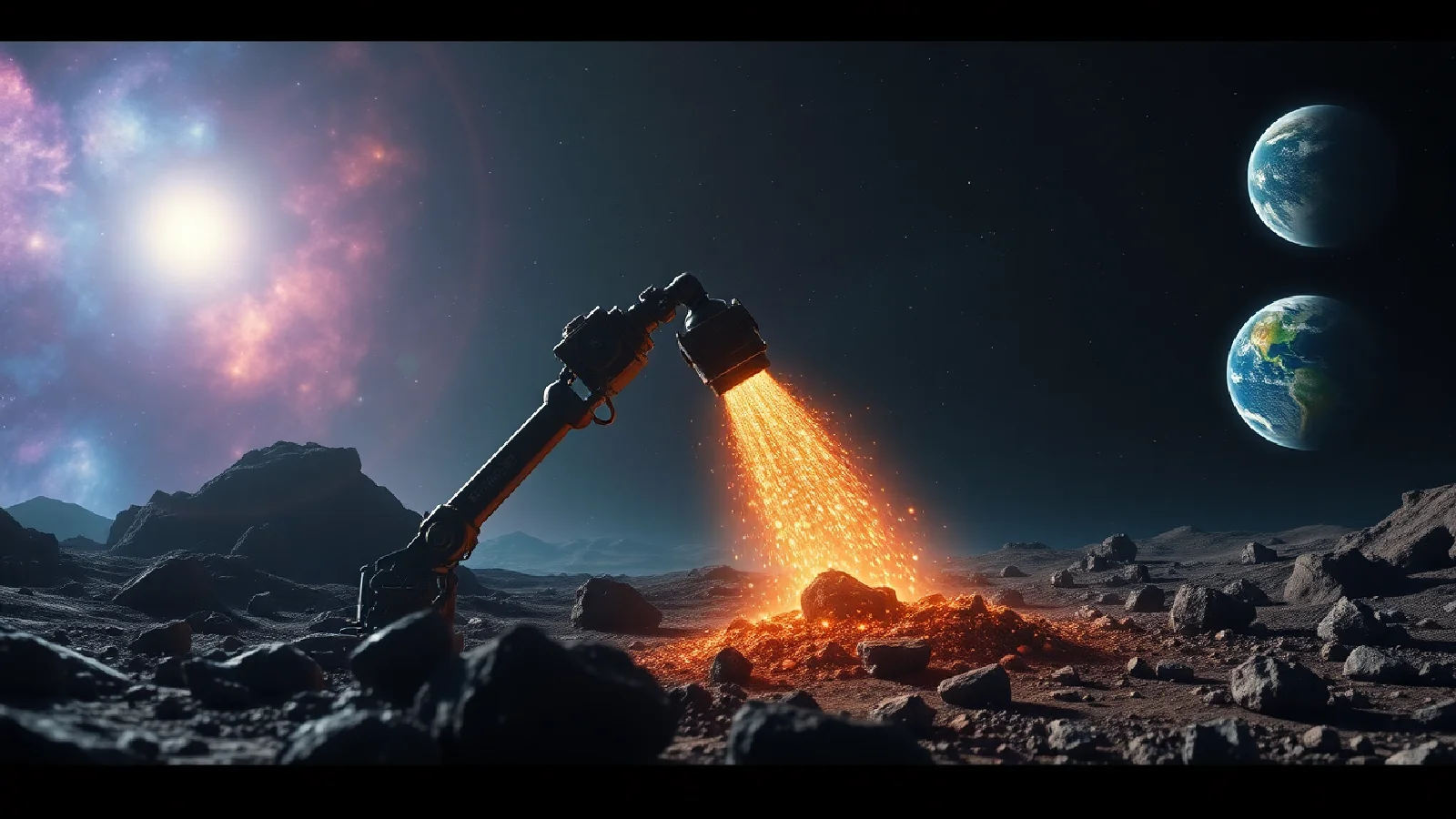
The Moon as a testbed for asteroids? As NASA increases robotic missions to our natural satellite, one observation stands out: every rover, every drilling system, every extraction process tested today in lunar regolith foreshadows tomorrow's technologies for exploiting asteroid resources. Far from being mere parallel projects, lunar programs and the future of space mining form a remarkable technical continuum.

From the Moon to Asteroids: An Unexpected Technical Proximity
The lunar and asteroidal environments share similar constraints that make space technologies developed for one directly applicable to the other. Near-zero gravity, absence of atmosphere, intense cosmic radiation, extreme temperatures: these are all common challenges that require adapted engineering solutions.
The VIPER (Volatiles Investigating Polar Exploration Rover) rover, designed to map water ice at the Moon's South Pole, perfectly illustrates this transferability. Its autonomous navigation systems, its ability to operate in permanently shadowed regions where temperatures reach -200°C, and its volatile detection instruments provide a solid technical foundation for future asteroid exploration vehicles.
Anchoring techniques and stabilization methods developed to keep equipment in place in the Moon's low gravity (about 1/6th of Earth's) are directly applicable to asteroids, where gravity is even lower. The OSIRIS-REx mission, which successfully collected samples from the asteroid Bennu, demonstrated the feasibility of these delicate maneuvers in microgravity. To learn more about the challenges of Martian exploration and related technological hurdles, see our article on Mars Future Plan.
ISRU: The Revolution of In-Situ Resource Utilization
ISRU (In-Situ Resource Utilization) represents the core of the transition between space exploration and exploitation. This concept, which involves transforming local materials into usable resources, is undergoing intensive experimentation on the Moon.
NASA's PRIME-1 (Polar Resources Ice Mining Experiment) project is currently testing drilling and heating systems capable of extracting water from lunar regolith. Once extracted, this water can be electrolyzed to produce breathable oxygen and hydrogen usable as rocket propellant. These thermal and chemical processes are perfectly transferable to volatile-rich asteroids.
According to the French Senate report on space resource exploitation, ISRU is "the sine qua non condition for the return to the Moon planned by 2030, but also the key to the development of new commercial activities in orbit." This strategy drastically reduces logistical costs by avoiding the need to transport all necessary resources for long-duration missions from Earth.
Key Lunar ISRU Technologies Transferable to Asteroids
- Drilling and extraction: Robotic systems capable of penetrating regolith and extracting targeted materials
- Thermal processing: Solar furnaces and heating systems to release trapped volatiles from rock
- Separation and storage: Cryogenic units to condense and store extracted water and gases

Autonomous Robotics: The Demand for Operational Independence
Communication delays between Earth and distant space objects make real-time control impossible. A signal takes about 1.3 seconds to reach the Moon, but can take up to 20 minutes for some asteroids. This constraint necessitates the development of autonomous robotic systems capable of making decisions without human intervention.
Robotic arms developed for lunar missions incorporate automatic anchoring capabilities, fine sample manipulation, and adaptation to irregular terrain. These skills are essential for asteroid mining, where vehicles will need to identify resource-rich areas, position themselves, and proceed with extraction without direct supervision.
The OSIRIS-REx mission demonstrated that a spacecraft could approach an asteroid, map its surface with precision, identify a safe landing zone, collect samples, and depart, all largely autonomously. This technical feat validates the approach adopted for future space mining missions.
"The exploitation of space resources is no longer science fiction: it is the condition for the development of new commercial activities in orbit and a lever for strategic autonomy." — French Senate Report, 2023
From Scientific Exploration to Commercial Exploitation
The transition between scientific missions and commercial operations is gradually beginning. While current NASA programs remain focused on research and technological demonstration, several private companies are already preparing the ground for economic exploitation.
As AZoMining highlights in its analysis of the future of extraterrestrial extraction, "private companies have pioneered this space race," with companies like Planetary Resources and Deep Space Industries identifying approximately 15,000 asteroids with significant mining potential.
The economic interest is considerable: some asteroids contain concentrations of precious metals (platinum, gold, rare earths) and industrial metals (iron, nickel) that far exceed what is found on Earth. Moreover, the presence of water in many carbonaceous asteroids makes them potential "space gas stations" for long-distance missions to Mars or beyond. According to Fortune Business Insights, the space mining market is expected to experience significant growth in the coming years.
Lunar technologies significantly reduce the risks and development costs for these future space mining ventures by validating processes in a relatively accessible environment before venturing further into the Solar System.
Why Asteroid Mining?
| Key Resource | Space Interest | Economic Potential |
|---|---|---|
| Water | Fuel (H2/O2), life support | Mission refueling |
| Precious Metals | Electronics, catalysts | High market value |
| Industrial Metals | Infrastructure construction | Various basic materials |
Material Synergies: 3D Printing and In-Space Manufacturing
Beyond extraction, lunar technologies also explore in-situ material transformation. 3D printing from lunar regolith is the subject of much research, with the goal of manufacturing structures, tools, and even spare parts without relying on Earth-based supplies.
These additive manufacturing processes are directly applicable to asteroids. Extracted materials could serve not only as propellants or consumables but also as raw material to build habitats, radiation shields, or even spacecraft components directly in space.
This approach radically transforms the space economy: instead of exporting raw resources to Earth (which remains difficult to make profitable given transport costs), a circular space economy could be developed where materials are processed and used in situ to fuel human expansion into the Solar System.
Missions to Mars, in particular, would greatly benefit from this infrastructure: asteroidal refueling stations located between Earth and the Red Planet would significantly reduce the mass and cost of crewed missions.
Time Horizon and Challenges to Overcome
The prospects for asteroid mining development are taking shape. Current and planned lunar missions for 2025-2030 will validate critical technologies, while the first asteroidal exploitation missions could begin around 2030-2035.
Several major obstacles remain, however. The international legal framework remains unclear: the 1967 Outer Space Treaty prohibits national appropriation of celestial bodies but does not clarify the status of extracted resources. Luxembourg and the United States have adopted national legislation authorizing commercial exploitation, creating a complex legal situation that will require international coordination. As the National Space Society reports, asteroid mining is key to the space economy.
Technical challenges include equipment miniaturization (payloads must remain light to limit launch costs), improved energy autonomy (solar panels are less efficient far from the Sun), and the development of economically viable sample return systems.
Finally, the space industrial ecosystem still needs to mature. Reusable launch infrastructures developed by SpaceX and other players, as demonstrated by the acceleration of Starlink deployment, are gradually reducing the cost of access to space, making space exploitation projects more economically viable. Harvard University has also published an analysis on the economics of future asteroid mining.
An Interconnected Technological Ecosystem
All these developments reveal an often-overlooked reality: space exploration forms a highly interconnected technological ecosystem. Martian rovers, asteroidal probes, orbital stations, and lunar missions are not isolated projects, but components of a global strategy where each advance feeds the others.
Autonomous navigation technologies developed for Starship benefit lunar rovers, which in turn inform the design of future asteroidal exploitation vehicles. Life support systems in hostile environments tested on the International Space Station feed the designs of lunar habitats, which prefigure tomorrow's asteroidal bases.
This incremental approach, where each step validates the technologies needed for the next, is the key to sustainable and economically rational space development. Rather than a risky leap towards asteroid exploitation, the international space community is meticulously building the technical, operational, and regulatory foundations for a permanent human presence beyond Earth. For a deeper understanding of what asteroid mining is and its importance, NSTXL offers a clear perspective.
The goal is no longer just to explore, but to establish a lasting presence in the Solar System, using local resources to fuel this expansion. And it is on the Moon, in the dusty silence of its polar craters, that this space revolution is being forged today.