Black Hole Mergers: Birth of Cosmic Giants
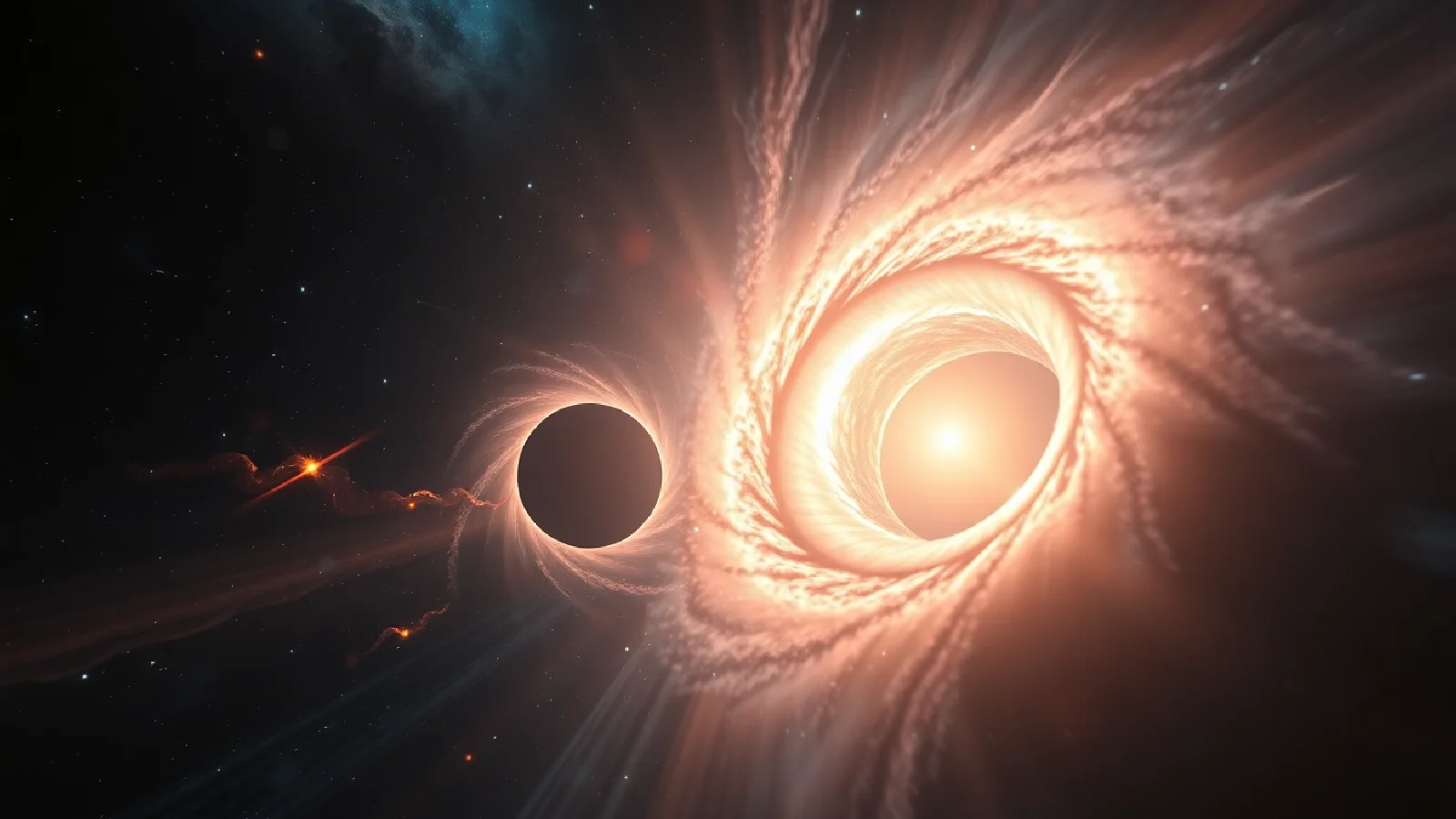
On November 23, 2023, three gravitational wave detectors located in the United States, Europe, and Japan captured an exceptional signal. Two cosmic monsters – black holes of 103 and 137 solar masses – had just merged billions of light-years from Earth. This titanic collision, named GW231123, is the most massive stellar black hole merger ever detected and opens an unprecedented window into the formation of cosmic giants.
These recent discoveries challenge our models of stellar evolution and suggest that supermassive black holes, lurking at the hearts of galaxies, could be born from a cascade of successive mergers rather than a single collapse.
A Record Detection That Challenges Classical Theories
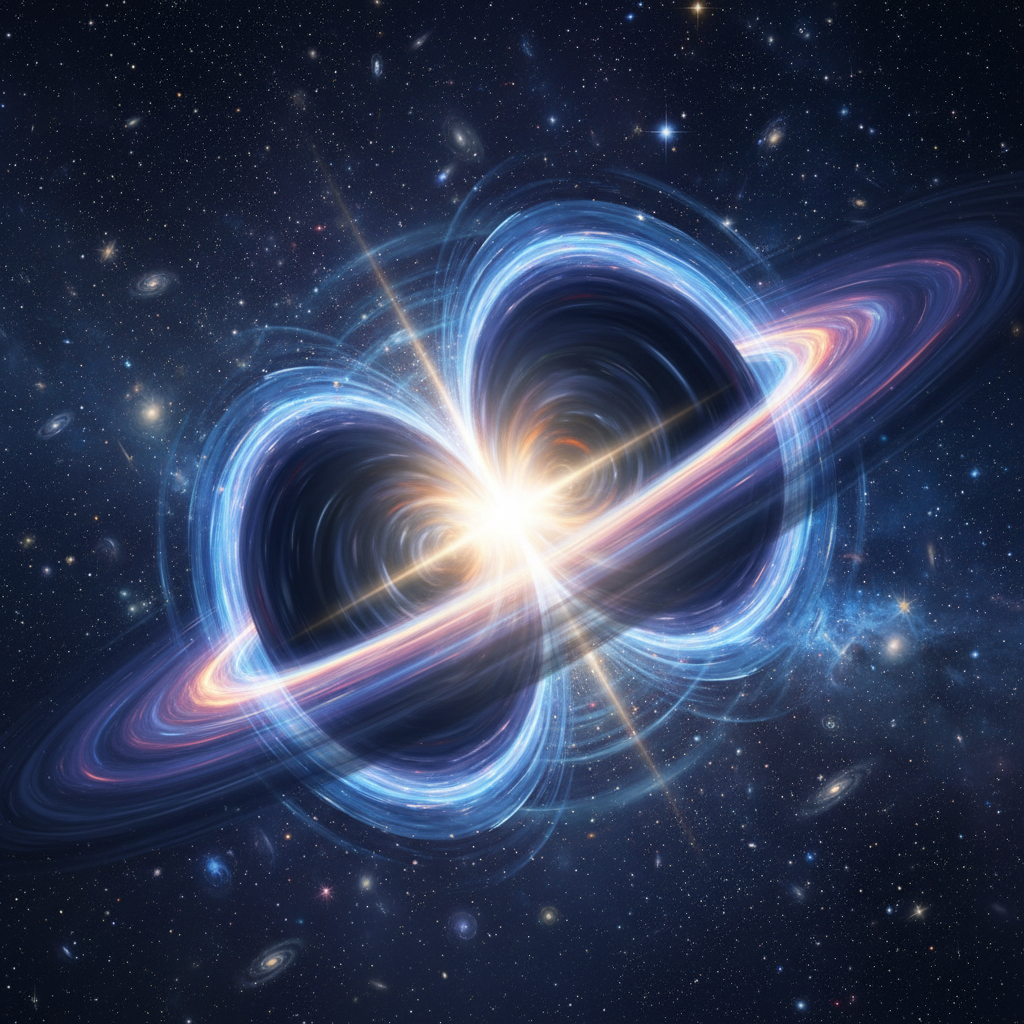
The GW231123 event, recorded by the LIGO-Virgo-KAGRA network, marks a turning point in our understanding of the violent Universe. International collaborations detected the merger of two black holes whose individual masses reached 103 and 137 times that of the Sun, respectively. This scientific publication was described as "unprecedented" by the FRS-FNRS.
The resulting black hole has a mass of 225 solar masses. A notable difference: approximately 15 solar masses literally evaporated during the collision, transformed into pure gravitational energy. It is precisely this colossal energy that generated the gravitational waves captured by our terrestrial detectors.
Revealing Extreme Spins
One detail particularly intrigues astrophysicists: the two black holes were spinning very rapidly before the merger. Their spin parameters (between 0.8 and 0.9) suggest a complex dynamic history. These high rotations are a major clue: these objects themselves could be the result of previous mergers, having accumulated angular momentum with each collision.
"Each of the black holes had a high spin, indicating a rich dynamic history. The final black hole is 225 M⊙, with about 15 M⊙ converted into gravitational energy."
A Cosmic Genealogy Emerges
The GW241011 signal, detected on October 11, 2024, reinforced the hypothesis of hierarchical growth of black holes. This atypical event revealed the merger of two bodies resulting in a black hole of approximately 200 solar masses.
Detailed analysis of the orbital motion showed unusual characteristics. One of the two black holes exhibited kinetic behavior suggesting it was itself the product of a previous merger. This discovery outlines the contours of a true cosmic family tree: some black holes would be "children" or "grandchildren" of earlier mergers.
Intermediate-Mass Black Holes, the Missing Link
These observations fill a major theoretical gap. Classical stellar evolution models struggle to explain the existence of such massive black holes directly resulting from the collapse of a star. The maximum expected mass for a "first-generation" stellar black hole is around 65 solar masses.
Intermediate-mass black holes (between 100 and 100,000 solar masses) therefore likely represent a crucial transitional stage: they are born from repeated mergers and constitute the elementary building blocks of future supermassive giants that dominate galactic centers.
Gravitational Waves, New Astronomy
Since the first historical detection in 2015 – which confirmed an Einstein prediction a century old – gravitational astronomy has experienced spectacular growth. The network of giant interferometers, comprising the American LIGO detectors, the Italian Virgo, and the Japanese KAGRA, now continuously scrutinizes the infinitesimal distortions of spacetime.
The GW250114 signal, captured on January 14, 2025, demonstrated the increased sensitivity of modern instruments. This detection also provided new experimental confirmation of the black hole area theorem: during a merger, the total surface area of the event horizon can never decrease.
How to Detect the Invisible
Gravitational waves propagate at the speed of light and literally deform the fabric of spacetime as they pass. Laser interferometers measure these microscopic deformations – equivalent to a fraction of the size of a proton – over arms several kilometers long.
When two black holes merge, they emit a characteristic signal called a "chirp": an oscillation whose frequency and amplitude gradually increase until the final collision. Analysis of this signal allows for the reconstruction of the masses, spins, and distance of the merging objects.
The Puzzle of Supermassive Formation
At the heart of almost all massive galaxies lies a supermassive black hole, whose mass can reach billions of times that of the Sun. The origin of these cosmic giants remains one of the major enigmas of modern astrophysics.
Hierarchical mergers of intermediate-mass black holes offer a viable mechanism for this rapid growth. In the dense environments of star clusters or galactic nuclei, black holes can repeatedly encounter each other, gradually merging to form increasingly massive objects.
The Race Against Cosmic Time
A theoretical challenge remains: how to explain the presence of already formed supermassive black holes less than a billion years after the Big Bang? Observations of distant quasars reveal cosmic giants at a time when the Universe was still in its infancy. Some models even predict an imminent giant merger within a century.
Scenarios of successive mergers, combined with rapid accretion of matter, could explain this accelerated growth. Initial black holes, with high spins like those detected in GW231123, could have captured and swallowed surrounding matter more efficiently.
Technological Challenges of Detection
The sensitivity of current detectors reaches impressive limits, but the LIGO-Virgo-KAGRA network continues to evolve. Regular technical improvements increase the observable volume of the Universe, thus multiplying the number of detectable events.
Upcoming generations of interferometers, including the Einstein Telescope project in Europe and Cosmic Explorer in the United States, are expected to increase detection range tenfold. These third-generation instruments will allow observation of black hole mergers up to the edges of the observable Universe.
Towards a Complete Mapping
The accumulation of detections now makes it possible to establish statistics on binary black hole populations. Astrophysicists are beginning to map the distribution of masses, spins, and merger rates at different cosmic epochs.
This data feeds models of stellar formation and galaxy evolution. Understanding merger mechanisms also sheds light on other areas, from gamma-rays to fast radio bursts, phenomena potentially linked to the extreme environments surrounding black holes.
A Window Opened on the Invisible
Recent detections like GW231123 and GW241011 represent only the beginning of a new era for astrophysics. Each captured signal enriches our understanding of the Universe's most violent processes and brings us closer to solving the mystery of supermassive black holes.
Gravitational astronomy, ten years after its first success, is now establishing itself as an indispensable tool for probing cosmic depths. Black hole mergers, far from being mere theoretical curiosities, trace the evolutionary path leading from massive stars to galactic giants.
| Event | Detection Date | Black Hole Masses (M☉) | Final Mass (M☉) | Energy Converted (M☉) |
|---|---|---|---|---|
| GW231123 | November 23, 2023 | 103 and 137 | 225 | ~15 |
| GW241011 | October 11, 2024 | ~200 (final) | ~200 | Unknown |
The next decade promises to be rich in discoveries: with increasingly sensitive detectors and continuously expanding event catalogs, we are on the verge of deciphering the true genealogy of the cosmic monsters that populate our Universe. Technologies developed to detect these distant phenomena also find terrestrial applications, as illustrated by NASA's space innovations or advances in Martian exploration.
Here are the main reasons why GW231123 is an exceptional detection:- Most massive merger: This is the most massive stellar black hole merger ever detected via gravitational waves.
- Giant black holes: Involves black holes of 103 and 137 solar masses.
- High spins: Extreme spin parameters (0.8-0.9) indicate a complex dynamic history, potentially resulting from previous mergers.
- Evidence of hierarchical growth: Supports the idea that supermassive black holes form through a succession of mergers.