Kessler Syndrome: Active Deorbit Missions Against Space Apocalypse

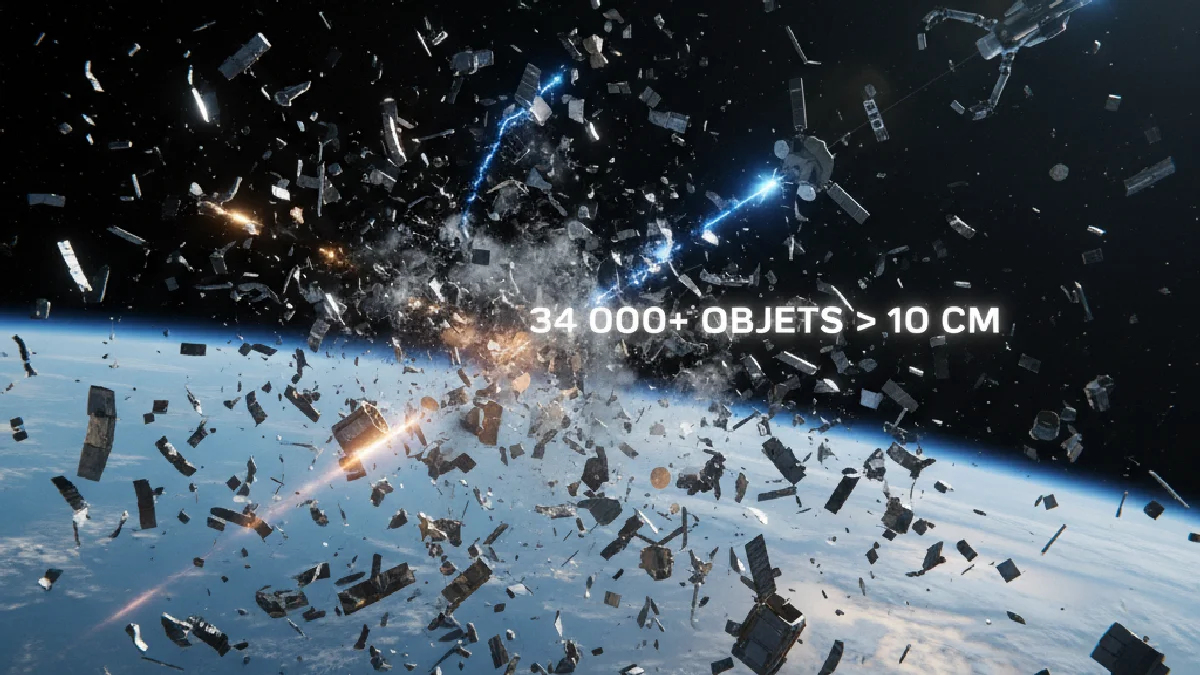
More than 34,000 objects larger than 10 cm currently orbit our planet, transforming low Earth orbit into a veritable minefield. These space debris, remnants of decades of space exploration, now threaten the very future of our orbital activities, as highlighted in the article on the growing threat of low Earth orbit debris. Faced with this growing threat, known as the Kessler Syndrome, a new generation of revolutionary space missions is taking shape: active deorbitation systems.
The urgency has never been greater. Each collision generates thousands of new fragments, creating a chain reaction that could render space unusable for future generations. It is in this critical context that pioneering missions like PRELUDE mark a major technological turning point.
PRELUDE: First Success for the Space Harpoon
The PRELUDE mission, launched by the European Space Agency (ESA) in 2024, constitutes an unprecedented technological demonstration. For the first time in space history, an autonomous craft successfully intercepted and captured a non-cooperative object in orbit using a kinetic energy harpoon.
The revolutionary process revolves around several critical phases:
- High-precision autonomous navigation towards the target
- Localization by optical and radar sensors
- Penetration of the dummy satellite by kinetic harpoon
- Controlled trajectory modification for deorbitation
This demonstration validates a fundamental concept: the combination of advanced technologies can reduce the deorbitation time to a few months, even for debris 10 to 30 centimeters in diameter. A technical feat that paves the way for a new era of space cleaning.
"The PRELUDE mission confirms that active deorbitation is no longer science fiction, but an operational technological reality" - ESA Press Release
The Technological Challenges of Space Capture
Despite this initial success, the technical challenges remain considerable. Capturing non-cooperative objects in orbit requires millimeter precision in an environment where speeds exceed 28,000 km/h.
Critical Orbital Precision
Position uncertainties of a few tens of centimeters can completely compromise a rendezvous mission. Tracking systems must achieve unparalleled precision to ensure interception, particularly for rapidly rotating or irregularly shaped debris.
Diversity of Targets
Unlike PRELUDE's standardized dummy target, real debris exhibits extremely varied characteristics. From metallic fragments to deployed solar panels, each object requires a tailored approach. This diversity forces engineers to develop versatile attachment systems: grapples, nets, robotic arms.

Towards a Fleet of Debris Hunters
The scale of the space challenge requires an industrial approach. According to CNES estimates, approximately 900,000 fragments from 1 to 10 cm and over 128 million smaller fragments currently populate low Earth orbit.
ClearSpace-1 and the New Generation
The ClearSpace-1 mission, planned for 2026, represents the logical evolution of PRELUDE. This European mission will target a real piece of debris: the Vespa adapter left by a Vega mission in 2013. More ambitious than its predecessor, it will test more sophisticated capture technologies on a real 112-kilogram object.
Astroscale's projects complement this approach with concepts of autonomous vehicles capable of handling multiple objects in a single mission. These "space tugs" could revolutionize the economic efficiency of active deorbitation.
Propulsion and Energy Management
Electric propulsion and solid propellant systems are at the heart of these missions. As detailed in the expertise on Hall ion propulsion, these technologies offer the energy efficiency necessary for prolonged orbital maneuvers.
Fuel management remains critical: each final deorbit maneuver consumes precious resources that limit the operational lifespan of hunter vehicles.
The Urgency of the Kessler Syndrome
The Kessler Syndrome, theorized by astrophysicist Donald Kessler in 1978, describes a scenario where the density of debris reaches a critical threshold. Beyond this point, collisions generate more debris than naturally re-enters the atmosphere, creating a self-sustaining chain reaction.
According to Canadian experts, "the critical point has been exceeded for space debris in Earth orbit". This situation makes active deorbitation no longer optional, but vital to preserve access to space.
Consequences of an Uncontrolled Cascade
A Kessler cascade would transform certain orbits into forbidden zones, compromising:
- Satellite communications
- Earth observation for climate and weather
- Space exploration missions
- The development of future space technologies
| Potential Consequence | Impact on Space Activity |
|---|---|
| Communications Cut | Disruption of vital services |
| Earth Observation | Lost climate and weather data |
| Space Exploration | Risky or impossible missions |
| Future Technologies | Hindered space innovation |
Regulatory and Economic Obstacles
Beyond technical challenges, active deorbitation faces complex legal barriers. Current international frameworks require the consent of satellite owners, even if defunct. This legal constraint significantly complicates space cleaning operations.
Costs and Economic Models
The high cost of a fleet of active vehicles capable of dealing with tens of thousands of threatening objects raises the question of funding. Economic models are slowly emerging, combining public funding, private partnerships, and potential taxes on future launches.
The space industry is exploring innovative mechanisms: mandatory insurance, deposit funds for deorbitation, and even concepts of "orbital tolls" to finance collective cleaning.
International Standards and Cooperation
International cooperation becomes crucial to transform technological demonstrations into a global operational system. The automation of deorbitation decisions requires harmonized protocols among major space powers.
Initiatives such as the European space surveillance project aim to create collective governance of the orbital environment. These efforts prepare for the integration of active deorbitation into regular space traffic management. A 2023 Space Challenge report also addresses this topic, highlighting the importance of collaboration.
The future of our space activities now depends on our ability to transform these technological innovations into viable industrial solutions. Missions like PRELUDE mark only the beginning of a race against time where human ingenuity must catch up with decades of space environmental neglect. The window for action is narrowing, but initial technical successes offer concrete hope for preserving space for future generations.