
Magnetars: Stellar Explosions Reveal Their Secrets
Magnetars: Stellar Explosions Reveal Their Secrets
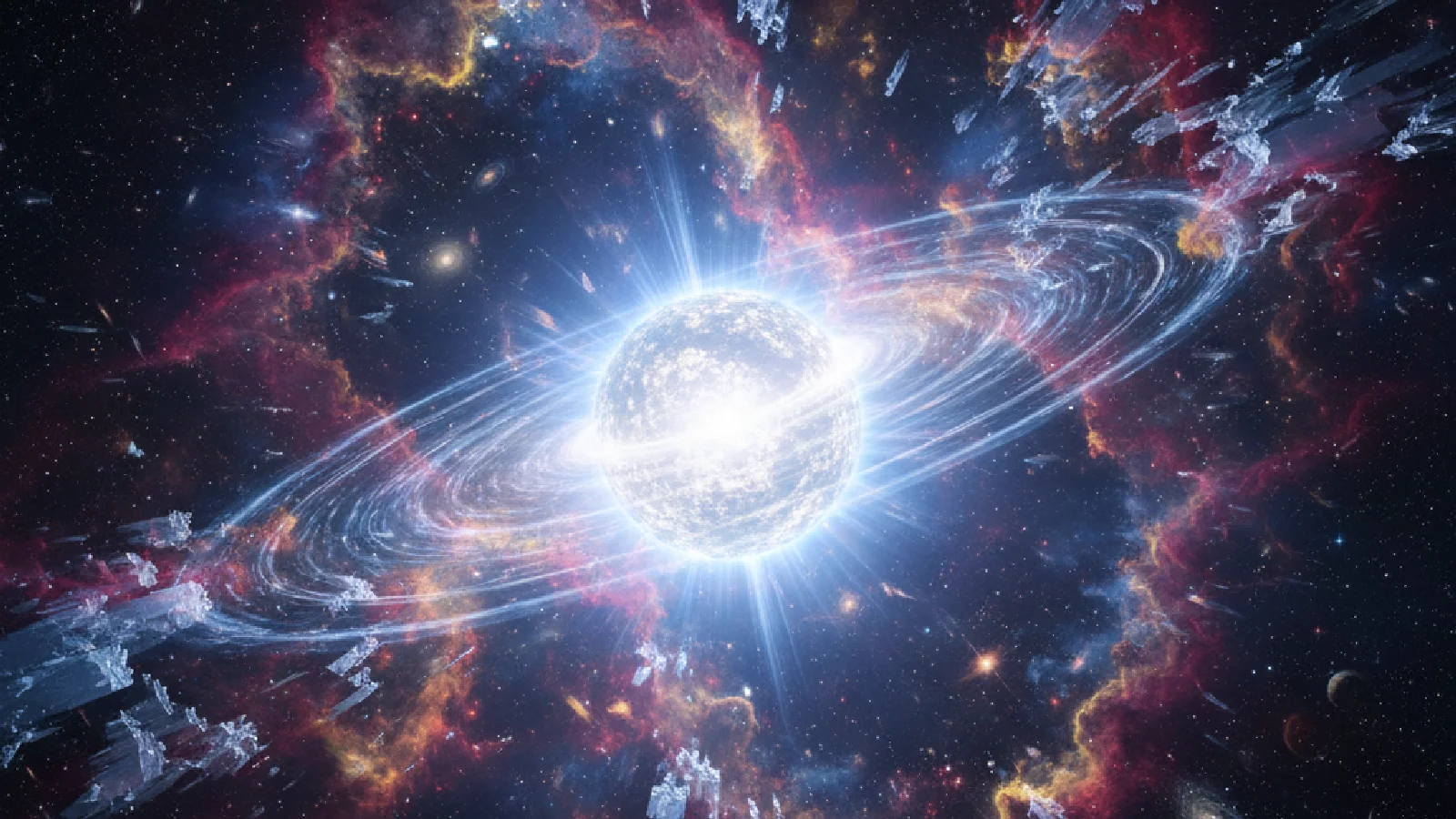
Magnetars are among the most fascinating and mysterious objects in the Universe. These neutron stars, endowed with magnetic fields of unimaginable intensity—millions of times stronger than the most powerful magnets on Earth (Magnetar, Wikipedia)—have long defied our understanding. Today, thanks to observations of very distant stellar explosions, astronomers are finally beginning to unravel the secrets of their formation and extraordinary behavior.
Massive Binary Systems: The Cradle of Magnetars
Recent observations reveal that magnetars often form under very specific conditions. Unlike classical neutron stars formed by the solitary collapse of massive stars, magnetars seem to favor a more complex environment.
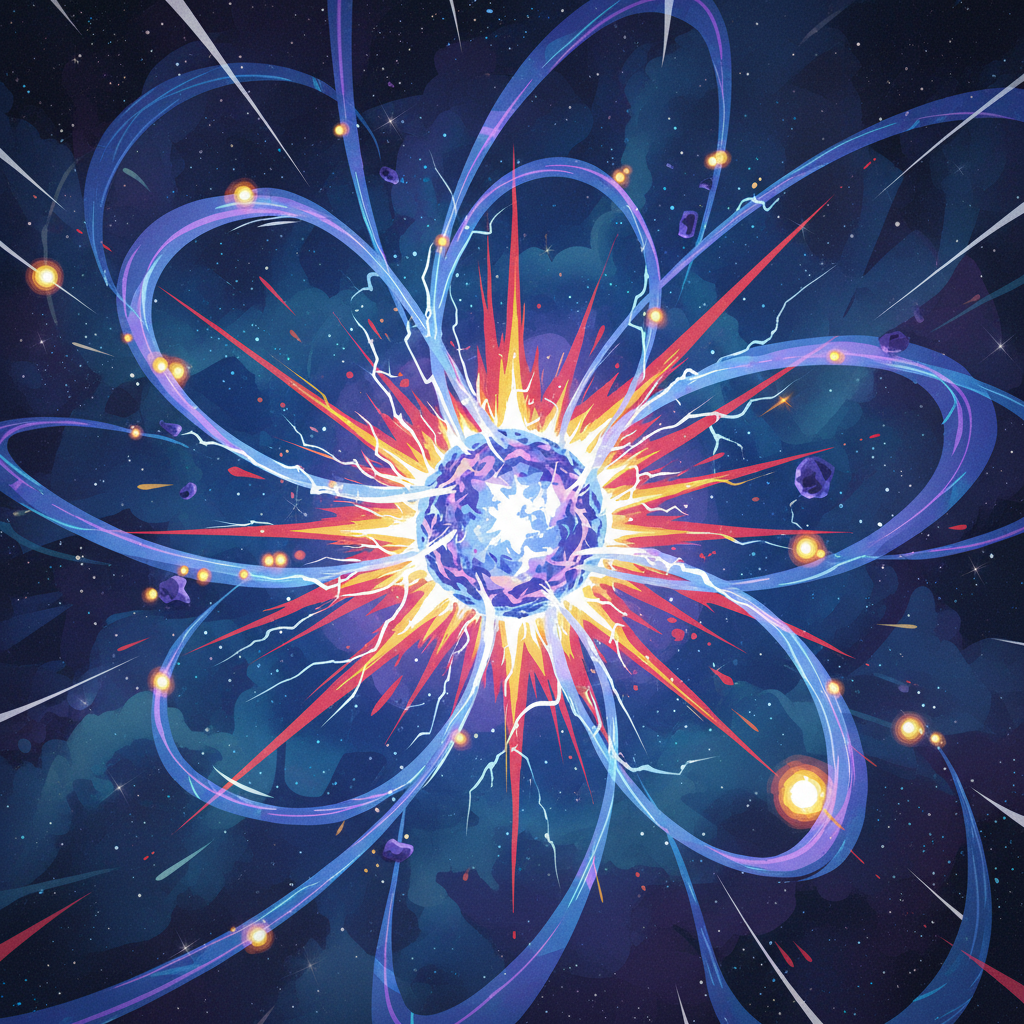
Recent studies show that many magnetars originate from massive binary systems where the heavier star loses its outer envelopes to its companion. This mass transfer process significantly accelerates the rotation of the receiving star before its final collapse.
This accelerated rotation creates ideal conditions for generating an extreme magnetic field through a Tayler-Spruit dynamo mechanism. This cosmic generator, fueled by the accretion of matter that falls back after the initial explosion, explains why some neutron stars develop such intense magnetic fields. To learn more about stellar dynamics, see our article on black hole mergers.
The Mystery of Low-Field Magnetars Solved
One of the most surprising discoveries concerns the existence of low-field magnetars. These seemingly contradictory objects are now explained by the same formation mechanism as their ultra-magnetic cousins (The enigma of magnetar formation finally solved?, ESO).
The difference lies in the intensity of the accretion process after the explosion. According to current theoretical models, the dynamo generator can produce variable magnetic fields depending on:
- The amount of matter that falls back after the explosion
- The initial rotation speed of the star
- The duration of the accretion process
This understanding finally unifies the magnetar family under a single theoretical framework, solving an enigma that had persisted for decades.
Cataclysmic Eruptions and Starquakes
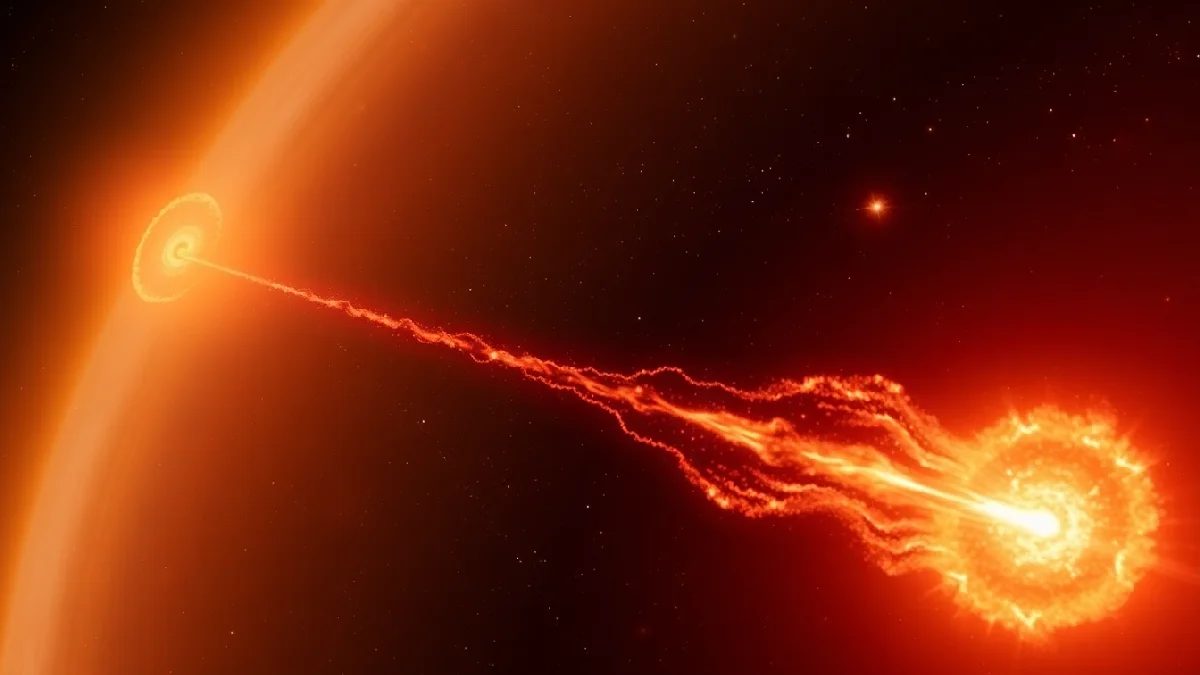
Recent observations have also provided a better understanding of the spectacular eruptions of magnetars. These explosions release phenomenal amounts of energy, capable of affecting Earth's atmosphere even from across the galaxy (Structure and evolution of the Universe - CEA-Irfu).
"The explosion of the magnetar SGR 1806-20 recorded in 2004 released more energy in a tenth of a second than our Sun produces in 100,000 years" - Swift satellite observations
These events result from major mechanical stresses in the ultra-dense crust of magnetars. When the pressure becomes unbearable, the surface undergoes true "starquakes" that instantly release colossal energy in the form of gamma and X-rays.
Astronomers have discovered that these eruptions can even synthesize heavy elements like gold and platinum, thus contributing to the chemical enrichment of the Universe.
Rotational Anomalies and Internal Structure
A particularly intriguing phenomenon observed in some magnetars is "anti-anomaly" braking. Unlike classical neutron stars that sometimes abruptly accelerate their rotation, some magnetars exhibit sudden slowdowns.
These unexpected rotational variations reveal crucial information about the internal structure of these extreme objects. McGill researchers have identified these anomalies as signatures of the possible presence of superfluids in the core of magnetars.
The implications are considerable for our understanding of matter under conditions impossible to reproduce on Earth, with densities exceeding that of atomic nuclei.
Fast Radio Bursts: Magnetars Speak
One of the most recent revelations concerns the link between magnetars and mysterious fast radio bursts (FRBs). Observations from the CHIME telescope have shown that at least some of these enigmatic signals indeed originate from nearby magnetars.
This discovery has opened a new window of observation into these extraordinary objects. FRBs now offer astronomers a way to study magnetars in real-time, revealing their dynamic properties with unprecedented precision.
Towards a Global Understanding
Recent advances paint a coherent picture of magnetar formation and behavior. Stellar collapse dynamics, envelope fallback, and binary interactions appear to be the key elements of this revolutionary understanding.
| Key Concept | Role in Magnetar Formation |
|---|---|
| Massive binary systems | "Cradle" of magnetars, heavier star loses mass. |
| Accelerated rotation | Creates ideal conditions for the magnetic field via the Tayler-Spruit dynamo. |
| Tayler-Spruit dynamo | Generates the extreme magnetic field based on matter accretion. |
| Post-explosion accretion | Determines magnetic field intensity (low-field or high-field magnetars). |
These discoveries transform our view of the Universe's most extreme objects and open new perspectives for high-energy astrophysics. Magnetars are no longer just cosmic curiosities, but essential natural laboratories for understanding physics under extreme conditions, as we will see in the latest universe news.
Future observations with next-generation telescopes promise to reveal even more secrets about these extraordinary cosmic magnets, solidifying our understanding of the Universe's most violent processes.