Roman and Webb: Unprecedented Synergy to Unravel Dark Energy
Dark energy remains one of the most fascinating enigmas in modern cosmology. Invisible and mysterious, it accounts for nearly 70% of the universe according to current estimates, but its influence on cosmic expansion still raises many questions. Two next-generation space telescopes, the Nancy Grace Roman and the James Webb, are poised to transform our understanding of this phenomenon through an unprecedented collaboration.
Roman: The Large-Scale Universe Mapper
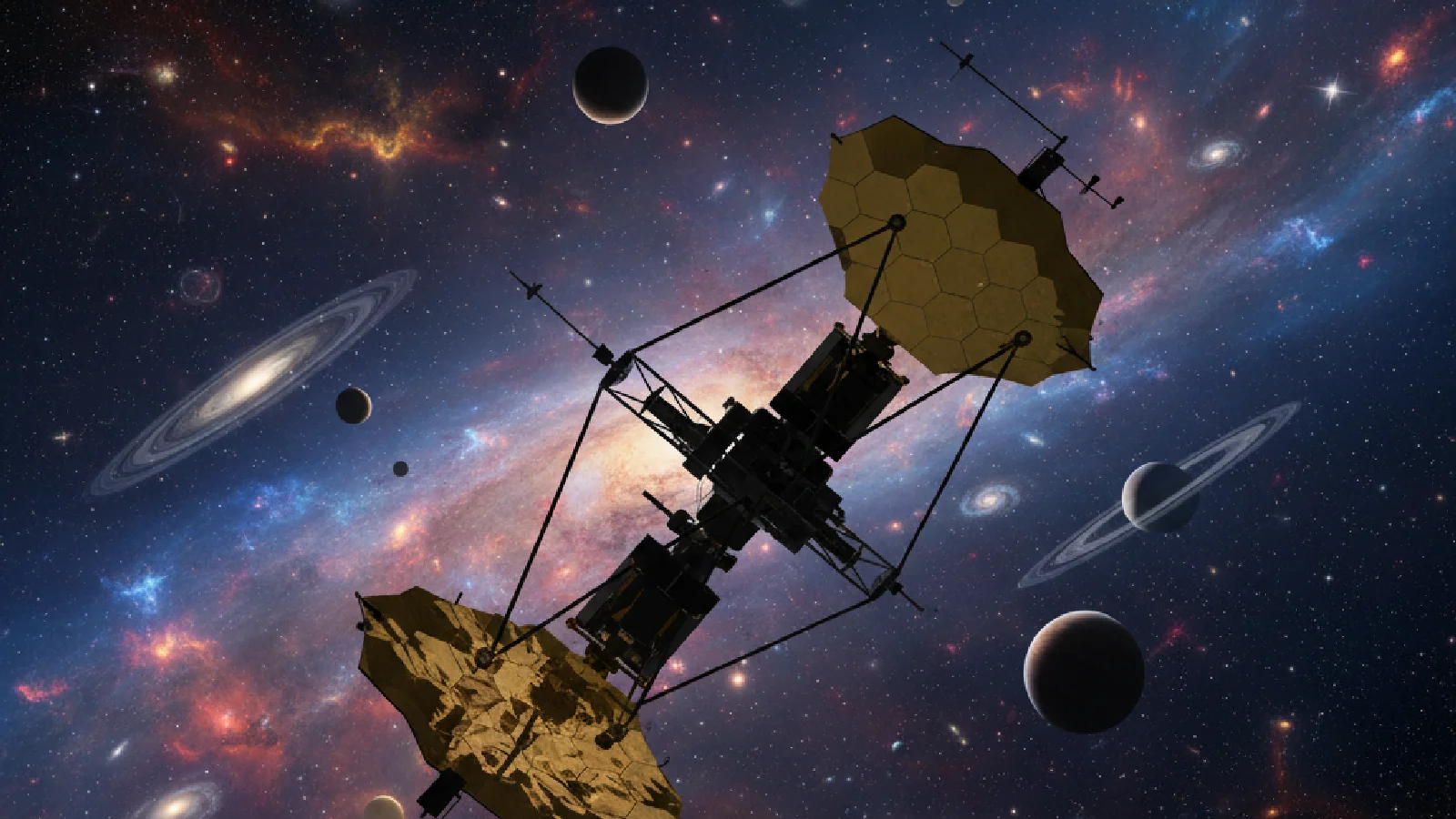
The Nancy Grace Roman Space Telescope), scheduled for launch in 2027, will revolutionize the study of dark energy through its massive statistical approach. With an exceptionally wide field of view – 100 times larger than Hubble's – this space observatory, also known as Nancy Grace Roman, will be able to map hundreds of millions of galaxies with remarkable precision.
Its main capabilities include:- Near-infrared imaging across vast areas of the sky
- Weak gravitational lensing measurements to trace dark matter distribution
- Monitoring Type Ia supernovae as cosmic standard candles
- Analysis of baryonic acoustic oscillations in galactic distribution
This large-scale approach will allow Roman to set global cosmological parameters with unparalleled precision, establishing a robust statistical framework for understanding the evolution of dark energy over billions of years.
Webb: The Expert in Early Cosmic Details
The James Webb, already operational, provides a complementary perspective thanks to its exceptional spectroscopic resolution and its ability to observe in the far-infrared. This unique combination allows it to probe the earliest epochs of the universe, where dark energy might reveal its oldest secrets.
"We can't see it directly, or at least we can't see it easily, so we call it 'dark'... it acts like another form of energy in the universe" - Jonathan Blazek, Northeastern University
Webb excels at observing early galaxies and very high-redshift supernovae, offering clues about the behavior of dark energy in the early universe. Its spectral precision allows for the detection of subtle variations that could indicate an evolution of dark energy over cosmic time.
The Revolutionary Complementarity of Both Approaches
The alliance between Roman and Webb creates remarkable scientific synergy. While Roman provides the massive statistics needed to establish general cosmological trends, Webb brings the fine resolution essential for understanding the underlying physical mechanisms.
This bidirectional collaboration allows for:
Cross-validation of measurements
Roman's large-scale observations can be compared with Webb's detailed measurements of individual objects, ensuring consistency between statistical approaches and in-depth analyses.
Constraining evolving dark energy models
The combination of data allows testing whether dark energy remains constant or evolves over time, a crucial question for our understanding of fundamental physics.
Reduction of systematic uncertainties
Both telescopes use different observation methods, allowing for the identification and correction of potential biases inherent in each approach.
A New Era for Observational Cosmology
The first data from the Dark Energy Survey, the result of six years of observations by a collaboration of over 400 scientists, has already strengthened the current cosmological model. Roman's arrival will multiply these capabilities by several orders of magnitude.
This new generation of instruments could notably solve enigmas such as the Hubble tension – the discrepancy between local and global measurements of the universe's expansion rate. Some models suggest that variable dark energy could simultaneously explain this tension and the early existence of large galaxies observed by Webb.
| Feature | Nancy Grace Roman Space Telescope | James Webb Space Telescope |
|---|---|---|
| Field of View | 100 times larger than Hubble | Exceptional spectroscopic resolution |
| Primary Target | Large-scale mapping, massive statistics | Observation of early and distant objects |
| Launch Date | Scheduled for 2027 | Operational |
Implications for Fundamental Physics
Beyond simple cosmological mapping, this Roman-Webb synergy opens up perspectives on the very nature of dark energy. Current theoretical models include various hypotheses: cosmological constant, dynamic scalar fields, or even the emergence of string theory.
Roman's ability to observe the effect of dark energy over vast volumes of the universe, combined with Webb's precision on the most distant objects, will allow distinguishing between these different theories with unprecedented accuracy.
This complementary approach is part of a broader scientific endeavor, where missions like the Roman telescope for exoplanet hunting and innovations in space propulsion are revolutionizing our exploration of the universe.
Towards a Unified Understanding of the Universe
The Roman-Webb association represents a major turning point in our quest to understand dark energy. By combining the respective strengths of these two observatories – one for the big picture, the other for fine details – the scientific community finally has tools commensurate with the immensity of the mystery to be elucidated.
This synergy could well be the key that will finally allow us to unravel one of the greatest mysteries of the universe, transforming our view of the cosmos and our place within it.