Europa and Enceladus: NASA Unveils Missions to Probe Their Oceans
Beneath the thick ice layers of Europa and Enceladus, two moons orbiting Jupiter and Saturn respectively, lie oceans that could harbor the necessary conditions for life. NASA is now taking a decisive step: after decades of distant observation, the American space agency is deploying an arsenal of sophisticated missions specifically designed to probe these ocean worlds and search for traces of extraterrestrial biology, a quest that could revolutionize our understanding of the habitability of celestial bodies.
The strategy revolves around a progressive approach: high-resolution orbital reconnaissance, followed by landing missions equipped with miniaturized laboratories capable of directly analyzing ice and materials ejected by active geysers. The goal is no longer just to assess the habitability of these environments, but to shift towards a direct search for biosignatures.

Europa Clipper: The Great Reconnaissance of Jovian Oceans
Launched in 2024, the Europa Clipper probe represents the first major mission dedicated to the close-up exploration of Europa. Its arrival in the Jovian system is planned for the early 2030s, where it will perform a series of low-altitude flybys of this icy moon, thus avoiding prolonged exposure to Jupiter's intense radiation.
The mission carries an unprecedented suite of instruments to unlock the secrets of this ice shell, several kilometers thick. The REASON (Radar for Europa Assessment and Sounding: Ocean to Near-surface) ice-penetrating radar will map the thickness of the ice shell and identify potential water-filled conduits connecting the deep ocean to the surface. A magnetometer will deduce the salinity of the subsurface ocean by measuring induced magnetic fields, while a thermal imager will search for areas of geological activity.
The MASPEX (MAss SPectrometer for Planetary EXploration) instrument is the key asset for detecting organic molecules. This ultra-sensitive mass spectrometer will analyze the plumes of water vapor that periodically escape from Europa's surface, searching for trace organic compounds, amino acids, and gases potentially resulting from metabolic activity.
Data collected by Europa Clipper will identify the most promising sites for a future landing mission, where drilling could directly access the subglacial ocean.
In parallel, the European JUICE (Jupiter Icy Moons Explorer) mission, launched in April 2023, will also arrive in the Jovian system in 2031. Although primarily focused on Ganymede, JUICE will perform several flybys of Europa, complementing Clipper's observations with its own radar and spectrometric instruments, as part of the broader exploration of planets and icy moons.
| Mission | Primary Target | Launch Date | Main Objective | Role for Europa |
|---|---|---|---|---|
| Europa Clipper | Europa | 2024 | Close-up exploration of Europa | Detailed surface observations |
| JUICE | Ganymede | 2023 | Exploration of Jupiter's icy moons | Europa flyby, complementary information |
Europa Lander: The Extraterrestrial Chemistry Lab
Building on reconnaissance data, the Europa Lander project is planned for the second half of the 2030s. This landing mission represents a qualitative leap in the search for extraterrestrial life: it will bring a true analytical chemistry laboratory to Europa's surface.
The lander will carry several revolutionary instruments:
- A micro-driller capable of penetrating several meters into the ice to collect samples from beneath the irradiated surface layer.
- A gas chromatograph coupled with a high-sensitivity mass spectrometer to identify complex organic molecules.
- A life detection microscope designed to spot cellular structures, nucleic acids, and characteristic isotopes of biological activity.
- A seismometer to probe the internal structure and detect geological activity.
Terrestrial contamination represents the major challenge for this mission. The development of ultra-clean sampling systems, capable of guaranteeing the absence of terrestrial microbes, is currently mobilizing engineering teams. According to research on the distribution of organic matter in the solar system, the detection of reliable biosignatures requires extremely rigorous analysis protocols to distinguish prebiotic chemistry from true biological signatures.
Enceladus: Geysers Delivered to Your Doorstep
On Saturn's side, the small moon Enceladus offers a spectacular advantage: its active geysers directly eject the contents of its internal ocean into space. First observed by the Cassini probe, these plumes escaping from fissures at the south pole provide a natural window into the moon's liquid depths.
NASA is developing two complementary mission concepts to exploit this unique opportunity. The Enceladus Life Finder (ELF) project would focus on repeated passes through these plumes, collecting and analyzing their composition with next-generation instruments. An improved time-of-flight mass spectrometer would measure chiral molecules (whose spatial orientation could betray a biological origin), complex organic compounds, and isotopic ratios of noble gases.
The Enceladus Orbilander concept goes even further: after an orbital phase of plume analysis, the craft would land on the icy surface near the active fissures. A landing system adapted to Enceladus's low gravity would allow for the deployment of a cryogenic plume condensate capture device and a drill to penetrate the ice crust.
The most audacious innovation lies in the integration of a nanopore detector, inspired by miniaturized DNA sequencers used on Earth, capable of identifying complex polymers that could constitute biological signatures. These missions to Enceladus could be launched in the 2030s, taking advantage of favorable launch windows to the Saturnian system.
Key Technologies: Seeing Through Ice and Autonomous Navigation
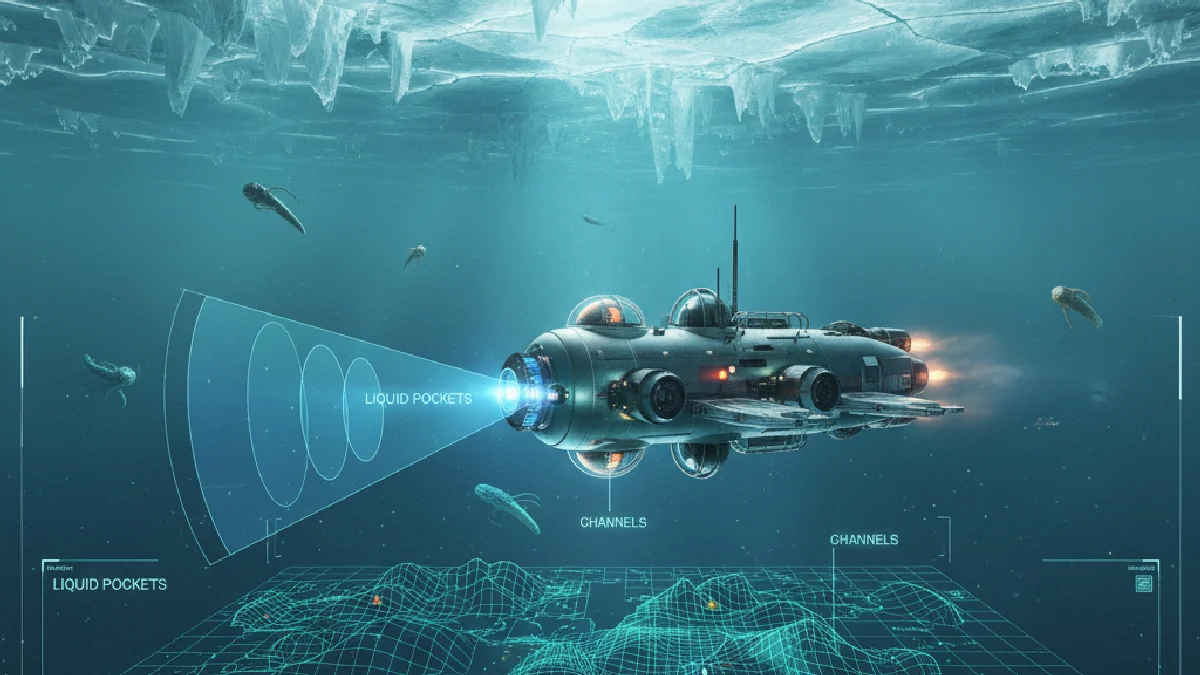
The exploration of these ocean worlds necessitates the development of breakthrough technologies. High-frequency radars for subglacial mapping are a priority. These instruments must penetrate several kilometers of ice while distinguishing interfaces between layers, liquid pockets, and circulation channels.
Autonomous navigation represents another major challenge. Close flybys of Europa or passages through Enceladus's plumes require metric precision, impossible to achieve with Earth-probe communication delays (between 40 minutes and over an hour depending on the planets' positions). Onboard systems will need to identify geological structures in real-time, adjust their trajectory, and select priority analysis targets.
As the Académie de l'air et de l'espace highlights in its analysis of space exploration, maintaining momentum in these ambitious programs requires not only technological advancements but also a clear strategy and sustained public support in the face of necessarily long costs and timelines.
From Terrestrial Ice to Extraterrestrial Oceans
Extreme terrestrial environments provide valuable analogues for preparing these missions. Subglacial lakes in Antarctica, isolated for millions of years under several kilometers of ice, present conditions similar to those of Europa. Drilling in these environments has allowed for testing sterile sampling protocols and verifying that microbial ecosystems can thrive in total darkness, fueled by rock chemistry rather than photosynthesis.
Terrestrial oceanic hydrothermal vents, where life teems around chimneys spewing fluids heated by geological activity, serve as a model for the ocean floors of Europa and Enceladus. Water-rock interactions there could provide the chemical energy necessary for metabolisms independent of sunlight.
These terrestrial comparisons guide the design of detection instruments: rather than exclusively searching for familiar structures, the missions are equipped to identify chemical imbalances, abnormal concentrations of certain molecules, or isotopic ratios incompatible with purely geochemical processes.
Timeline and Prospects: A Two-Decade Quest
The exploration timeline for these icy moons spans the next two decades. Europa Clipper kicks off with its anticipated arrival around 2030-2031, closely followed by JUICE. The first detailed scientific data should be available by the mid-2030s, informing the final design of Europa Lander.
For Enceladus, the timeline will depend on budgetary decisions and the results of the Jovian missions. An Orbilander-type mission could be launched in the late 2030s, with an arrival in the Saturnian system in the early 2040s.
This gradual approach reflects scientific caution: each mission refines the questions for the next, reducing risks and optimizing the chances of detection. Unlike missions to the Moon or asteroid exploitation, where economic and strategic stakes accelerate deadlines, the search for extraterrestrial life in icy oceans prioritizes methodological rigor.
The stakes extend far beyond the scientific realm. The discovery of a form of life, even microbial, in an extraterrestrial ocean would revolutionize our understanding of life's place in the universe. If biology can emerge independently on two bodies in the same solar system, it would suggest that habitable worlds are likely numerous throughout the galaxy.