Race to the Lunar South Pole: Strategic Stakes of a Conquest
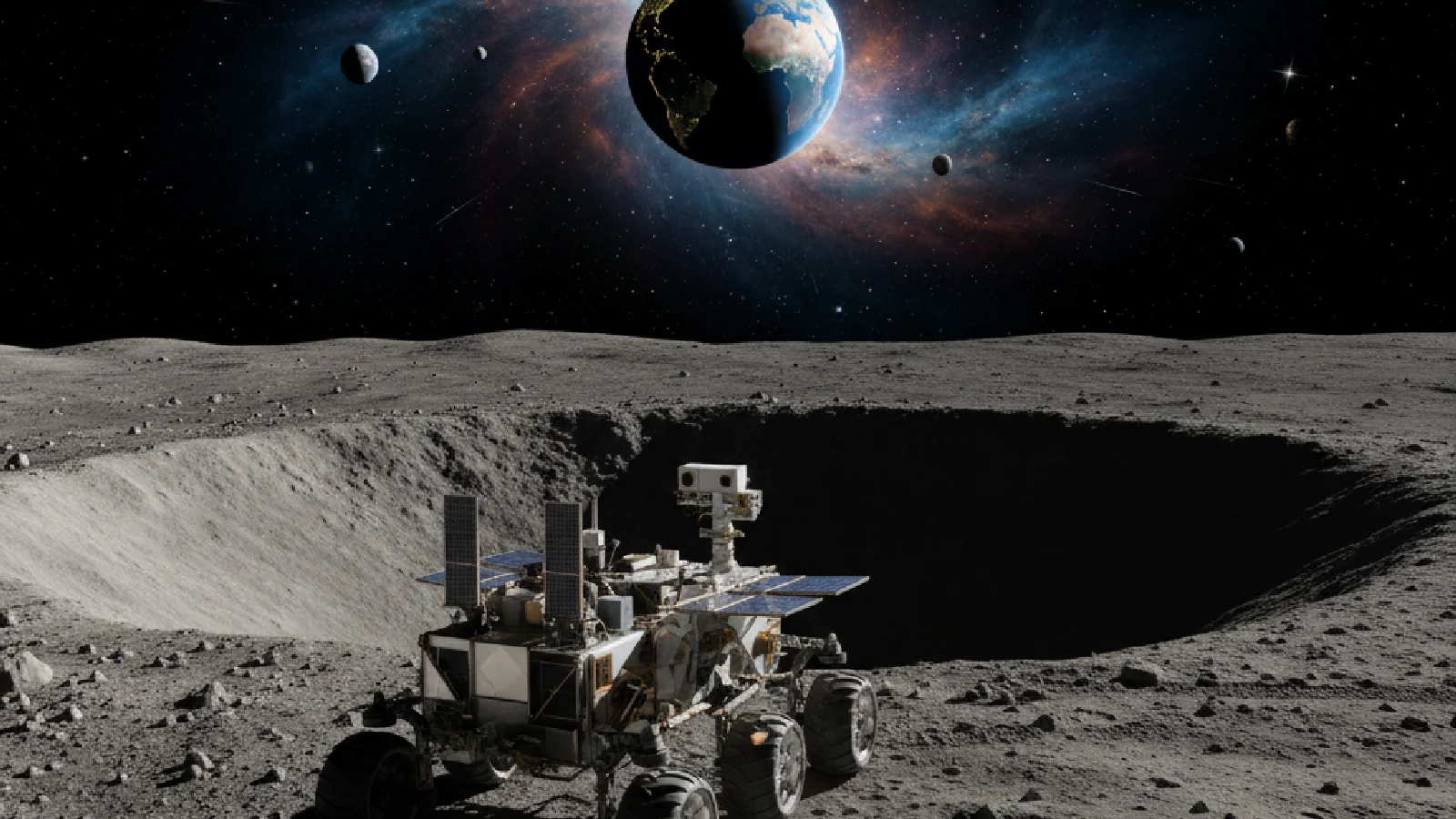
When the Chandrayaan-3 lander touched down near the lunar South Pole in July 2023, and then the Chang'e-6 probe returned to Earth in June 2024 with samples from the far side, two space powers reached a symbolic milestone. These successes are not merely technical feats: they usher in a new era of space competition, where lunar resources become a major strategic issue. The South Pole of our natural satellite, with its water-ice reserves buried in perpetually shadowed craters, is now the focus of all covetousness.
The Lunar South Pole: A Coveted Strategic Treasure
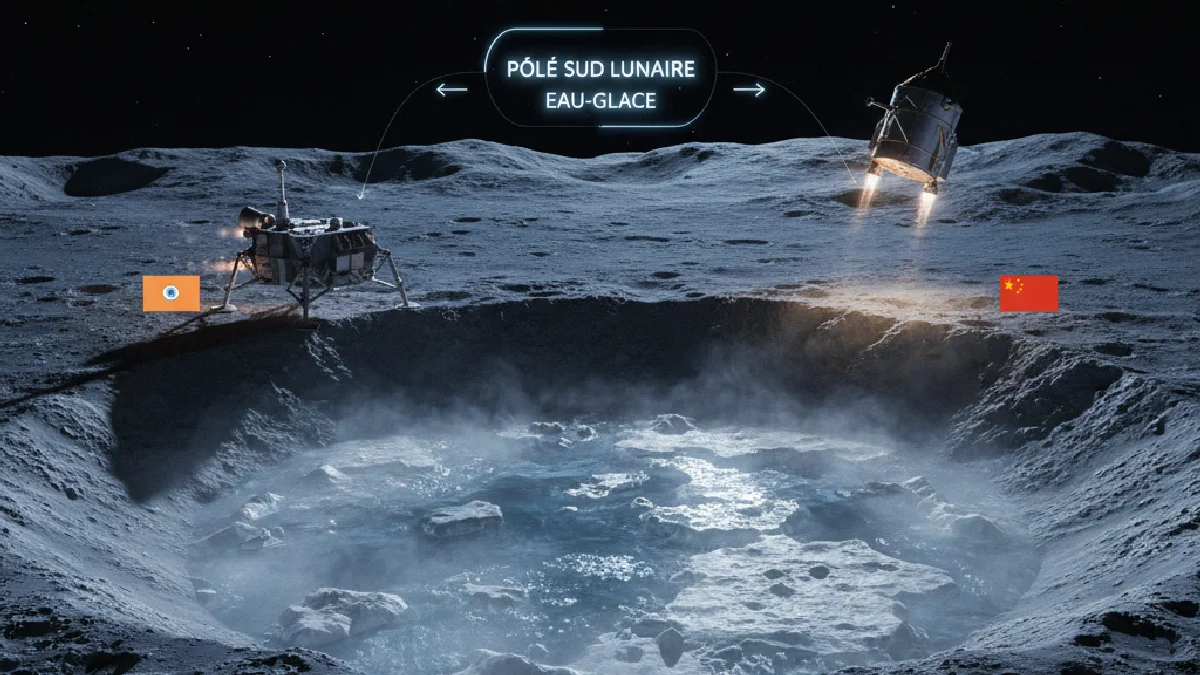
The main asset of the lunar South Pole lies in its water-ice deposits, buried in craters that have never been exposed to direct sunlight. This ice represents much more than a mere scientific curiosity: it is the key to establishing sustainable human presence on the Moon.
Water can be broken down into hydrogen and oxygen, allowing for the production of rocket fuel directly on site. This capability would transform the Moon into a space gas station, drastically reducing the cost of missions to Mars or asteroids. It would also provide potable water and breathable oxygen for future lunar colonies.
The Chandrayaan-3 mission confirmed the presence of these reserves in the lunar regolith, demonstrating India's ability to map and prospect these valuable resources. This technological prowess positions New Delhi as a credible player in lunar exploration, alongside the United States and China.
Chang'e-6: When the Far Side Reveals Its Secrets
By bringing back samples from the far side of the Moon, China achieved a historic milestone. The Chang'e-6 mission revealed traces of olivine mixed with asteroid impact residues, providing new data on the composition of the lunar subsurface. According to Le Monde, these discoveries shed light on the geological processes that shaped our satellite.
China's mastery of sample collection and return from geologically complex sites demonstrates a clear technological advantage. This ability to operate on the far side — where direct communication with Earth is impossible — testifies to a sophistication that worries other space powers.
The Chang'e-6 mission confirmed China's ability to conduct complex operations on inaccessible lunar sites, marking a decisive step in the race for space resources.
The next step is already planned: Chang'e-7, scheduled for late 2026, will directly target the South Pole to prospect for exploitable resources.

A New North-South Competition Axis
Unlike the 1960s lunar race, which focused on US-Soviet rivalry, the current competition redraws the geographical and political map of space exploration. As The Conversation highlights, a North-South competition axis is emerging, where nations like India, China, and soon other Asian and Global South countries are claiming their place.
This dynamic profoundly alters the balance. Space programs are no longer the exclusive preserve of a few Western superpowers. India, with its relatively modest space budget but remarkable efficiency, proves that an emerging power can compete with established giants.
The United States responds with the Artemis program, which plans for astronauts to return to the Moon by 2028. But Artemis is no longer a solitary initiative: it mobilizes international partners and integrates private actors like SpaceX. This collaborative approach contrasts with China's strategy, which is more focused on technological autonomy and selective partnerships with Russia or certain developing countries.
Comparison of Space Approaches
| Aspect | Artemis Program (USA) | Chang'e (China) & Chandrayaan (India) Programs |
|---|---|---|
| Philosophy | International collaboration, private actors | Technological autonomy, selective partnerships |
| Objectives | Return of astronauts, collaboration, ISRU exploitation | Sample collection, ISRU prospecting |
| Partners | Over 30 signatory countries of the Artemis Accords, SpaceX | Russia, certain developing countries |
In-Situ Resource Utilization Technologies: The Decisive Factor
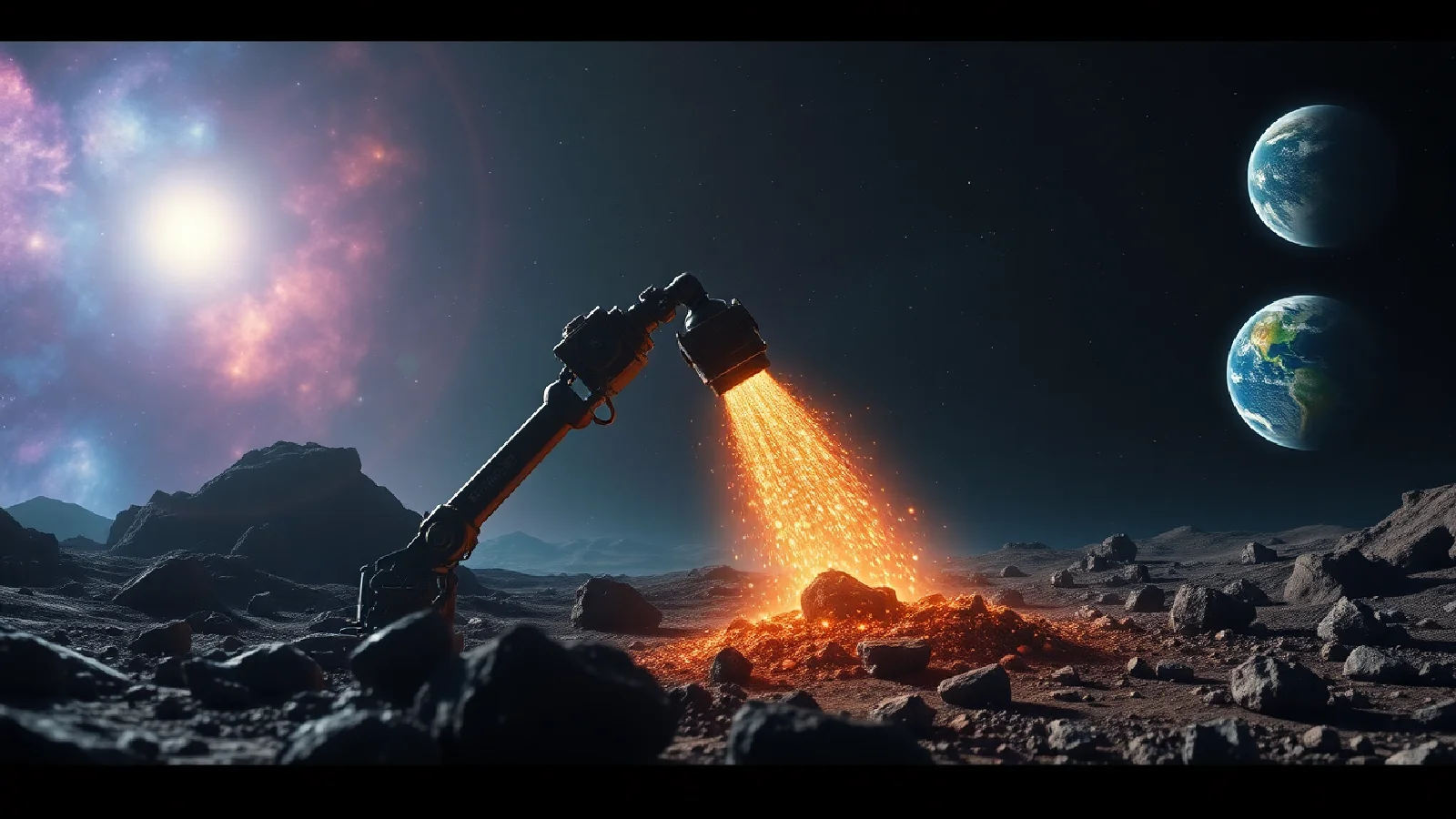
The ability to exploit lunar resources on site is becoming the differentiating factor in this new space race. In-Situ Resource Utilization (ISRU) technologies allow ice to be transformed into water, oxygen, and fuel, reducing dependence on Earth-based supplies.
These technologies include:
- Ice extraction from polar craters by drilling or heating
- Water electrolysis to separate hydrogen and oxygen
- Additive manufacturing using lunar regolith as construction material
NASA and the Chinese Space Agency are investing heavily in these technologies. Upcoming missions — Chang'e-7, Artemis III, Chandrayaan-4 — will all aim to test prototypes for extracting and processing lunar resources. The first actor to master these processes on a large scale will gain a considerable strategic advantage, particularly for asteroid mining technologies that will build on these innovations.
Space Legal Framework in Question
The intensification of lunar activity raises unprecedented legal questions. The 1967 Outer Space Treaty prohibits national appropriation of celestial bodies but remains vague on the commercial exploitation of resources.
In 2015, the United States passed a law authorizing its private companies to exploit space resources. It then launched the Artemis Accords, a parallel legal framework signed by some thirty countries, which promotes transparency and establishes "safety zones" around lunar installations. China and Russia have not adhered to it, preferring to work on a bilateral lunar station.
This fragmentation of space law is concerning. Should the 1967 Treaty be revised? Should an international regulatory authority be created? Should common rules for exploitation be defined? The answers to these questions will determine whether the Moon becomes a field of cooperation or exacerbated rivalry.
Some specialists advocate for a regime similar to that of international seabeds, with benefit sharing. Others defend a more liberal model, inspired by terrestrial mining law. Between these opposing visions, the risk of a legal vacuum grows as technical capabilities advance.
Prospects: Cooperation or Confrontation?
The proliferation of space actors makes cooperation both more necessary and more difficult. Scientific stakes would argue for pooling efforts: understanding the Moon's origin, studying its water resources, preparing for Martian exploration. However, geopolitical logics push towards competition.
The next decade will be decisive. If the Artemis (linfo.re), Chang'e (SciencePresse and Cité de l'espace) and Chandrayaan programs achieve their objectives, several lunar bases will coexist at the South Pole by 2035. How will these installations interact? Will they share scientific data? Will they coordinate their operations to avoid interference?
The history of the International Space Station (ISS) shows that lasting cooperation is possible, even between geopolitical rivals. But the ISS was built in a post-Cold War context, which is now over. Will the Moon of the 21st century be a field of peaceful sharing or a new theater of confrontation? The answer will depend as much on political choices as on technical successes.
The race to the lunar South Pole has only just begun, and it is already redefining global balances. As humanity extends its presence beyond Earth, the decisions made today on the governance of space resources will shape tomorrow's international order. Between cooperation and competition, the Moon crystallizes the ambitions and tensions of a changing world, where outer space becomes a strategic issue as crucial as the oceans or cyberspace. The upcoming missions, whether Chinese, Indian, or American, will write the first pages of this new space epic, with the fundamental question in the background: to whom do the resources of space belong?