
Tech News Digest on the Eve of 2026
The year 2025 is drawing to a close, and today's weak signals are becoming tomorrow's dominant trends. With just weeks until 2026, the global technological landscape is transforming at a dizzying pace. R&D investments are reaching historic highs, with over $2.4 trillion allocated to emerging technologies this year, according to the latest industry reports.
This technological revolution is no longer confined to Silicon Valley giants. It now extends to all sectors of activity, redefining our working methods, communication styles, and even our vision of innovation. Companies that can anticipate these changes will gain a decisive competitive advantage for the coming decade.
From spectacular advances in generative artificial intelligence to the first concrete applications of quantum computing, 2026 promises to be a pivotal year. Let's explore together the main trends that will shape our immediate technological future.
Generative Artificial Intelligence Reaches Maturity
More Powerful and Accessible Models
Generative AI reaches a new milestone in 2026 with the emergence of multimodal models capable of simultaneously processing text, image, video, and audio. According to Gartner, 85% of companies will integrate generative AI solutions into their business processes by the end of the year.
Usage costs have dropped by 70% compared to 2024, democratizing access to these technologies for SMEs. OpenAI, Anthropic, and Google now offer models optimized for specific use cases, reducing computational power requirements.
New Sectoral Applications
- Healthcare: AI-assisted diagnosis with a 94% accuracy rate
- Education: Personalized virtual tutors reaching 12 million students
- Finance: Real-time predictive risk analysis
- Creative: Automated marketing content generation for 60% of agencies
This democratization is accompanied by a professionalization of practices, as we observed in our analysis of the revolution in AI-assisted development.
"Generative AI is no longer an experimental tool but is becoming a strategic pillar of digital transformation" - Jensen Huang, CEO of Nvidia

Collaborative Robotics Transforms Industry
Intelligent and Adaptable Robots
The collaborative robotics market is exploding with 43% growth this year. These new robots, equipped with advanced AI, adapt in real-time to their environment and collaborate naturally with humans. Tesla, Boston Dynamics, and ABB are deploying solutions that are revolutionizing production lines.
Next-generation cobots integrate autonomous learning capabilities, reducing programming times by 80%. This evolution allows manufacturing companies to achieve unprecedented operational flexibility.
Impact on Employment and Skills
| Sector | Jobs Created | Jobs Transformed | Investment (Millions €) |
|---|---|---|---|
| Automotive | 85,000 | 320,000 | 2,400 |
| Logistics | 62,000 | 180,000 | 1,800 |
| Healthcare | 35,000 | 95,000 | 950 |
| Agri-food | 28,000 | 140,000 | 1,200 |
This transformation is accompanied by a massive need for training, with 2.3 million professionals needing to acquire new skills by the end of 2026.
Expanding Service Robots
Service robots are massively entering public and private spaces. Airports, hospitals, and shopping centers are deploying robotic assistants capable of natural interactions. The market reaches $18 billion this year, driven by improved conversational interfaces.
Cybersecurity: The Post-Quantum Era Begins
Emerging Threats and New Vulnerabilities
2025 confirmed the urgency of strengthening cybersecurity with a 67% increase in sophisticated cyberattacks. The emergence of quantum computing forces a complete overhaul of current encryption systems. Companies are investing heavily in post-quantum cryptography.
Adversarial AI attacks are multiplying, requiring the deployment of adaptive defense systems. The average cost of a data breach now reaches $4.88 million, pushing organizations towards preventive approaches.
Innovative Solutions and Zero Trust
- Zero Trust Architecture adopted by 78% of large companies
- Defensive AI capable of detecting 99.2% of threats in real-time
- Generalized multimodal biometric authentication
- Homomorphic encryption securing data during processing
This security evolution aligns with the concerns we analyzed regarding the future of autonomous technologies and their implications.
Cloud and Edge Computing: A New Architecture
Decentralization and Performance
Edge computing matures with the deployment of 5.2 million edge computing points worldwide. This hybrid architecture reduces latency by 85% for critical applications while optimizing bandwidth costs.
Hyperscalers (AWS, Azure, Google Cloud) are repositioning their offerings towards edge-native solutions, enabling local processing of sensitive data. The edge computing market reaches $87 billion this year.
Sustainability and Energy Efficiency
| Metric | 2024 | 2025 | 2026 Target |
|---|---|---|---|
| Average PUE datacenters | 1.58 | 1.41 | 1.25 |
| Renewable energy (%) | 42% | 58% | 75% |
| AI Efficiency (TOPS/W) | 156 | 284 | 450 |
Green data centers integrate innovative cooling technologies and 100% renewable energy sources. Microsoft announces the carbon neutrality of its cloud infrastructure by the end of 2026.
Extended Reality: Towards Pragmatic Metaverse
Mature Professional Applications
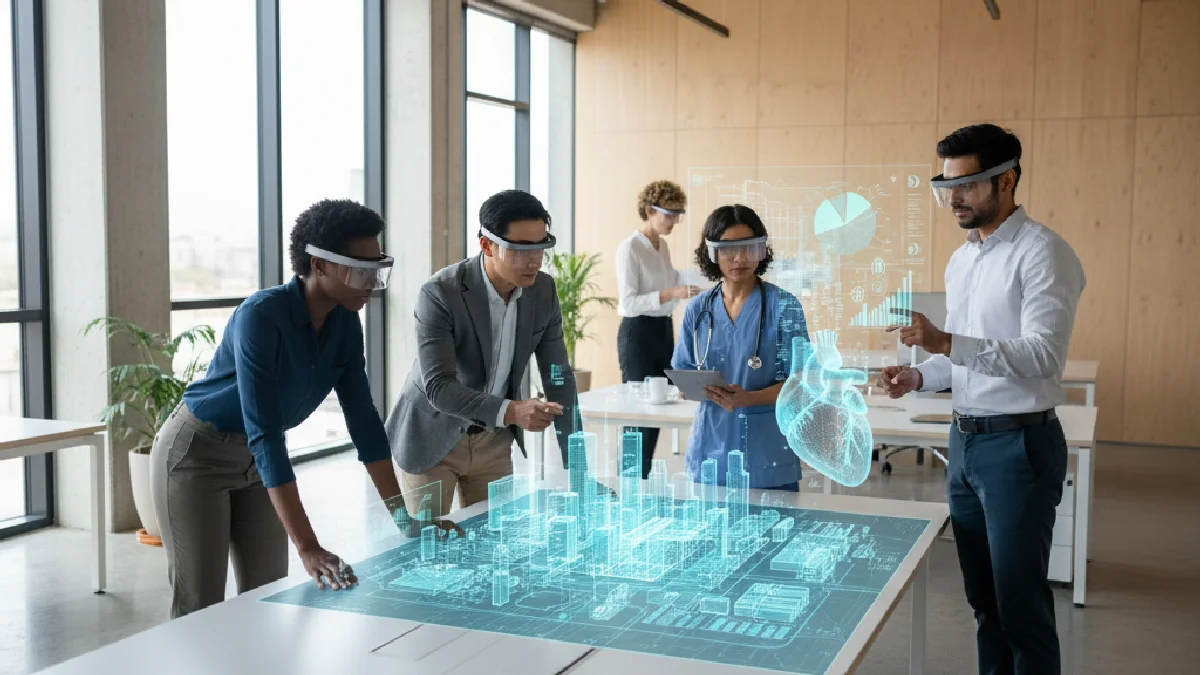
Extended Reality (XR) finally finds its concrete applications in business. Immersive training, assisted maintenance, and remote collaboration become standard in 65% of large organizations. The average ROI reaches 340% on XR training projects.
Apple Vision Pro and Meta Quest 4 democratize access with prices dropping by 40%. Next-generation standalone headsets offer 8 hours of battery life and half the weight.
Open and Interoperable Ecosystems
- Massively adopted WebXR open standards
- Interoperable platforms connecting different metaverses
- Virtual economy generating $78 billion in transactions
- Content creators: 2.4 million active professionals
Biotechnologies and Digital Health
Personalized Medicine and AI
AI applied to healthcare revolutionizes diagnosis and treatments. Algorithms now analyze genomics, proteomics, and phenomics to propose tailor-made therapies. The success rate of new oncological treatments increases by 32% thanks to these approaches.
Digital patient twins allow simulating the effectiveness of treatments before administration. This technology, deployed in 150 hospitals this year, reduces side effects by 45%.
Advanced Wearable Technologies
According to IT Social, continuous monitoring devices achieve medical precision. Blood glucose, blood pressure, and heart rate are continuously monitored by non-invasive sensors.
"2026 marks the advent of a more human technology, focused on well-being and prevention rather than mere treatment" - IT Social 2026 Forecast Report
Challenges and Opportunities of the Transition
Governance and Regulation
Regulatory frameworks are accelerating with the fully operational European AI Act and similar legislation in 47 countries. Tech companies are investing $12 billion in compliance and AI ethics.
Digital sovereignty becomes a priority with the development of national clouds and the localization of critical data. Europe launches its Gaia-X 2.0 program with €8.5 billion.
Training and Talent Adaptation
- 15 million professionals in technological reskilling
- Highly sought-after hybrid skills (tech + business)
- Tech salaries up 28% global average
- Gender gap reduced to 31% in tech jobs (vs 38% in 2024)
Conclusion
2026 promises to be a major turning point in contemporary technological history. The innovations we observe today – mature artificial intelligence, collaborative robotics, post-quantum security, and decentralized architectures – are no longer experiments but are becoming the foundations of our digital economy.
This accelerated transformation redefines the rules of competitive play. Organizations that can orchestrate these emerging technologies, while preserving ethics and sustainability, will gain a decisive lead. Investment in human capital and continuous training remains the key success factor in this transformation.
Beyond purely technological aspects, 2026 marks the emergence of a more responsible digital ecosystem. Issues of data governance, algorithmic transparency, and environmental impact are becoming central to innovation strategies.
To stay at the forefront of these technological developments, discover our other in-depth analyses on Technology and prepare for the exciting challenges that await us in 2026.