
USB4 and Thunderbolt 5: The End of 20 Gbps SSD Enclosures
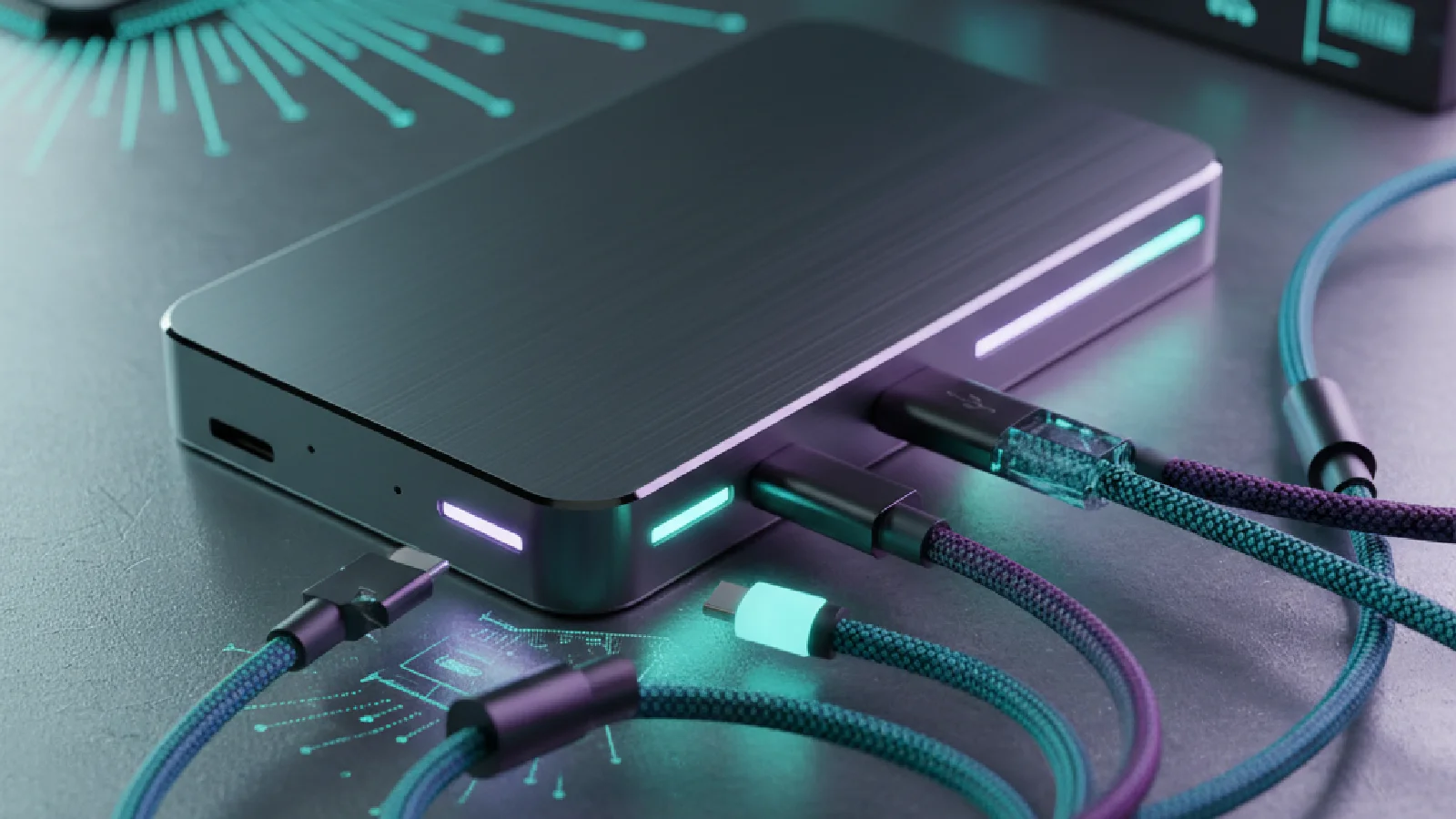
Content creators and audiovisual professionals know that slow file transfers can kill productivity. For years, USB 3.2 Gen 2x2 and its 20 Gbps represented the high-end of consumer external storage. But a new generation of technologies — USB4 v2 and Thunderbolt 5 — is radically changing the game with speeds reaching 80 Gbps, or even 120 Gbps in boost mode. External SSD enclosures are entering an era where bandwidth constraints are fading away.

The 20 Gbps Ceiling: A Limit Surpassed
USB 3.2 Gen 2x2 already represented a significant leap compared to previous generations. With a theoretical bandwidth of 20 Gbps — or about 2.5 GB/s in real-world conditions — this standard allowed for comfortable transfers for most daily uses. But it showed its limitations when it came to handling 4K or 8K video rushes, voluminous RAW libraries, or complex editing projects.
Modern internal NVMe SSDs, connected via PCIe 4.0 x4, offer sequential read speeds easily exceeding 7 GB/s. Plugging such an SSD into a USB 3.2 Gen 2x2 enclosure therefore meant throttling its actual performance. For professionals seeking maximum fluidity, this situation became frustrating.
The Emergence of USB4: A 40 Gbps Foundation
Introduced in 2019 and based on Thunderbolt 3 technology, USB4 initially offered a throughput of 40 Gbps. As Kingston Technology points out, this standard integrates PCIe tunneling, DisplayPort support, and universal compatibility with older USB and Thunderbolt devices. From its release, USB4 doubled the available bandwidth compared to USB 3.2 Gen 2x2.
However, the initial USB4 had variations: some basic implementations were limited to 20 Gbps, while others reached 40 Gbps depending on manufacturer choices. This fragmentation slowed down mass adoption among consumers.
Thunderbolt 5 and USB4 v2: 80 Gbps and 120 Gbps Boost Mode
The real breakthrough comes with Thunderbolt 5 and USB4 version 2.0. Both technologies promise a nominal bandwidth of 80 Gbps bi-directionally. Thunderbolt 5 goes even further by offering an asymmetric boost mode reaching 120 Gbps in one direction — ideal for massively sending data to an 8K display or remote storage.
Concretely, this means real transfer rates exceeding 6 GB/s, with potential peaks of 10 GB/s or even 15 GB/s in boost mode, depending on hardware configurations. The first compatible Thunderbolt 5 enclosures already show read/write speeds above 6 GB/s, as reported by EuroCAPA, allowing NVMe SSDs to be utilized almost at their full native PCIe capacity.
| Technology | Nominal Throughput (Gbps) | Real Throughput (GB/s) | Boost Mode (Gbps) |
|---|---|---|---|
| USB 3.2 Gen 2x2 | 20 | 2.5 | N/A |
| USB4 | 40 | 5 | N/A |
| Thunderbolt 5 / USB4 v2 | 80 | > 6 | 120 (asymmetric) |
“Thunderbolt 5 opens a new chapter for external storage: speeds are no longer dictated by the interface, but by the actual performance of the internal SSD.”
Enhanced Power Delivery
Beyond bandwidth, Thunderbolt 5 and USB4 v2 also bring a significant improvement in power delivery. While basic USB4 offers 7.5 W to accessories (compared to 15 W for Thunderbolt 4), new implementations can provide up to 240 W via Power Delivery 3.1.
This allows for:
- Directly powering very large capacity SSDs (8 TB and more) without external power
- Simultaneously charging a laptop while maintaining high-speed transfers
- Supporting multi-disk RAID configurations in an external enclosure
For professional workflows requiring multiple power-hungry peripherals, this capability significantly changes the user experience.

Concrete Performance: What Do These Speeds Change?
Let's take a concrete example: transferring a 500 GB 8K video editing project.
- USB 3.2 Gen 2x2 (20 Gbps): approximately 3 minutes 20 seconds (at 2.5 GB/s real)
- USB4 (40 Gbps): approximately 1 minute 40 seconds (at 5 GB/s real)
- Thunderbolt 5 (80 Gbps): less than 50 seconds (at 10 GB/s real)
Daily, this difference translates into total fluidity in the following operations:
- 8K video editing directly from an external SSD without slowdowns
- AI workflows requiring fast access to large datasets
- Near-instant incremental backup of voluminous RAW photo libraries
- Full system cloning in minutes
These gains transform the use of external drives, which are no longer perceived as slow backup solutions, but as true extensions of internal storage.
Compatibility and Backward Compatibility
One of the major assets of USB4 v2 and Thunderbolt 5 remains their backward compatibility. New cables and peripherals work with older USB-C ports, even if the speed is then limited by the oldest interface. As MacGeneration specifies, modern controllers now integrate full support for USB 3.2 Gen 2x2, ensuring a smooth transition.
This compatibility facilitates gradual adoption: there's no need to replace all your peripherals overnight. Users can invest in a high-end Thunderbolt 5 enclosure and continue to use it on older machines, even if it means benefiting from reduced speeds while waiting to upgrade.
The Impact for Professionals and Creators
For video editors, professional photographers, and data scientists, the arrival of these technologies constitutes a decisive advance. Native 8K editing from an external drive finally becomes fluid, without requiring proxies or preloading into RAM. Multi-terabyte libraries become instantly accessible, with no perceptible latency.
AI engineers and data scientists can now load voluminous datasets from external storage at speeds comparable to internal storage, facilitating rapid experimentation on different machines. This flexibility significantly improves iteration cycles.
As for production studios, the ability to manage multiple simultaneous 8K video streams from a single Thunderbolt 5 RAID enclosure simplifies hardware configurations, reduces costs, and improves reliability.
The Link with the Broader Technology Ecosystem
The increasing adoption of these very high-bandwidth interfaces is part of a global dynamic of data flow optimization. Just as Edge AI and PLCs transform industrial automation by processing critical information locally and quickly, Thunderbolt 5 and USB4 v2 allow data to be physically brought closer to its processing location without performance loss.
Similarly, in the context of the battle between ARM and Intel/AMD in data centers, the rapid evolution of connectivity standards illustrates a broader trend: every component in the IT chain must keep pace with innovation to avoid becoming a bottleneck.
Democratization and Price: When Will These Technologies Become Accessible?
Currently, Thunderbolt 5 SSD enclosures remain expensive, often selling for between 150 and 300 euros excluding the SSD. But like any innovation, prices should gradually decrease as production industrializes and competition intensifies.
According to market analyses, by 2026-2027, USB4 v2 and Thunderbolt 5 enclosures are expected to represent a growing share of sales, while USB 3.2 Gen 2x2 models will be relegated to the entry-level segment. Chipset manufacturers, notably Intel, Qualcomm, and MediaTek, are making numerous announcements of compatible controllers, which will accelerate adoption.
For general consumers, the transition will be gradual. Laptops and desktops equipped with Thunderbolt 5 or USB4 v2 ports are becoming widespread on high-end models in 2025-2026, and are expected to be present on mid-range models by 2027.
Towards a New Era of External Storage
USB4 v2 and Thunderbolt 5 mark a turning point in the history of external storage. 20 Gbps SSD enclosures, once considered high-performing, are quickly becoming insufficient for demanding professional uses. With real speeds exceeding 6 GB/s and prospects reaching 10 to 15 GB/s, these new standards erase the boundary between internal and external storage.
Content creators, engineers, and image professionals now have tools to process vast volumes of data without compromising on speed. This evolution promises to redefine workflows, accelerate production cycles, and open new creative possibilities. External storage finally enters the era of ultra-high performance.
FAQ (JSON format - translate question and answer fields only): [ { "answer": "Both offer 80 Gbps nominal bandwidth, but Thunderbolt 5 also provides an asymmetric boost mode reaching 120 Gbps in one direction. Thunderbolt 5, developed by Intel, also guarantees strict certifications in terms of DisplayPort, PCIe, and power compatibility, while USB4 v2 is an open standard managed by the USB-IF, potentially less expensive to implement.", "question": "What is the difference between USB4 v2 and Thunderbolt 5?" }, { "answer": "Older USB-C cables will physically work, but will not deliver the maximum speeds of Thunderbolt 5. To fully benefit from 80 Gbps, it is necessary to use certified Thunderbolt 5 or USB4 v2 cables, designed to support these high frequencies and limit signal loss.", "question": "Will my old USB-C cables work with Thunderbolt 5?" }, { "answer": "No, they remain relevant for classic consumer uses (document backup, photos, HD videos). However, for heavy professional workflows (8K editing, AI datasets, massive RAW libraries), they now represent a bottleneck that Thunderbolt 5 and USB4 v2 eliminate.", "question": "Are USB 3.2 Gen 2x2 enclosures becoming useless?" }, { "answer": "Opt for PCIe 4.0 x4 (or even PCIe 5.0) NVMe SSDs offering sequential read/write speeds above 7 GB/s. Models like the Samsung 990 Pro, WD Black SN850X, or Crucial T700 are particularly suitable for taking advantage of Thunderbolt 5 bandwidth.", "question": "Which internal SSDs should I choose to maximize the performance of a Thunderbolt 5 enclosure?" }, { "answer": "The first laptops and desktops equipped with Thunderbolt 5 and USB4 v2 will arrive in 2025-2026 in the high-end segments. Widespread availability in mid-range models is expected by 2027-2028, with a gradual decrease in prices for external enclosures and certified cables by then.", "question": "When will these technologies become truly widespread?" } ]