Room-Temperature Superconductors: The LK-99 Dream
In July 2023, an announcement from South Korea sent ripples through the global scientific community: researchers claimed to have created LK-99, a material capable of conducting electricity without resistance at ambient temperature and pressure. A feat that, if confirmed, would revolutionize our relationship with energy and pave the way for groundbreaking technologies.
The crystalline compound based on copper, lead, phosphorus, and oxygen promised to achieve the Holy Grail of modern physics. Yet, several months after this sensational announcement, the room-temperature superconductor remains more than ever a scientific mirage.

The Promise of a Technological Revolution
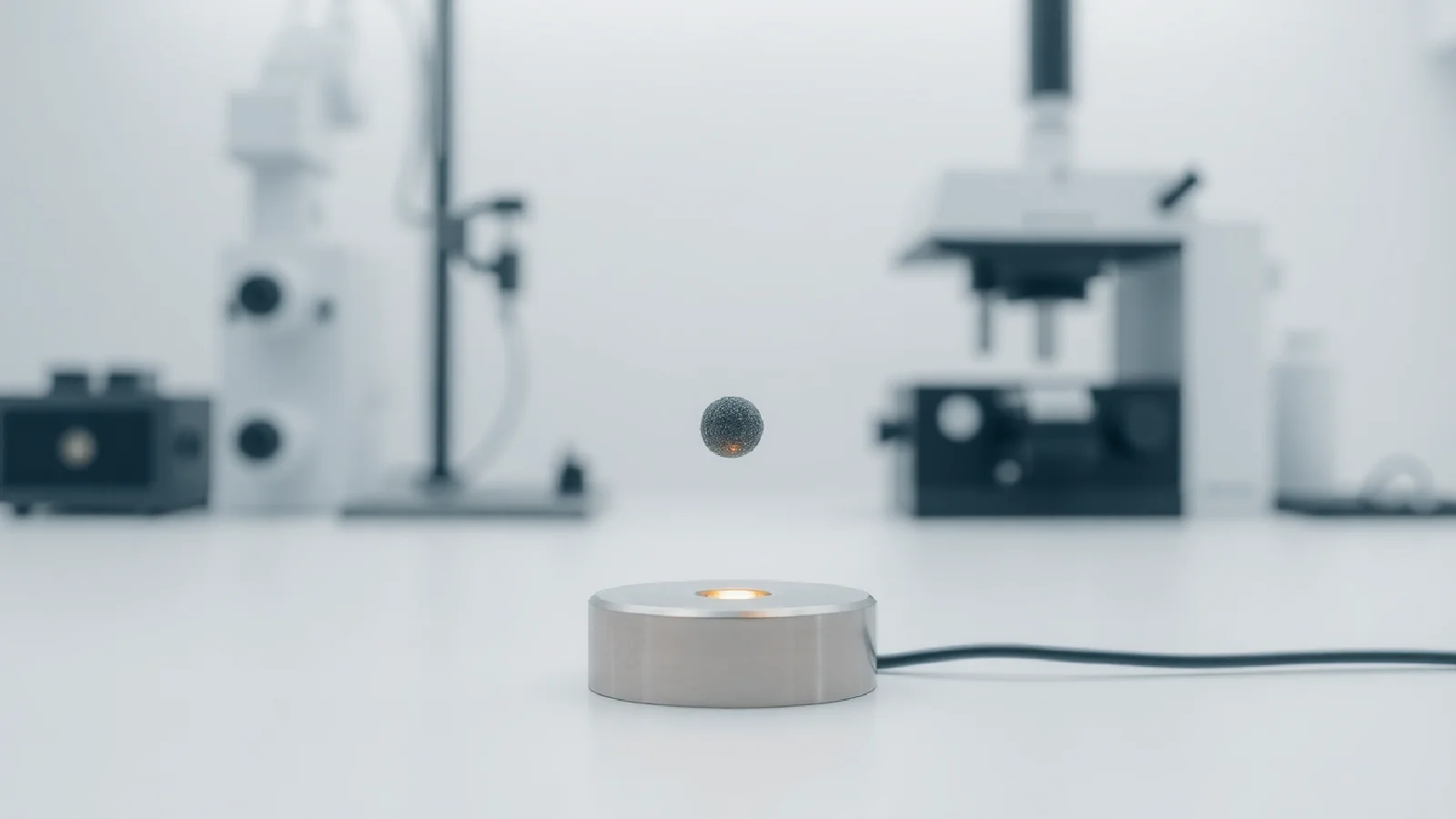
Superconductors possess a fascinating property: they can conduct an electric current without any resistance, unlike traditional conductive materials where electrons lose energy as they pass through. This exceptional characteristic is accompanied by another spectacular phenomenon: the Meissner effect, which allows the material to repel magnetic fields and create magnetic levitation effects.
Historically discovered in 1911 by Dutch physicist Heike Kamerlingh Onnes, superconductors only operate under extreme conditions: very low temperatures (often below -200°C) or enormous pressures. These constraints drastically limit their practical applications, reserving them for specialized fields such as MRI medical imaging or quantum physics research.
_The stakes of a room-temperature superconductor extend far beyond academia._ According to researchers, such a discovery would revolutionize:
- Electricity transmission without energy loss over long distances
- Energy storage with superconducting batteries
- Transportation through magnetic levitation
- Quantum computing with ultra-high-performance processors
- Portable and accessible medical imaging
LK-99: An Apparently Simple Synthesis
What particularly struck people about the LK-99 announcement was the apparent simplicity of its manufacturing. The authors described a process comparable to preparing a homogeneous paste followed by baking in an oven at around 127°C. This technical accessibility contrasted sharply with the usual complexity of superconductor research.
The material itself seemed to meet the much-sought-after criteria: superconductivity at both ambient temperature and pressure after a simple heat treatment. Images accompanying the publications showed samples seemingly levitating above magnets, fueling general enthusiasm.
This "democratized" approach to superconductivity naturally attracted the interest of many laboratories worldwide, all eager to reproduce and confirm these promising results.
| Characteristic | Traditional Materials | Superconductors (theoretical) | LK-99 (claim) |
|---|---|---|---|
| Electrical Resistance | High | Zero | Zero |
| Operating Temperature | Ambient | Very low (< -200°C) | Ambient |
| Operating Pressure | Ambient | Enormous (metallic hydrides) | Ambient |
The Test of Scientific Reproduction
However, science relies on a fundamental principle: the reproducibility of results. And it is precisely on this point that LK-99 began to reveal its weaknesses. Multiple reproduction attempts conducted in university and private laboratories have not confirmed the extraordinary properties announced.
Research teams noted several concerning anomalies:
- The absence of complete disappearance of electrical resistance
- Critical field measurements a thousand times lower than expected values
- Inconsistencies in the initial published data
- The impossibility of faithfully reproducing the described synthesis
As experts from Radio-Canada explain, nearly a month after the announcement, this breakthrough had still not been the subject of an article published in a recognized scientific journal, fueling the doubts of the scientific community.
The Skepticism of the Scientific Community
The caution of physicists regarding LK-99 is explained by the history of false promises in this field. Over the decades, numerous announcements of room-temperature superconductors have been disproven by more thorough analyses. This legitimate distrust quickly turned into assumed skepticism in the face of accumulating troubling evidence.
"If you made a room-temperature superconductor tomorrow... you'd be famous, you'd win the Nobel Prize," recalls Damian Pope of the Perimeter Institute for Theoretical Physics.
Accusations of scientific fraud quickly emerged, with some experts pointing to the measurement methods used and the quality of the evidence provided. The photo of the levitating material, which had so impressed the general public, does not constitute, according to specialists, sufficient "guarantee of superconductivity."
This controversy perfectly illustrates the difference between media enthusiasm and scientific rigor. Where social networks ignite over a potentially revolutionary discovery, science imposes its own rhythms and validation requirements.
Real Advances in Superconductivity
While LK-99 captivated media attention, fundamental research on high-temperature superconductors methodically continued its advances. Metallic hydrides currently represent one of the most promising avenues, even if they still require extreme conditions.
These materials show superconductivity close to ambient temperature, but only under pressures of the order of 10,000 bars. While this constraint still limits their practical applications, it nevertheless constitutes significant progress compared to conventional superconductors.
Current research also explores other avenues, particularly two-dimensional materials similar to graphene that some researchers are trying to manufacture under more accessible conditions. These approaches, although less spectacular than the promises of LK-99, offer more solid and verifiable prospects.
The Future of Superconductivity
The LK-99 episode reminds us that authentic science progresses through methodical steps rather than spectacular revolutions. The Holy Grail of room-temperature superconductivity remains today a major experimental challenge rather than the product of a confirmed discovery.
This quest nevertheless continues to mobilize research teams worldwide. Every advance, however modest, contributes to our understanding of the fundamental mechanisms governing superconductivity. This knowledge is essential for developing new materials with increasingly remarkable properties.
History teaches us that true scientific breakthroughs often emerge from patient and rigorous research rather than sensational announcements. In this field as in others, time plays a crucial role in the maturation of discoveries.
Room-temperature superconductivity remains a legitimate and exciting goal. But its realization will likely still require many years of in-depth research, far from media spotlights and hasty promises. In the meantime, current applications of superconductors continue to evolve and improve, paving the way for future innovations.