Starship: 'Rapid Unscheduled Disassemblies' Accelerate the Journey to Mars
On January 16, 2025, at 5:30 PM local time, SpaceX's Starship S33 launched from Starbase, Texas, for its seventh integrated test flight. Seven minutes later, the most powerful spacecraft ever built experienced what SpaceX euphemistically calls a "rapid unscheduled disassembly" (RUD). This terminology, despite its apparent humor, conceals a revolutionary philosophy of aerospace engineering.
At an altitude of 146 kilometers, after the successful separation of the Super Heavy booster, the cascading failure of five out of six Raptor engines transformed what was meant to be a demonstration flight into a valuable technical lesson. Far from being a mere failure, this event perfectly illustrates SpaceX's iterative and accelerated strategy to revolutionize access to space and prepare for Martian missions.
The Chronology of a Technical "Disassembly"
The S33 flight began nominally. The Super Heavy booster, equipped with 33 Raptor engines, performed perfectly during the initial ascent phase. Hot staging occurred as planned, allowing Starship to continue its ascent with its six vacuum-optimized Raptor engines.
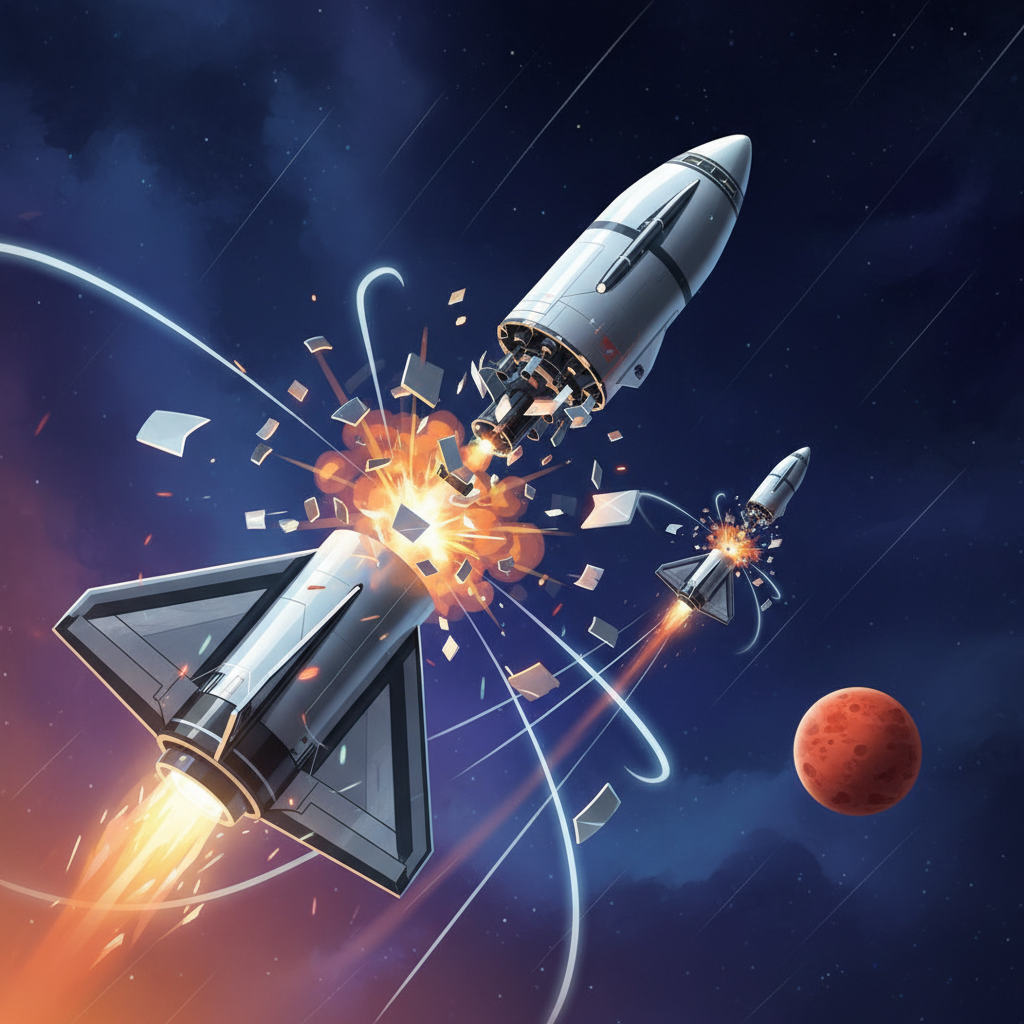
It was at the seventh minute of flight that the situation deteriorated. SpaceX's internal investigations identified the root cause: a fuel injection system failure, likely due to a blockage or leak in one of the Raptor engine's turbopumps. This initial failure triggered a domino effect particularly revealing of Starship's technical challenges.
"Every failure brings us closer to success. We learn more in an hour of failure than in months of perfect simulations." - SpaceX guiding principle according to their 2025 technical reports
The software control system failed to isolate the malfunctioning engine quickly enough. Four other engines shut down in sequence, creating a thrust loss exceeding the vehicle's stability margin. This cascade of failures, documented by real-time telemetry, offers valuable lessons for future flights.
Anatomy of a Failure: Technical Lessons Learned
Post-flight analysis reveals several critical points that transform this failure into an accelerator of development. The fuel injection system failure highlights the crucial importance of turbopumps in the Raptor engine architecture. These components, subjected to extreme pressures and temperatures exceeding 3000°C, represent one of the major challenges of modern space propulsion.
The anomalies in the software control logic constitute the second major lesson. The system did not detect the degradation of the malfunctioning engine's parameters quickly enough to isolate it before the failure propagated. This sequence, now perfectly documented, allows SpaceX engineers to completely rethink the algorithms for fault detection and isolation.
| Key Component | Observed Failure | Lesson for SpaceX |
|---|---|---|
| Fuel injection system | Turbopump blockage/leak | Requires increased robustness of turbopumps under extreme conditions |
| Software control logic | Rapid malfunctioning engine isolation | Improvement of fault detection and isolation algorithms |
| Raptor engines | Cascading shutdown | Address propulsion challenges under high stress conditions |
Unlike traditional approaches in the space industry, SpaceX does not consider these failures as failures but as "high-value flight data." This philosophy, inherited from the digital technology sector, transforms each test flight into a controlled scientific experiment where failure is an integral part of the learning process.
Immediate Improvements: SpaceX's Responsiveness
In response to these "rapid unscheduled disassemblies," SpaceX implemented a series of technical improvements with remarkable speed. The real-time monitoring system for Raptor engines has been reinforced with new pressure and temperature sensors, allowing for earlier detection of anomalies.
Automatic shutdown thresholds have been made more conservative, prioritizing the preservation of the overall mission rather than the maximum performance of an individual engine. This approach, inspired by commercial aviation safety systems, represents a major evolution in the design of reusable spacecraft.
The redesign of the feed valves is the most significant improvement. The new valves incorporate redundant isolation systems preventing the propagation of failures from one engine to another. This seemingly minor modification could revolutionize the reliability of future flights.
The ascent abort algorithm has also been redesigned for increased responsiveness. In the event of a major failure, the system can now decide on the optimal recovery mode in less than 100 milliseconds, whether it's an emergency landing or an alternative rescue trajectory.
The Super Heavy Booster: Success in Failure
Paradoxically, the Starship S33 failure perfectly validated the Super Heavy booster recovery process. The launch tower, nicknamed "Mechazilla," demonstrated its ability to capture and secure the booster with remarkable precision.
This successful recovery illustrates SpaceX's modular approach: each component of the Starship system can evolve independently. While the upper stage experiences technical difficulties, the booster accumulates operational successes, reducing overall development costs.
The booster's "rapid disassembly" after recovery has also been optimized. Technical teams can now inspect and return the 33 Raptor engines to service in less than two weeks, compared to several months for traditional space systems.
Direct Implications for Martian Missions
These technical lessons directly impact the Mars-Ready version of Starship. Fuel margins are recalculated to account for a more demanding trans-Mars trajectory, where no terrestrial assistance is possible in case of failure.
Thermal coatings benefit from the experience gained from each flight. Prolonged exposure to interplanetary vacuum, during the six to nine months of travel to Mars, requires materials capable of resisting cosmic radiation and extreme thermal variations.
The flight software now incorporates autonomous diagnostic capabilities inspired by previous failures. The system can identify, isolate, and compensate for an engine failure without compromising the Martian mission. This autonomy is crucial for missions where communication with Earth can take up to 24 minutes.
The redundancy architecture has been redesigned according to the principles of modern space conquest. Each critical system has multiple backups, inspired by lessons learned during "rapid unscheduled disassemblies."
Accelerating Development: A Race Against Time
This iterative approach allows SpaceX to significantly accelerate its development pace. While traditional space programs space out their test flights by several years, SpaceX aims for a monthly flight rate by 2025.
Each "rapid unscheduled disassembly" reduces the time needed to identify and correct design flaws. This method, inspired by agile software development, revolutionizes the engineering of complex systems in aerospace.
Data collected during each flight, successful or not, feeds increasingly accurate simulation models. These simulations allow for virtual testing of thousands of failure scenarios, accelerating the identification of potential failure points.
Integrating cutting-edge technologies developed by NASA into the SpaceX ecosystem creates a unique synergy. Starship failures indirectly benefit from decades of institutional space research, while bringing the agility of the private sector.
Philosophy of Risk: Cultural Revolution
Beyond technical aspects, "rapid unscheduled disassemblies" reveal a cultural revolution in the approach to space risk. SpaceX consciously accepts a high failure rate during the development phase to maximize learning and accelerate innovation.
This philosophy contrasts sharply with the traditional approach of the space industry, where each flight represents an investment of several hundred million euros. By drastically reducing production and launch costs, SpaceX can afford to fail fast and often.
Transparent communication around these failures also transforms public perception of space challenges. "Rapid unscheduled disassemblies" become educational moments, raising public awareness of the complexities of space engineering.
Horizon 2025-2030: Towards Mars and Beyond
The lessons learned from each failure bring SpaceX closer to its ultimate goal: establishing an autonomous human colony on Mars. Automated cargo missions could begin as early as 2026, followed by the first crewed flights to the Red Planet in the following decade.
The Starship architecture, perfected by these "rapid unscheduled disassemblies," promises to revolutionize access to space. With a potential launch cost of less than $10 per kilogram to orbit, the system could democratize space as the internet democratized information.
The applications extend far beyond Mars:- Regular lunar missions
- Construction of massive space stations
- Exploration of Jupiter and Saturn's moons
Every failure today builds the successes of tomorrow.
Conclusion
Starship's "rapid unscheduled disassemblies" perfectly embody the ongoing revolution in the space industry. Far from being mere failures, these events represent innovation accelerators that bring humanity closer to its multi-planetary destiny.
SpaceX's approach, combining risk acceptance and rapid learning, transforms each test flight into a cornerstone of space development. This method, inspired by the most innovative technology sectors, promises to reduce by decades the time needed to establish a permanent human presence on Mars.
While the S33 flight failure continues to fuel technical analyses, the Starbase teams are already preparing for the next flight. Because in SpaceX's philosophy, the best way to overcome a "rapid unscheduled disassembly" is still to... fly again.