Starlink: Orbital Surveillance and Anomalies Under the Microscope
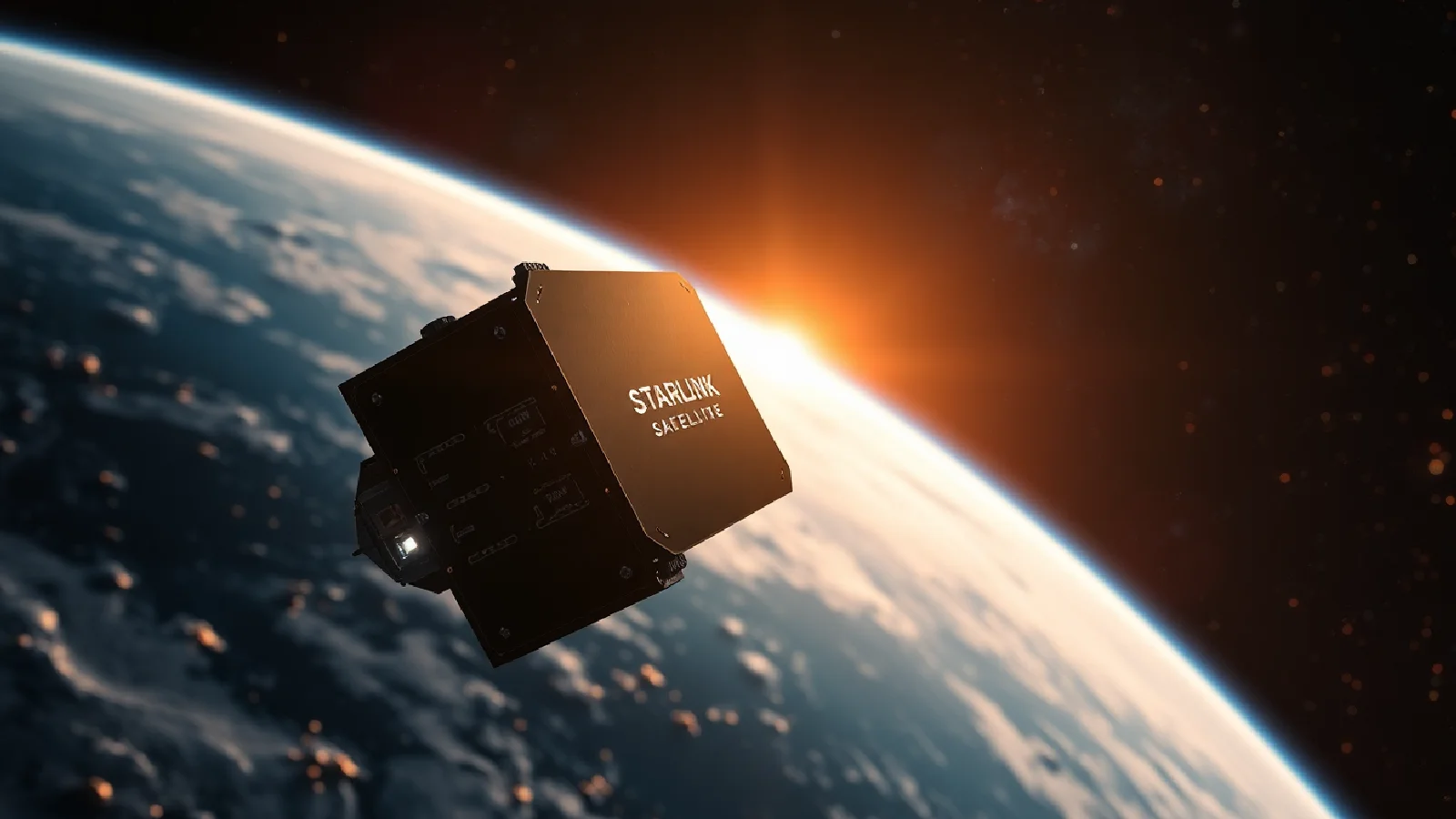
The Starlink constellation by SpaceX is now crossing a critical threshold with over 9,000 active satellites orbiting in low Earth orbit. This unprecedented density fundamentally transforms the challenges of space surveillance and reveals new technical difficulties related to orbital anomalies. The recent explosion of a Starlink satellite on December 17 perfectly illustrates the growing complexity of this new space paradigm.
This major development raises crucial questions: how can thousands of spacecraft operating simultaneously be effectively monitored? What are the protocols for managing orbital anomalies? And most importantly, how can collision risks be anticipated and prevented in an increasingly congested space environment?
Starlink Constellation Surveillance Architecture
The surveillance of the Starlink constellation relies on a complex technological ecosystem combining onboard systems and external surveillance networks. Each satellite integrates navigation sensors of the star-tracker type, allowing precise real-time localization, and sophisticated autonomous avoidance algorithms.

Onboard Detection Systems
Starlink satellites possess remarkable self-monitoring capabilities. These onboard systems continuously analyze the health of each component and automatically detect internal anomalies. Star-trackers, combined with inertial measurement units (IMUs), enable precise navigation and real-time avoidance maneuvers.
Telemetry provided by SpaceX to its institutional partners significantly enriches the space surveillance catalog. This data includes the position, velocity, attitude, and operational status of each satellite, creating a dynamic map of the constellation.
External Surveillance Networks
Global tracking relies on a network of terrestrial and space-based sensors:
- High-frequency radars for real-time trajectory tracking
- Optical telescopes for nocturnal observation and object characterization
- Laser stations for ultra-precise distance measurements
- Commercial partnerships with entities like LeoLabs for orbital surveillance
This hybrid infrastructure allows for continuous surveillance of the 9,000+ active satellites, a considerable logistical and technical challenge.
| Surveillance Type | Sensors/Methods | Primary Objective |
|---|---|---|
| Onboard | Star-trackers, IMU | Precise localization, autonomous avoidance, telemetry |
| External (Terrestrial) | Radars, Telescopes, Lasers | Trajectory tracking, object characterization, distance measurements |
| External (Partnerships) | Commercial data | Complementary orbital surveillance |
Recent Anomalies: Technical Analysis of Incidents
The December 17 incident involving Starlink satellite 35956 offers a revealing case study of current technical challenges. Operating at an altitude of 418 kilometers, this satellite experienced an internal deflagration caused by an "energy source", ruling out the hypothesis of an external collision.
Anomaly Mechanism
Technical analysis reveals that the explosion caused the rupture of the propulsion tank, leading to a rapid orbital decay of approximately four kilometers in the semi-major axis. This anomaly illustrates the inherent risks associated with the miniaturized propulsion systems of modern satellites.
The phenomenon was accompanied by the ejection of a limited number of detectable fragments, moving at low relative velocities. This characteristic distinguishes this anomaly from a catastrophic collision, which would generate more high-velocity debris.
"The satellite remains largely intact, in a disordered rotation, and will perform its atmospheric re-entry with complete destruction within a few weeks" - SpaceX Statement
Emergency Response Protocols
Following this anomaly, SpaceX immediately activated its enhanced surveillance protocols in collaboration with NASA and the US Space Force. This institutional cooperation demonstrates the importance of international coordination for managing space incidents.
Surveillance teams launched an intensive tracking campaign to catalog and monitor the trajectory of each fragment. This effort aims to anticipate collision risks with other satellites and accurately predict the atmospheric re-entry of debris.
Technical Challenges of Increasing Orbital Density
The proliferation of Starlink satellites generates unprecedented technical challenges that redefine space surveillance standards. The current density necessitates a complete revision of traditional orbital tracking methods.
Detection of Small Objects
Monitoring thousands of satellites simultaneously requires detecting and cataloging small-sized objects. Starlink satellites, with their mass of approximately 260 kg, represent an intermediate challenge between large traditional satellites and microscopic space debris.
Surveillance systems must now process exponential volumes of data to maintain an accurate and real-time orbital catalog. This evolution requires increasingly sophisticated processing algorithms.
Complex Operational Coordination
The 2019 incident involving a critical close approach between the ESA Aeolus satellite and a Starlink satellite revealed coordination gaps between space operators. This event catalyzed the development of new inter-operator communication protocols.
Managing avoidance maneuvers becomes particularly complex when each satellite performs frequent trajectory adjustments. This permanent orbital dynamic significantly complicates collision prediction calculations.
Autonomous Avoidance Algorithms
Starlink satellites integrate automated avoidance systems capable of reacting in real-time to collision threats. These algorithms continuously analyze trajectory data and automatically trigger corrective maneuvers if necessary.
However, this automation raises questions about coordination with other operators who may not have such reactive systems. Harmonizing avoidance protocols becomes crucial to prevent maneuver conflicts.
Impact on the Space Ecosystem and Astronomy
The proliferation of the Starlink constellation profoundly transforms the orbital environment and generates significant impacts on observational astronomy. These effects require major technical and regulatory adaptations.
Electromagnetic Disturbances
Recent research by the Academy of Sciences reveals that large constellations generate unintentional electromagnetic radiation that disrupts radio astronomical observations. These interferences complicate the detection of faint astronomical signals.
The study published in Astronomy & Astrophysics demonstrates that unintentional emissions from Starlink satellites can mask cosmic signals of major scientific interest. This issue requires innovative technical solutions.
Orbital Light Pollution
The light trails generated by Starlink satellites passing through the field of telescopes pose increasing challenges for optical astronomy. Observatories are developing de-noising algorithms to eliminate these artifacts from scientific images.
The impact is particularly significant for large automated astronomical surveys that require very high-quality data. Astronomers are working on software and hardware solutions to mitigate these disturbances.
Regulatory Challenges and Future Developments
Managing large constellations raises complex regulatory questions that extend beyond the technical framework. International organizations are developing new standards to govern this space evolution.
Deorbiting Regulations
Current requirements mandate deorbiting within 25 years to limit long-term debris accumulation. This time constraint necessitates reliable propulsion systems and rigorous end-of-life protocols.
SpaceX employs a proactive approach with orbital altitudes allowing for natural atmospheric re-entry in case of control system failure. This strategy reduces the risks of uncontrolled debris accumulation.
Enhanced International Coordination
The evolution towards thousands of active satellites simultaneously requires enhanced international coordination. Space agencies are developing real-time information-sharing platforms to improve orbital safety.
Developing common standards for avoidance protocols and inter-operator communication becomes an absolute priority to maintain the safety of the space environment.
Emerging Surveillance Technologies
The space industry is developing next-generation technologies to meet the surveillance challenges of large constellations. These innovations transform orbital detection and tracking capabilities.
Space-based space surveillance systems are emerging as a complementary solution to terrestrial networks. These dedicated satellites offer continuous coverage and improved precision for orbital tracking.
Artificial intelligence is revolutionizing surveillance data processing. Machine learning algorithms enable the analysis of massive volumes of telemetry and the automatic detection of behavioral anomalies.
As discussed in our analysis of NASA's cutting-edge technologies, these technical advancements open new perspectives for space surveillance and collision prevention.
Conclusion
The Starlink constellation perfectly illustrates the challenges of modern space: how to effectively manage thousands of objects simultaneously evolving in low Earth orbit? Recent incidents demonstrate that space surveillance must evolve towards more sophisticated systems, combining autonomous onboard detection and global surveillance networks.
The explosion of satellite 35956 reveals the crucial importance of anomaly management protocols and international coordination. These events, though rare, highlight the need to anticipate and prepare adapted responses to space incidents.
The future of space surveillance relies on the integration of emerging technologies: artificial intelligence, space-based surveillance, and automated coordination between operators. These developments will determine our ability to maintain a safe and sustainable space environment in the face of the proliferation of satellite constellations.
The success of this technological transition conditions not only the economic viability of large constellations but also the preservation of access to space for future generations. A challenge that extends far beyond the technical framework to touch upon issues of space sovereignty and sustainable development of Earth's orbit.